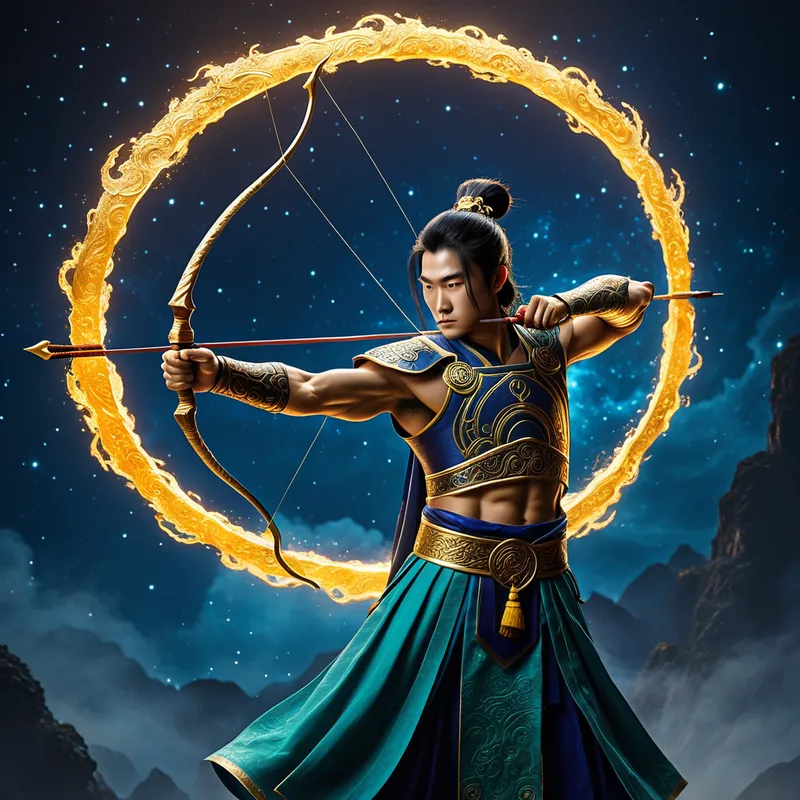
Hou Yi the Divine Archer Myth Meaning & Symbolism
A myth of divine skill and tragic humanity, where a hero's greatest victory sows the seeds of his ultimate, lonely fall from grace.
The Tale of Hou Yi the Divine Archer
In the time before time was measured, when the Jade Emperor ruled the heavens, a calamity was born from celestial indulgence. Ten suns, children of the sun god Dijun, grew weary of their orderly procession across the sky. In a fit of youthful rebellion, they decided to rise together. The world below, which knew the gentle caress of one sun, was now seared by ten.
The rivers boiled into steam. The great forests became fields of ash. The very earth cracked open, its lips parched and bleeding. Humanity and beast alike cowered in whatever shadow they could find, their cries a silent prayer against the blinding, scorching light. The Jade Emperor, seeing the fabric of creation unravel, knew a hero was needed—not a god, for the gods had caused this, but a being of both heaven and earth.
Thus, he summoned Hou Yi. He was not a god of council, but a god of the bow, a master of the vermilion bow and white-feathered arrows that could pierce the fabric of the sky itself. His presence was like a cool mountain wind, his eyes sharp as a hawk’s. The Emperor’s command was dire: restore order. Save the world.
Hou Yi descended to the scorched earth. He climbed the highest peak, the stone hot enough to blister divine skin. He faced the ten blazing orbs, their heat a physical wall, their light a pain that sought to blind even him. He did not plead. He did not command. He nocked an arrow, the white feathers trembling not with fear, but with focused intent. He drew the vermilion bow, a crescent of potential against the chaos.
Thrum. The first arrow sang through the superheated air. A sun exploded in a shower of golden sparks that fell to earth as molten stone. A collective gasp, a release of pressure, echoed across the land. Thrum. Thrum. Thrum. One by one, the rebellious suns were struck from the sky. With each shot, the world cooled a degree. With each fallen star, shadows grew longer and deeper, a blessing of shade. He shot nine times, until only one sun remained, hanging obedient and alone in a sky now tinged with merciful blue.
For this, he was hailed as the savior of all. But a hero’s work is never done. In the wake of the suns came monsters born of the imbalance: the gargantuan Zhayu that devoured villages, the nine-headed hydra that poisoned lakes, the colossal bird that blotted out what little sun remained. Hou Yi hunted them all, his arrows finding their mark with unerring justice, cleansing the earth.
As his ultimate reward, the Queen Mother of the West gifted him the Pill of Immortality. A single dose would grant eternal life to a god; a full pill would ascend a mortal to heaven. He took it home to his beloved wife, the beautiful Chang'e, for safekeeping, dreaming of a shared eternity.
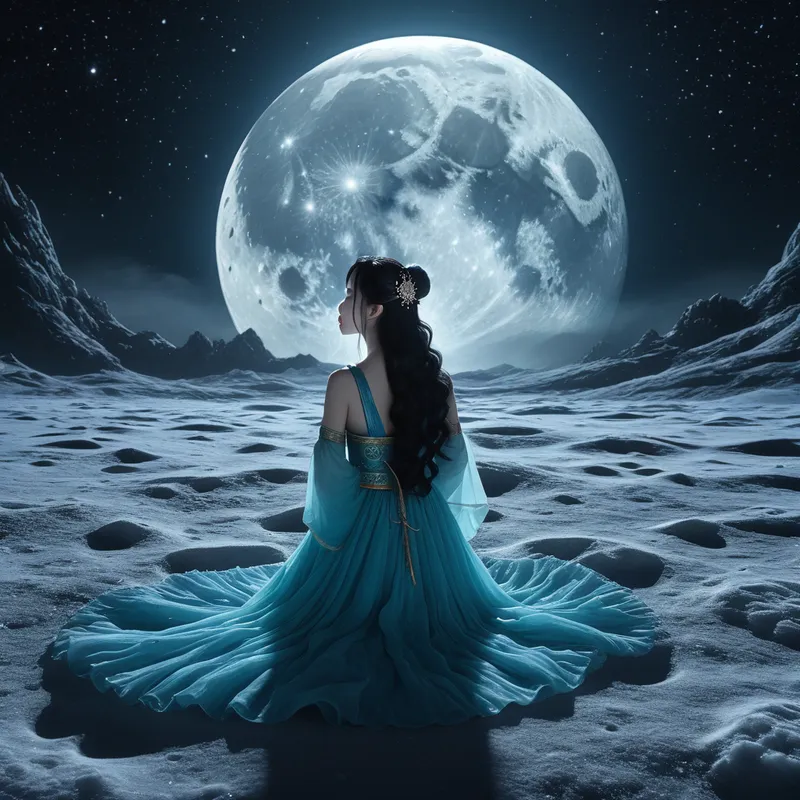
But fate is a trickster. While Hou Yi was away, a thief came for the pill. To protect it, Chang'e made a desperate choice: she swallowed it herself. Immediately, her body grew light as gossamer. She floated upwards, through the roof, into the night sky, pulled inexorably not to the glorious heavens, but to the cold, silent, and lonely Moon Palace. There she remained, an eternal prisoner of her sacrifice.
Hou Yi returned to an empty home and a sky that now held his love as a distant, pale specter. The great archer, who could shoot the sun from the sky, could not bring down the moon. His divine power was useless. He built a garden of her favorite foods and fruits, offering them to her pale light, a ritual of longing under the silent stars. The savior of the world was left a lonely man on earth, separated from his love by the very cosmos he had helped to order, his victory complete, his heart forever pierced by an arrow of his own making.
Cultural Origins & Context
The myth of Hou Yi is a foundational narrative woven from threads of ancient Chinese astronomy, shamanistic practice, and early Taoist philosophy. It predates organized Taoism but was seamlessly absorbed into its cosmological framework, appearing in texts like the Shan Hai Jing and later elaborated in poetry and folklore. It was not a tale confined to temples; it was a story told by firesides, explaining the nature of the sun and moon, the reason for droughts, and the bittersweet price of extraordinary power.
Societally, it functioned as a parable of natural order (Dao) and the consequences of disrupting it. The ten suns represent a catastrophic excess of Yang energy, which Hou Yi, through disciplined skill (a form of cultivated Yin action), must rebalance. His subsequent monster-slaying reinforces the hero’s role in maintaining the boundary between the civilized human world and the chaotic forces of nature. The story was told not just to inspire awe, but to teach that even necessary, world-saving actions carry profound and personal karmic weight, a core Taoist insight.
Symbolic Architecture
At its heart, the myth is a profound study in paradox. Hou Yi embodies the archetypal Hero, but his journey subverts the simple triumph. His arrows symbolize focused intention, the ability to discriminate and eliminate excess. He is the principle of Wei Wu Wei—action through non-action—applied with devastating precision. He does not fight the suns with fire, but with a single, perfect point of counter-force.
The archer’s target is always the self; the external chaos is but a reflection of internal discord.
The Elixir of Immortality is the ultimate symbol of Taoist alchemy, representing the perfected self, the fusion of Yin and Yang into a transcendent whole. Yet, in the myth, it becomes an agent of separation. Chang'e’s consumption and ascension to the moon transforms her into the ultimate Yin symbol—cold, distant, reflective. Hou Yi, the solar Yang hero, is forever grounded on earthy, mortal Yin. Their separation is the cosmos itself, a divine marriage sundered, illustrating that the pursuit of absolute perfection (immortality) can rupture the very wholeness it seeks.
The Dreamer's Resonance
When this myth stirs in the modern dreamtime, it often signals a profound somatic and psychological reckoning with one’s own “sun-shot” power. To dream of being an archer aiming at a blazing target may reflect the dreamer’s need to confront an overwhelming, “scorching” situation in their life—a career burning them out, a relationship of intense heat, or an inflated sense of self (pride). The body may feel the heat, the tension in the bow arm, the dryness in the throat.
Conversely, dreaming of the lonely moon or a lost elixir speaks to the consequence of such heroic action. It is the somatic feeling of cold isolation after a great victory, the “what now?” emptiness. The dreamer may be processing a grief born of success, a sacrifice of personal connection made for a grand achievement. The myth manifests not as a call to adventure, but as a deep processing of its aftermath—the integration of the shadow side of the hero’s journey, where the cost of saving one’s world is counted in the currency of the heart.
Alchemical Translation
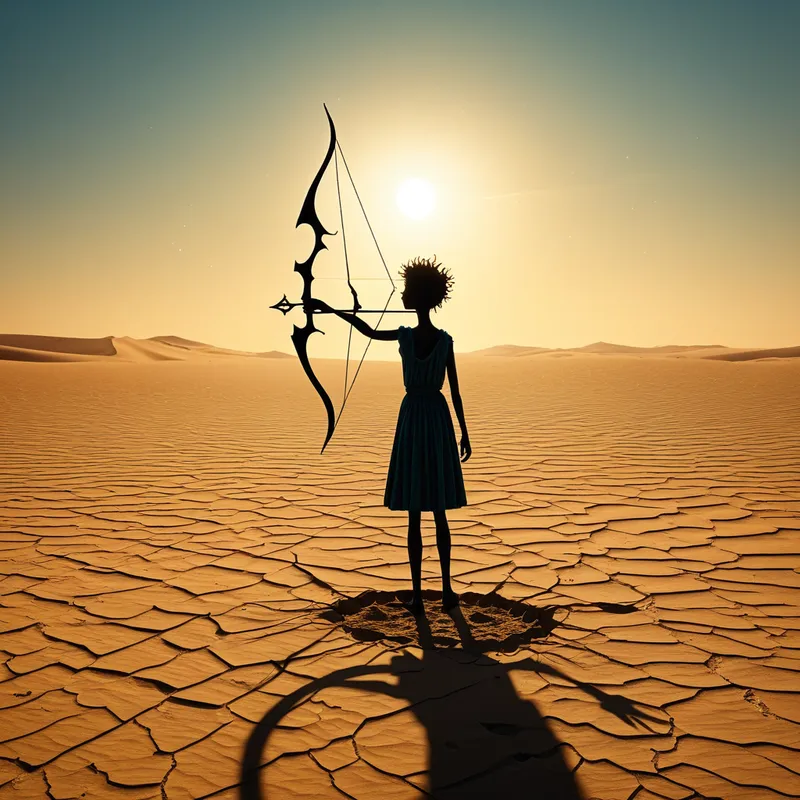
For the modern individual, Hou Yi’s saga is a masterclass in the alchemy of individuation. The first stage is Nigredo—the blackening, the scorched earth under ten suns. This is the psychic state of being overwhelmed by a dominant, unconscious complex (e.g., ambition, rage, a brilliant but destructive talent) that threatens to consume all other aspects of the self.
Hou Yi’s shooting is the Albedo—the whitening. It is the conscious, disciplined application of the ego (the archer) to differentiate and “shoot down” these inflamed contents. It requires supreme focus (the bow) and truthful discrimination (the arrow). This is the heroic labor of setting boundaries, saying “no” to what is excessive, and establishing inner order.
The final and most difficult alchemy is not in obtaining the gold of immortality, but in digesting the leaden weight of the consequences.
The gift of the elixir represents the Citrinitas—the yellowing, the dawn of a higher synthesis. But here lies the critical turn. In the psychic process, the “elixir” (the insight, the wholeness) is often initially projected onto an other (Chang'e, the beloved, the anima). Its “loss” to the moon is the painful withdrawal of that projection. The dream of shared immortality is shattered, forcing the hero to realize the elixir was never for external union alone.
The eternal separation—Hou Yi on earth, Chang'e on the moon—signifies the Rubedo, the reddening, not as a blissful union, but as the achieved state of conscious tension. The individual must learn to hold the solar, active principle (the heroic ego) and the lunar, receptive principle (the soul, the unconscious) in a state of respectful, eternal dialogue across the inner cosmos. The ultimate triumph is not in avoiding the fall, but in building the ritual garden of offering—the conscious, enduring relationship with all that was gained and all that was, necessarily, lost.
Associated Symbols
Explore related symbols from the CaleaDream lexicon:
- Sun — The central target of Hou Yi's might, representing overwhelming Yang energy, divine authority, and the inflated ego or passion that must be disciplined and reduced to a sustainable singularity.
- Moon — The destination of Chang'e and the symbol of separated Yin, representing the soul, reflection, cold beauty, and the eternal, longing counterpart to the solar hero's grounded existence.
- Archery Bow — The instrument of focused will and discrimination, embodying the tension between power and control, the arc of intention that translates inner resolve into world-altering action.
- Sacrifice — The core currency of the myth; Hou Yi sacrifices his divine standing for mortal love, Chang'e sacrifices her earthly life for duty, and both pay the price of eternal separation for their choices.
- Hero — Hou Yi epitomizes this archetype, not in an untarnished way, but in its full tragic dimension—the one who acts for the whole and bears the personal cost of that action in solitude.
- Elixir of Immortality — The ultimate Taoist alchemical goal, which in the myth becomes a paradoxical agent of division, symbolizing the peril of seeking perfect transcendence at the expense of earthly connection.
- Order — The divine mandate Hou Yi fulfills; his arrows impose cosmic and natural balance, representing the necessary, often violent, re-establishment of harmony after a period of chaotic excess.
- Grief — The permanent emotional landscape of Hou Yi after his victory; the deep, enduring sorrow that accompanies great achievement and irreparable loss, the shadow of the hero's glory.
- Light — Manifest as both the scorching, destructive light of the ten suns and the soft, elusive light of the moon, representing the dual nature of illumination as both clarifier and isolator.
- Divine — The ambiguous state of Hou Yi, who possesses god-like power but is subject to profoundly human tragedy, illustrating the intersection and tension between celestial duty and mortal heart.