
Hotaru Myth Meaning & Symbolism
A tale of a celestial maiden whose light is scattered across the mortal world, becoming the fireflies that illuminate the summer night.
The Tale of Hotaru
Listen, and let the veil between worlds grow thin. In the time when the sky was closer to the earth, and the Takamagahara was but a breath away, there lived a maiden of the celestial realms. She was a Tennin, whose robe was woven from the light of the morning star and whose every step left a trail of soft, silver luminescence. Her name is lost to the ages, but her essence was pure, radiant light.
Her purpose was to tend the lanterns of the heavens, ensuring the constellations burned bright to guide the souls below. But her heart was curious, drawn to the whispers rising from the mortal world—the sigh of the wind through bamboo, the chuckle of a stream, the profound, fertile darkness of the earth. One evening, as she leaned over the balustrade of heaven, the wind—a mischievous Fujin—caught the sleeve of her heavenly robe. The clasp, a jewel of condensed starlight, came undone.
The robe, the source of her power and her tether to the heavens, fluttered away like a dying leaf. She reached for it, but it was gone, swallowed by the vast, hungry dark between the realms. Instantly, her celestial light began to fade. She felt herself falling, not with a crash, but with a slow, silent dissolution. As she tumbled toward the world of Utsushiyo, her form did not hold. Her unity shattered.
Her consciousness fragmented into ten thousand, a hundred thousand pieces. Each fragment was a memory of light, a spark of her celestial being. They did not hit the earth as a body, but settled upon it as a gentle, glowing rain. Where they landed, in the damp grasses by riverbanks, in the hollows of old trees, in the quiet spaces between roots, they took new form. Tiny, fragile bodies of black and gold, each carrying within its belly a captured piece of her stolen starlight.
And so, on the first humid evening of summer, they awoke. Not as a goddess, but as a constellation cast down to earth. They pulsed with her longing, her lost memory of the sky. They could not speak, could not reclaim their whole self, but they could glow. They would spend their brief lives dancing in the darkness, a silent, beautiful elegy to a lost unity, illuminating the night not as a single sun, but as a community of wandering, mournful stars. The people below, feeling the profound sorrow and beauty in their light, named them Hotaru.
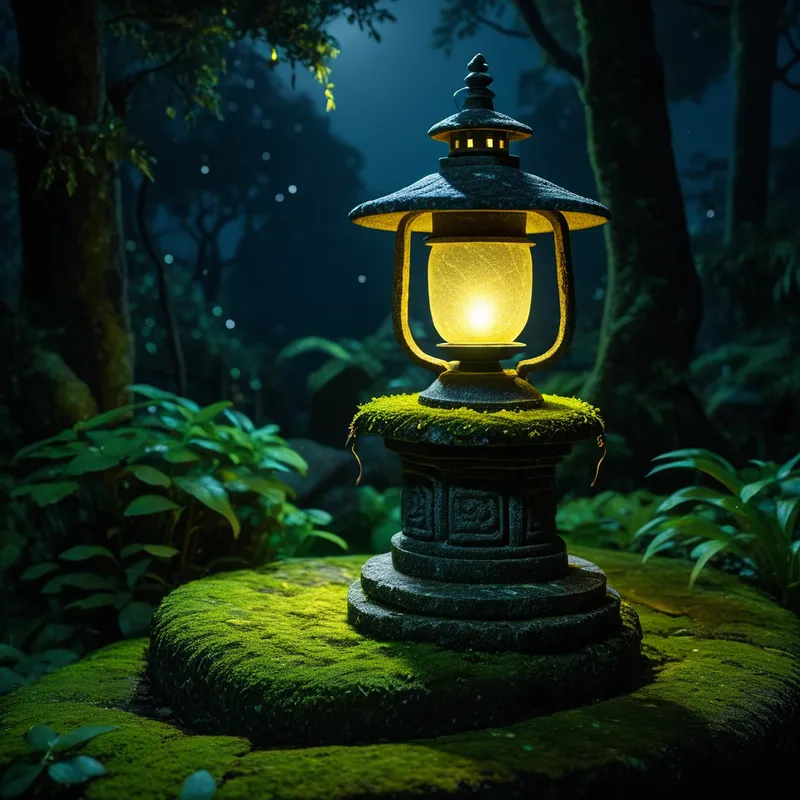
Cultural Origins & Context
The myth of Hotaru is not codified in a single, canonical text like the Kojiki. Instead, it lives in the oral tradition, a mukashibanashi whispered from elders to children during the humid tsuyu evenings, when the first fireflies appear. It belongs to the vast body of nature animism that underpins Shinto, where natural phenomena are imbued with spirit—kami.
This story functioned as an etiological myth, explaining the origin of the fireflies' enchanting, melancholic light. But its deeper function was pedagogical and emotional. In agrarian societies deeply attuned to the seasons, the firefly's brief lifespan (often just one to two weeks as an adult) was a powerful metaphor for mono no aware—the poignant awareness of impermanence. The tale taught that profound beauty is often born from loss, and that even a fractured spirit can create wonder. It was a story told not just to explain, but to cultivate a specific, respectful sensitivity towards the fleeting wonders of the natural world, encouraging listeners to pause and truly see the "living stars" of a summer night.
Symbolic Architecture
Psychologically, the myth of Hotaru is a profound map of a traumatic fragmentation and the subsequent search for wholeness. The celestial maiden represents an original state of psychic integrity—a Self that is luminous, purposeful, and connected to the transcendent (the heavens). The loss of the robe is the catalytic wound, the fall from grace that shatters this unity. This could symbolize any profound loss: of innocence, of love, of a core identity, of spiritual connection.
The fallen light does not die; it multiplies. The psyche’s response to catastrophic rupture is not always annihilation, but often a diaspora of the soul.
The resulting fireflies are the fragmented complexes of the personality, each carrying a shard of the original light—a memory, a talent, a pain, a hope. They are not evil, but isolated and lonely, doomed to brief, flickering existences. Their light is the symbolic manifestation of consciousness itself, struggling to exist in the darkness of the unconscious (the mortal world). The dance of the fireflies, then, is not a mere display. It is a non-verbal communication between these fragments, a symbolic representation of the psyche's innate urge to re-member itself, to find its lost connections in the dark.

The Dreamer's Resonance
When this myth pattern activates in the modern dreamer, it often manifests as dreams of scattered light. One might dream of a cherished object breaking into countless pieces, each glowing. Of a familiar person dissolving into points of light. Of trying to gather stars from a dark pool, only to have them slip through one's fingers. The somatic experience is one of acute, diffuse longing—a homesickness for a state of being one cannot fully recall.
These dreams signal a process of acknowledging psychic fragmentation. The ego may feel solid, but the dream reveals the underlying condition: parts of the self have been lost, exiled, or forgotten following some wounding event. The flickering, elusive quality of the dream images points to the fragility of these disconnected complexes. They are not yet integrated; they are visiting, making their presence and their pain known. The dreamer is in the stage of naming the diaspora, becoming aware that the loneliness or melancholy they feel is not a vague mood, but the collective sigh of their own scattered inner lights.

Alchemical Translation
The alchemical journey modeled by the Hotaru myth is not one of a heroic quest to slay a dragon, but of the humble, patient work of gathering. Individuation, in this context, is the process of becoming the compassionate witness to one's own fragmentation. The first step is the nigredo—the acknowledgment of the fall, the acceptance of the wound and the resulting blackness.
The work is not to become the celestial maiden again, for that unity is forever changed. The work is to become the warm, attentive night that holds the dancing lights.
The modern individual must learn to sit in their own darkness without despair and observe the flickering lights within—the sudden flash of an old grief (a blue firefly), the gentle pulse of a forgotten creativity (a gold one), the frantic blink of anxiety (a white one). This is the albedo, the whitening, where consciousness illuminates the contents. One does not force the lights to merge; one first honors each fragment's existence, its story of separation.
Integration, the rubedo or reddening, occurs when these disparate lights begin to recognize each other. In psychological terms, this is when complexes lose their autonomy and start to communicate, forming a new, more complex whole. The ego becomes not a single bright star, but the serene field in which the constellation of the Self can reform. The transformed individual carries the memory of the fall and the fragmentation, but their light is no longer a sign of loss. It is a testament to a wholeness that has been earned, a luminosity that embraces both its celestial origin and its earthly, fragile, beautiful form. They become the garden that welcomes the fireflies, understanding that their dance is the language of a soul remembering itself.
Associated Symbols
Explore related symbols from the CaleaDream lexicon: