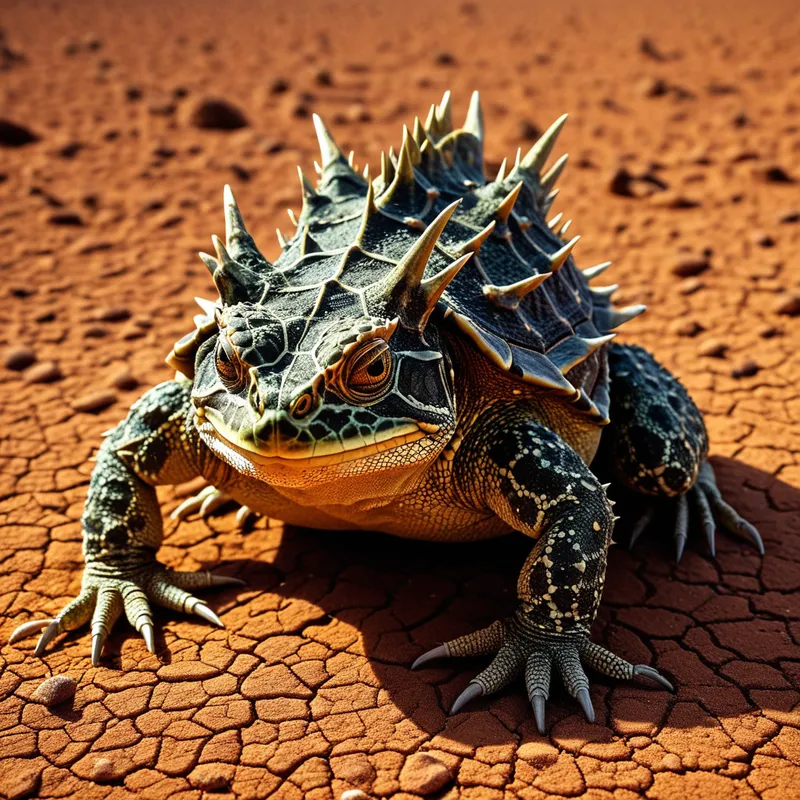
Horned Toad Myth Meaning & Symbolism
A tale where a humble, armored creature offers its sacred blood to save a people, becoming a guardian of life and a symbol of ultimate sacrifice.
The Tale of Horned Toad
In the time before memory, when the sun was a closer, fiercer eye, the world was a great, thirsty beast. The rains had forgotten their song. The rivers were only ghosts of themselves, pale scars on the land. The people, their lips cracked like the clay beneath their feet, turned their faces to a sky of relentless, polished blue. Their prayers were dry whispers, lost in the heat-shimmer.
In this crucible of want, a great thirst-demon, a spirit of absence, had coiled itself around the heart of the world. It drank not from rivers, but from the hope in the people’s hearts, growing fat on their despair. The shamans danced until their feet bled, but their drums found no echo in the hollow sky. The hunters returned with empty hands, for even the animals had fled or turned to dust.
It was then that the smallest of the people, a child whose voice was almost gone, wandered beyond the edge of the camp. She stumbled over stones that felt like old bones, her vision swimming. As she fell, her hand landed not on scorching rock, but on something living, patient, and cool. It was Horned Toad, sitting in the scant shadow of a withered sage.
The child looked into its ancient, pebbled eyes. “Grandfather,” she rasped, “the world is dying.”
Horned Toad blinked slowly, a movement of continents. Its body, a fortress of spines and plates, was a map of survival. It knew the secret ways of the earth, how to draw moisture from the very air, how to wait out eternity in stillness. It saw the demon’s work—not as a shadow in the sky, but as a sickness in the soil, a paralysis in the roots of life.
“The demon fears life,” Horned Toad spoke, its voice the sound of stones shifting deep underground. “It fears the flow that connects all things.”
The child carried the small, armored being back to the people. They gathered, a circle of despair. Horned Toad moved to the center, a humble king on a throne of dust. It did not look to the empty sky. Instead, it looked at the people, at their dry eyes, at the dying ember of community in their hearts.
“The water is gone from above,” Horned Toad said. “But life is not only water. Life is blood. It is the river inside.”
And then, with a deliberate, sacred motion, Horned Toad did a terrible and gracious thing. It pressed its own spiked brow against a sharp flint. A single, brilliant drop of its blood welled forth, glowing with an inner light like captured sunset. It let the drop fall onto the parched earth.
Where it struck, a sound like a deep, waking sigh shuddered through the ground. A green tendril, impossibly vibrant, pierced the dust. Then another. A tiny spring, clear and cool, began to weep from the very spot. The demon of thirst, whose power was in absence, recoiled from this sudden, defiant presence—this offering that was also a weapon.
But one drop was not enough to break the demon’s hold. Horned Toad knew. It met the eyes of the shaman, then the child, then the weary hunters. It was an unspoken question, and in their returned gaze, it found its answer. This was its people. This was its place.
Horned Toad offered its sacred blood again, and again. Each crimson drop was a seed of life, a hammer against the void. With each sacrifice, the green spread. The spring became a trickle, then a stream. The demon, faced with this relentless, willing gift—a power it could not comprehend or steal—unraveled like a mirage, its hunger defeated not by force, but by a deeper, more ancient law.
As the waters returned, Horned Toad did not rise up, transformed into a giant. It remained small, its form perhaps even more weathered. But it was now forever changed. Its blood, its very essence, had become part of the land’s memory. It had become the guardian of the threshold between life and desolation, a living testament that the greatest strength often wears the armor of the small, the patient, and the willing.
Cultural Origins & Context
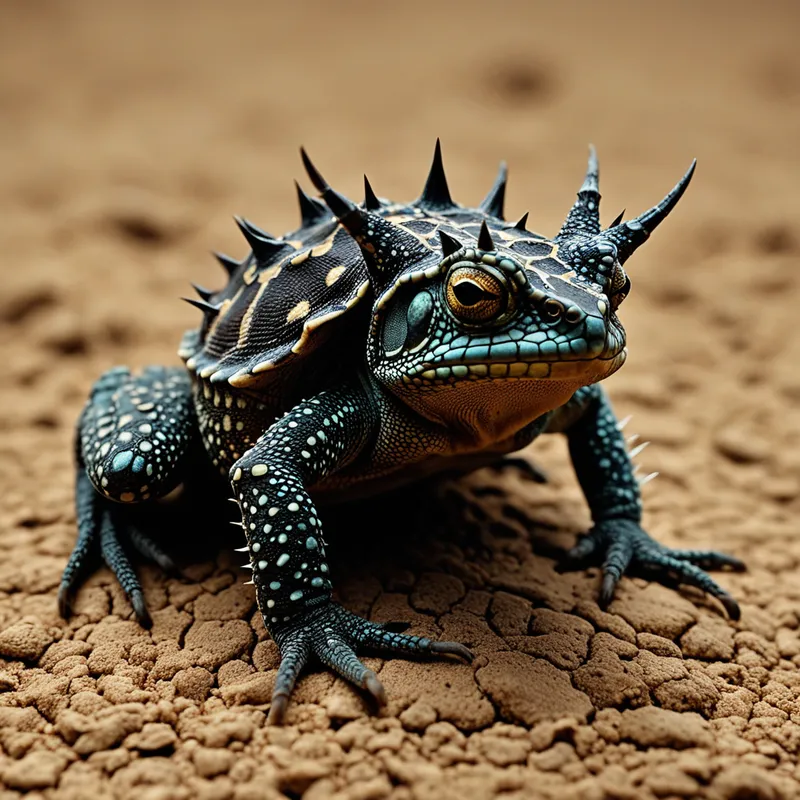
The narrative of Horned Toad as a life-giving benefactor is found among several Pueblo and Southwestern tribes, including the Tewa, Tiwa, and others. This myth was not mere entertainment; it was a vital strand in the cultural and ecological worldview of desert-dwelling peoples. Passed down orally through generations, often by elders and storytellers during winter gatherings or communal work, the tale served multiple functions.
It was, first, a lesson in keen observation and respect. The Horned Toad is a real creature, supremely adapted to arid environments. The myth encodes practical wisdom: this animal is a sign of life’s tenacity, to be honored, not feared. Secondly, it reinforced core communal values. The myth models absolute self-sacrifice for the good of the whole, a principle essential for survival in a harsh environment. It teaches that heroes are not always the strongest hunters or warriors, but can be the most humble and connected beings. Finally, it functioned as an etiological story, explaining the origin of water sources, the distinctive appearance of the Horned Toad, and the sacred covenant between the people and the non-human persons of their world.
Symbolic Architecture
At its heart, the Horned Toad myth is a profound allegory of the container and the contained, the protector and the protected. The Horned Toad’s physical form is its primary symbol: a spiked, plated, miniature fortress.
The ultimate protection is not a wall that keeps life out, but a vessel that allows life to be given away.
Its armor symbolizes boundaries, resilience, and the ability to endure harsh psychic or physical climates. Yet, within this formidable container flows the ultimate liquid of life—blood. The myth dramatizes the moment when the strongest boundary is voluntarily opened for the sake of connection and nurture. The Horned Toad is the archetype of the vas, the sealed vessel that must be opened to complete the work.
Psychologically, the Horned Toad represents the part of the Self that holds our most vital life-force—our passion, our soul’s essence, our emotional truth—often under heavy guard due to past injury or the demands of survival (the drought). The “thirst-demon” is the psychic force of deprivation, depression, or meaninglessness that drains this inner well. The myth instructs that defeating this demon does not come from hoarding our life-force more fiercely, but from the courageous, controlled sacrifice of it. The act of giving from our deepest reserve is what paradoxically breaks the drought and restores the flow.
The Dreamer's Resonance
When the image of the Horned Toad arises in a modern dream, it often signals a critical juncture in the dreamer’s relationship with their own resources and boundaries. The psyche is presenting an image of the Self that has become overly fortified, perhaps to the point of isolation. The dreamer may be experiencing a period of emotional or creative drought, a sense of being parched and cut off from the waters of feeling, inspiration, or connection.
Dreaming of a Horned Toad can indicate that the dreamer’s survival mechanisms—their psychological “armor”—have served their purpose but are now preventing the necessary flow of life. The pivotal moment in the dream may involve the Horned Toad bleeding, or the dreamer interacting with its spikes. This is a somatic signal from the unconscious. It points to a need for a sacred, deliberate sacrifice—not a reckless loss, but a conscious choice to be vulnerable, to offer something precious (time, truth, love, forgiveness) to a situation that feels barren. The dream is a preparation for the alchemical act of opening the sealed vessel of the heart.
Alchemical Translation
The journey of the Horned Toad is a perfect map for the stage of individuation known as mortificatio and ablutio—death-and-cleaning. The drought represents a psychic stagnation, a nigredo. The armored self sits in the center of this desolation, holding the last of the anima.
Transmutation begins not when we receive what we lack, but when we give what we fear to lose.
The alchemical operation is the piercing of the vessel. This is the mortificatio: the conscious, painful decision to break one’s own hardened defenses. The Horned Toad’s blood is the prima materia of the soul being offered up. This is not a destruction, but a sacred release. The resulting flow of water is the ablutio, the cleansing flood that follows the sacrifice, washing away the psychic “demon” of stagnation and revealing the new, fertile ground of the personality.
For the modern individual, this translates to a profound inner process. It is the moment we choose to express a long-guarded grief, to risk genuine intimacy behind our walls of independence, to invest a cherished dream into the world despite the fear of it drying up. The myth assures us that this voluntary, painful offering is not a loss, but the only ritual potent enough to call the waters back. We do not become the water; we become, like Horned Toad, the eternal guardian of the spring that our own sacrifice revealed. Our armor remains, but it is now the sacred boundary around a source, not a prison for a hoard.
Associated Symbols
Explore related symbols from the CaleaDream lexicon: