Honeycomb Myth Meaning & Symbolism
A myth of a primordial being whose self-sacrifice births the first hive, creating a sacred pattern of life, death, and sweet, communal renewal.
The Tale of Honeycomb
Listen. Before the rivers learned their names, when [the world](/myths/the-world “Myth from Tarot culture.”/) was a canvas of soft clay and whispering mist, there existed the Unshaped. From its dreaming silence emerged a being of pure resonance, a vibration given form. They called it The Hum.
The Hum moved through the Unshaped, and its song was the first sound. But the song was lonely. It echoed in the vastness, with nothing to receive it, nothing to give it shape or meaning. The Hum felt a deep, aching pull in its core—a longing not for an echo, but for a chorus. It desired not just to make, but to nourish.
For ages uncounted, The Hum wandered the formless plains, its song growing heavy with this yearning. Then, one eternal twilight, it came to a still place where the mists clung thickest. Here, the silence was absolute, a hunger of its own. The Hum sang into it, and the silence drank the song but gave nothing back. Despair, a cold and heavy sap, began to flow within The Hum. It saw that its beautiful, solitary music was not enough. Creation required not just a singer, but a sacrifice.
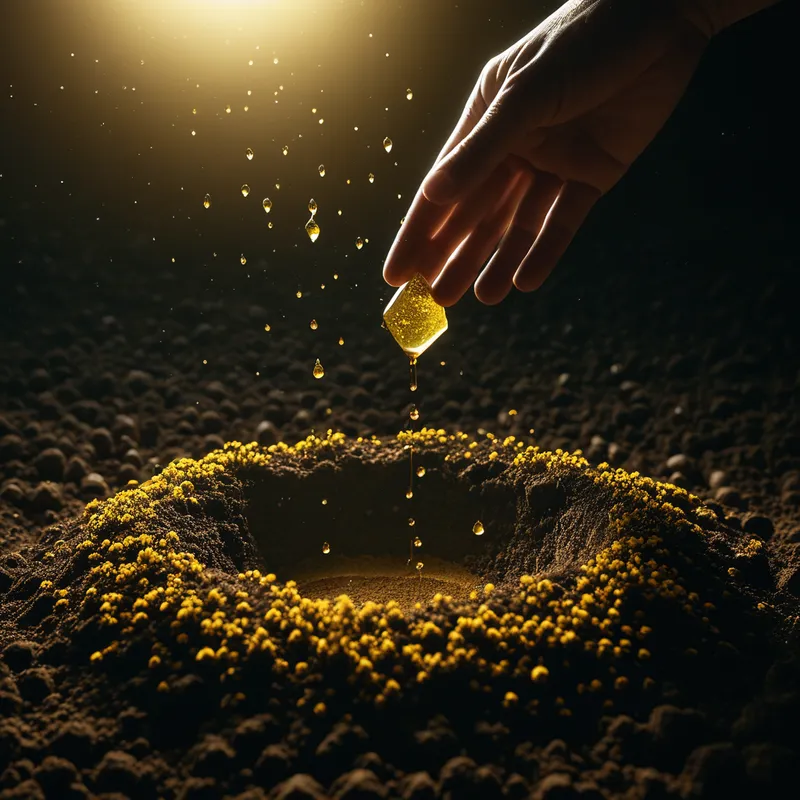
With a final, resonant note that shook the foundations of the Unshaped, The Hum pressed its hands against its own chest. There was no tearing, no violence of flesh, for it was made of light and intention. Instead, it began to unfold. From its core, a golden, viscous light—the first nectar—began to seep. As this sacred substance flowed, The Hum’s own luminous body began to crystallize into a pattern, a structure born of perfect necessity.
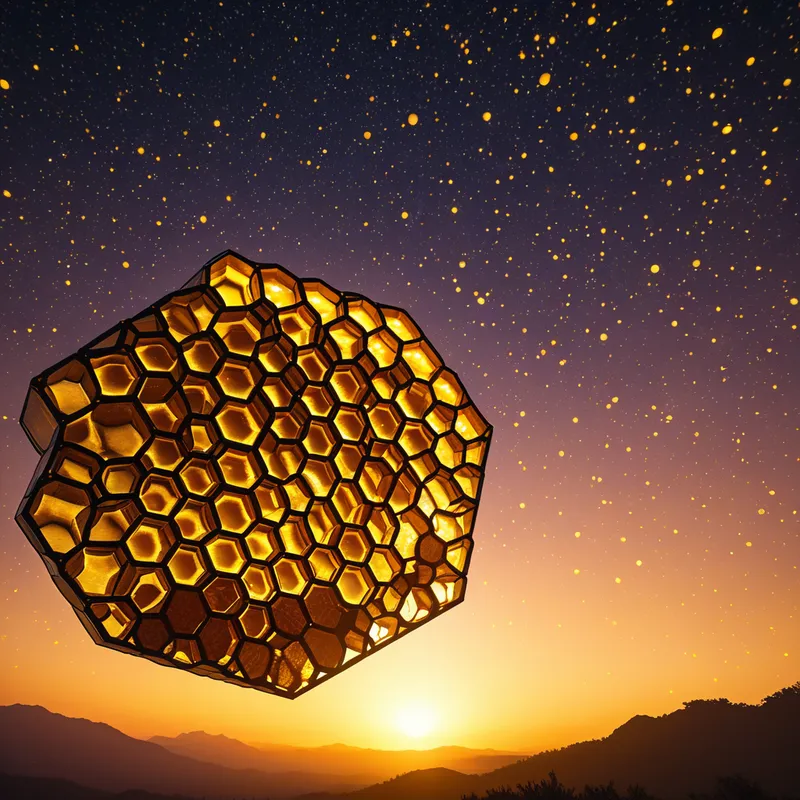
Its skin became walls of warm amber. Its flowing essence stabilized into geometric perfection: the hexagon. Cell by golden cell, The Hum transformed itself. The song did not end; it was transmuted. The hum became the quiet, industrious vibration of life within each new chamber. The last of its conscious thought poured out as the first golden drop, which fell to the fertile darkness below.
Where it landed, [the earth](/myths/the-earth “Myth from Hindu culture.”/) quickened. From that point, the pattern spread—not as a replication, but as an invitation. The perfect, empty cells of The Hum’s now-sacrificed body waited. And from [the mist](/myths/the-mist “Myth from Celtic culture.”/), drawn by the sweetness and the song now held in sacred architecture, came the first stirrings: not bees as we know them, but sparks of collective spirit. They entered the hexagonal chambers, and [the hive](/myths/the-hive “Myth from Various culture.”/) breathed its first breath. The Hum was gone, but in its place was Honeycomb: a palace of nourishment, a cathedral of communal song, a promise that from one’s deepest sacrifice, the sweetest, most enduring life can be built.
Cultural Origins & Context
The myth of Honeycomb is central to the oral traditions of the Natural culture, a people deeply attuned to ecological reciprocity and the unseen patterns governing life. It was not a story told to children at bedtime, but a sacred narrative recited during the Hiving Festival. The teller was always the Honey-Speaker, whose role was less about beekeeping and more about mediating between human community and the more-than-human world of collective industry.
The societal function was multifaceted. Primarily, it was a foundational ethic, encoding the principles of sustainable harvest: you take only what is given, you honor the source, and you understand that your sustenance comes from a cycle of sacrifice and renewal. Secondly, it served as a model for social organization. The ideal community, like the hive, was to be structured efficiently (hence the hexagon, symbolizing optimal use of resources) but animated by a shared, nourishing purpose that transcended the individual. The myth grounded their technology, their art, and their governance in a biological and spiritual blueprint.
Symbolic Architecture
At its core, the myth maps the [psyche](/myths/psyche “Myth from Greek culture.”/)’s [journey](/symbols/journey “Symbol: A journey in dreams typically signifies adventure, growth, or a significant life transition.”/) from undifferentiated potential to structured, nourishing [consciousness](/symbols/consciousness “Symbol: Consciousness represents the state of awareness and perception, encompassing thoughts, feelings, and experiences.”/). The Unshaped represents the unconscious—fertile, full of potential, but without form or [direction](/symbols/direction “Symbol: Direction in dreams often relates to life choices, guidance, and the path one is following, emphasizing the importance of navigation in personal journeys.”/). The Hum is the emerging ego, the first sense of “I” that seeks to express itself.
The greatest creation is not an act of will, but an act of surrender. The self must become a vessel, not a monument.
The Hum’s [loneliness](/symbols/loneliness “Symbol: A profound emotional state of perceived isolation, often signaling a need for connection or self-reflection.”/) is [the ego](/myths/the-ego “Myth from Jungian culture.”/)’s tragic realization that [identity](/symbols/identity “Symbol: Identity represents the sense of self, encompassing personal beliefs, cultural background, and social roles.”/) forged in [isolation](/symbols/isolation “Symbol: A state of physical or emotional separation from others, often representing a need for introspection or signaling distress.”/) is meaningless. Its yearning is the pull of [the Self](/myths/the-self “Myth from Jungian culture.”/)—Jung’s concept of the total, integrated psyche—calling it into [relationship](/symbols/relationship “Symbol: A representation of connections we have with others in our lives, often reflecting our emotional state.”/). The critical turn is the understanding that true creation requires de-creation of the old form. The [hexagon](/symbols/hexagon “Symbol: The Hexagon often symbolizes harmony and balance, reflecting the interconnectedness of relationships and structures in life.”/) is the [symbol](/symbols/symbol “Symbol: A symbol can represent an idea, concept, or belief, serving as a powerful tool for communication and understanding.”/) of this [paradox](/symbols/paradox “Symbol: A contradictory yet true concept that challenges logic and perception, often representing unresolved tensions or profound truths.”/): it is the most efficient, stable, and communal shape in [nature](/symbols/nature “Symbol: Nature symbolizes growth, connectivity, and the primal forces of existence.”/), representing the optimal [structure](/symbols/structure “Symbol: Structure in dreams often symbolizes stability, organization, and the framework of one’s life, reflecting how one perceives their environment and personal life.”/) that emerges when the psyche organizes itself around a central, nourishing [purpose](/symbols/purpose “Symbol: Purpose signifies direction, meaning, and intention in life, often reflecting personal ambitions and core values.”/), rather than around the fragile [identity](/symbols/identity “Symbol: Identity represents the sense of self, encompassing personal beliefs, cultural background, and social roles.”/) of [the ego](/myths/the-ego “Myth from Jungian culture.”/).
The [honey](/symbols/honey “Symbol: A sweet, viscous substance produced by bees, symbolizing natural sweetness, reward, and nourishment.”/), the sweet nectar, symbolizes the libido not as sexual [energy](/symbols/energy “Symbol: Energy symbolizes vitality, motivation, and the drive that fuels actions and ambitions.”/), but as vital [life](/symbols/life “Symbol: The symbol of ‘Life’ represents a journey of growth, interconnectedness, and existential meaning, encompassing both the joys and challenges that define human experience.”/) force—psychic energy that becomes “sweet,” meaningful, and sustaining only after it has been processed through the structured sacrifice of the ego. The [hive](/symbols/hive “Symbol: A symbol of collective society, organized productivity, and communal interdependence, often representing both harmonious cooperation and potential loss of individuality.”/) is the achieved [personality](/symbols/personality “Symbol: Personality in dreams often symbolizes the traits and characteristics of the dreamer, reflecting how they perceive themselves and how they believe they are perceived by others.”/), a complex, living [system](/symbols/system “Symbol: A system represents structure, organization, and interrelated components functioning together, often reflecting personal or social order.”/) where individual elements (thoughts, feelings, instincts) work in concert to produce and preserve what is [life](/symbols/life “Symbol: The symbol of ‘Life’ represents a journey of growth, interconnectedness, and existential meaning, encompassing both the joys and challenges that define human experience.”/)-giving.
The Dreamer’s Resonance
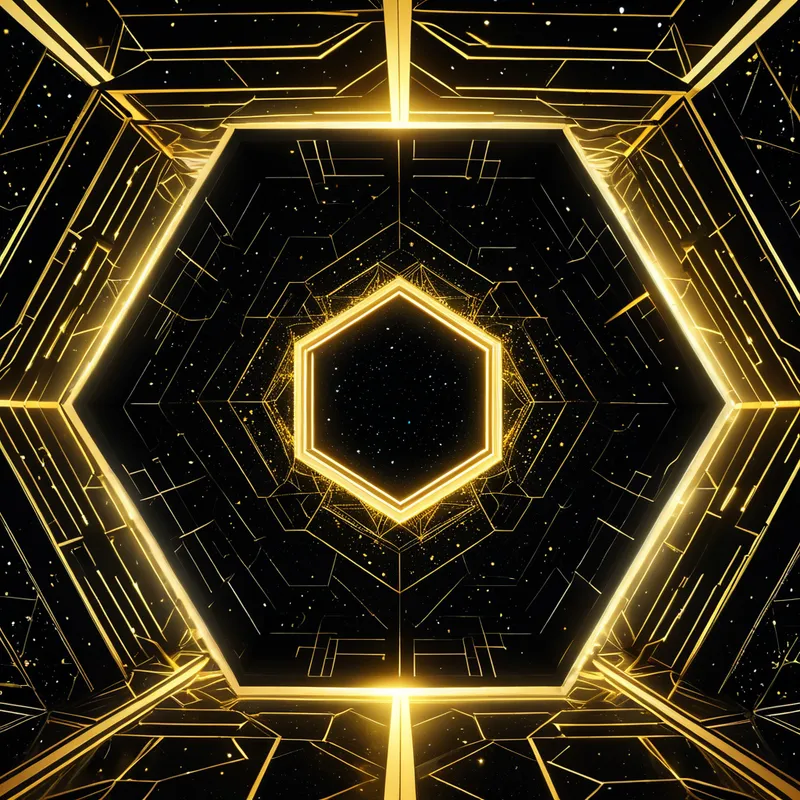
When the pattern of Honeycomb appears in modern dreams, it signals a profound process of psychic reorganization. It rarely appears as literal bees or hives. More often, dreamers report labyrinths with hexagonal corridors, computer motherboards with golden circuits, or the feeling of their own ribs forming a cage of warm, geometric light.
Somatically, this can accompany feelings of tightness in the chest—not necessarily anxiety, but a sense of compression into new form. Psychologically, the dreamer is undergoing what the myth describes: the conscious ego (The Hum) is being called to sacrifice its current, perhaps outmoded, structure for the sake of a greater, more nourishing wholeness. This is the pain of growth, the “unfolding” that feels like a dissolution. The dream is an assurance from the deep unconscious that this dissolution has a pattern, a sacred geometry. It is not chaos, but a restructuring towards greater efficiency and capacity to hold communal, life-sustaining energy. The dream asks: What old form of yourself must crystallize and become architecture so that a sweeter, more communal life can flourish within you?
Alchemical Translation
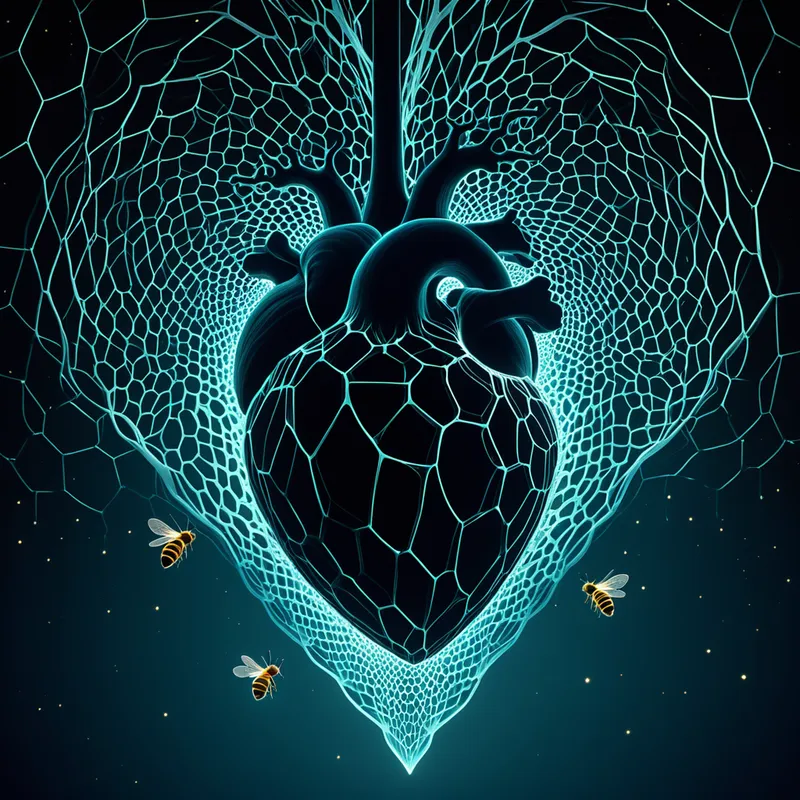
The alchemical journey mirrored in the Honeycomb myth is the opus contra naturam—the work against nature, which in depth psychology means the work against the ego’s natural tendency to seek permanence and sovereignty. The Hum begins in a state of [prima materia](/myths/prima-materia “Myth from Alchemical culture.”/) (the Unshaped). Its longing is the [nigredo](/myths/nigredo “Myth from Alchemical culture.”/), the darkening, the despair of isolation that initiates the work.
The act of self-sacrifice is the central alchemical operation: [solutio](/myths/solutio “Myth from Alchemical culture.”/) (dissolution) and coagulatio (coagulation) happening simultaneously. The fluid song (spirit) solidifies into geometric structure (matter), while the solid form (The Hum) dissolves to release nourishing spirit (nectar). This is the coniunctio oppositorum—the union of opposites.
Individuation is the self building a hive for its own soul. The ego provides the wax; the Self secretes the honey.
For the modern individual, the myth models the path of individuation. We are all, at some point, The Hum, singing our solo in [the void](/myths/the-void “Myth from Buddhist culture.”/). The crisis comes when that song feels empty. The alchemical translation is the conscious engagement with that crisis: allowing our rigid self-concepts to soften, to be restructured by a pattern that serves not just our individual ambition, but our capacity to contribute to a greater whole—be it family, community, or the totality of the psyche itself. The “honey” we produce is our unique gift to the world, but it can only be made after we have allowed ourselves to be remade into a vessel that can hold the process. The golden, stable structure of the hive is the [lapis philosophorum](/myths/lapis-philosophorum “Myth from Alchemical culture.”/), the philosopher’s stone—not a magical object, but the achieved state of a psyche that has found its perfect, nourishing form.
Associated Symbols
Explore related symbols from the CaleaDream lexicon: