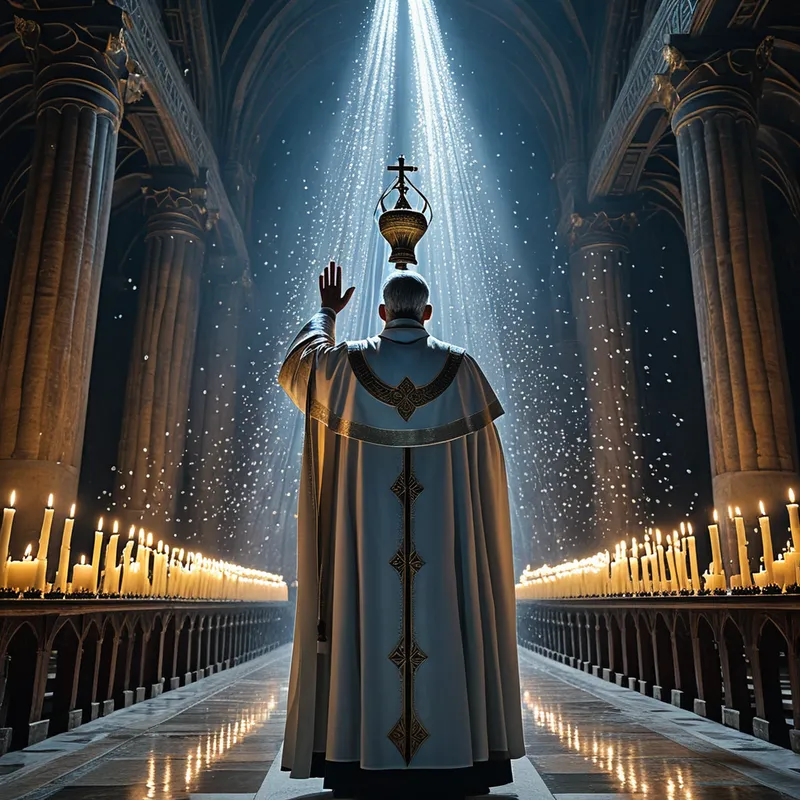
Holy Water Myth Meaning & Symbolism
A sacred element consecrated by divine breath, transforming primal chaos into a vessel of grace, memory, and the promise of psychic rebirth.
The Tale of Holy Water
Listen. Before the word, there was the deep. A formless, teeming abyss, a womb of potential and terror. Then, a breath moved over the face of the waters. Not a wind, but a presence—a holy whisper that separated the waters above from the waters below, carving space for life from the primal soup. This was the first consecration.
But the memory of chaos lingers. The waters of the great flood, sent to wash clean a corrupted world, remembered by the sign of the rainbow—a covenant etched in light and vapor. The waters of the Nile, turned to blood, a river of judgment and liberation. The people wandered, a dry-throated multitude in a desert of stone, until the staff struck the rock at Horeb and life gushed forth. Water was never merely water; it was the arena where the divine will met human desperation.
Then came the one from Nazareth. He walked to the muddy banks of the Jordan, not a pristine temple spring, but a river of history and repentance. His cousin, the wild prophet John, plunged him beneath the surface. As he rose, gasping, the heavens were torn open. A dove descended, and a voice thundered from the deep places of the sky: “This is my Son.” In that moment, the water itself became a witness, a participant in the revelation. It held the imprint of the divine.
His first sign? At a wedding in Cana, where joy had run dry. Six stone jars, meant for the rites of purification, stood empty. “Fill them with water,” he said. And when they drew it out, it had become wine—not just drink, but the blood of the grape, the essence of celebration and sacrifice prefigured. He spoke to a woman by a well, offering her not the water that leaves one thirsty again, but “living water” springing up to eternal life. He spat in the dust to make mud, anointing the eyes of the blind. He calmed the storm-tossed sea with a word, commanding the very chaos from which the world was born.
On the night he was betrayed, he took a basin and a towel. He, the master, knelt and began to wash the dusty, road-worn feet of his disciples. Peter protested, but was told, “Unless I wash you, you have no share with me.” Here, water was not spectacle, but service; not power, but humility; the cleansing necessary for communion.
Then, the final offering. From his pierced side, as he hung upon the cruciform tree, there flowed blood and water. The last of the living water, mingled with the wine of the new covenant, poured out onto the dust of the world. And when he emerged from the tomb, the first thing he did was breathe on his followers. “Receive the Holy Spirit.” The breath over the waters of creation became the breath in the upper room, the spirit now to be carried in the vessel of the community.
So the apostles went out, and with that breath, they spoke over common water. They invoked the name of the Father, and of the Son, and of the Holy Spirit. They cast out, by the authority of that name, every unclean spirit, every memory of the primal chaos. They called upon the water to become a fountain of rebirth, a well of salvation. And it was so. The water remembered. It became a tomb and a womb.
Cultural Origins & Context
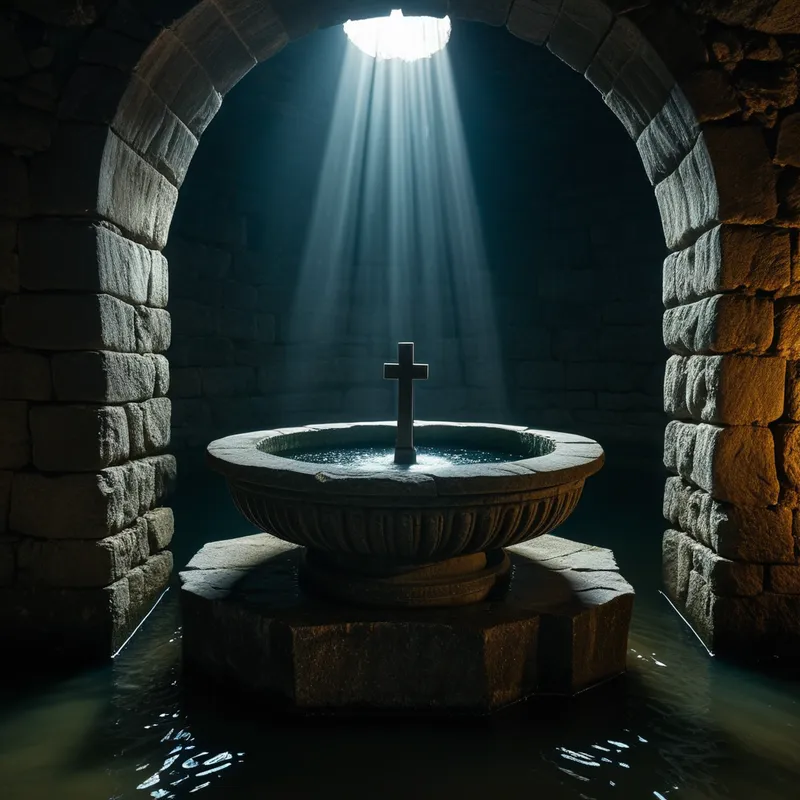
The practice of blessing water is not a late invention, but flows from the deep well of Jewish ritual purity laws (mikveh) and the profound symbolism of water in the Ancient Near East. For early Christians, often converts from Judaism or Gentile God-fearers, water was the primary threshold of initiation. The Sacrament of Baptism was public, dramatic, and dangerous in an era of persecution. It often occurred in natural bodies of water or in the baptisteries of catacombs.
The formal blessing of water for various uses—baptism, the sprinkling of the faithful (Asperges), the blessing of homes and objects—developed as the Church grew and its liturgical life became more structured. By the early medieval period, rites for creating “Holy Water” and “Baptismal Water” were distinct and elaborate, involving exorcisms, prayers, and the mingling of salt (a preservative and symbol of wisdom).
Its societal function was multifaceted. It was a tangible link to the sacred in a world perceived as spiritually perilous. It marked boundaries—between the profane and sacred space, between the old life and the new. It was a communal medicine, a shared resource of grace that families would take home, using it to bless their fields, their thresholds, and their sick. The myth was passed down not just in scripture, but in the ritual action itself—in the feel of the sprinkle on the forehead, the taste of the salt, the sound of the prayer echoing in stone.
Symbolic Architecture
At its core, the myth of Holy Water is about the sanctification of the elemental. It declares that matter is not opposed to spirit, but can become its perfect vessel.
The miracle is not that water becomes something else, but that it becomes fully itself—a memory bank of divine action, a liquid archive of grace.
Water symbolizes the unconscious itself—the formless, emotional, primal depths of the psyche. In its unblessed state, it represents the chaotic, potentially destructive power of untamed emotion and instinct (the flood). The act of consecration is the act of consciousness entering the unconscious and ordering it without destroying its vital, life-giving nature. The breath (Holy Spirit) over the water is the logos—the meaningful word—imposing a pattern of sacred purpose onto the raw material of the soul.
The salt exorcised and added is a crucial alchemical detail. Salt represents wisdom, preservation, and the enduring essence. It is the principle of consciousness and differentiation that prevents the blessed water—the now-ordered unconscious—from slipping back into undifferentiated chaos. The myth thus presents a model of the healthy psyche: a dynamic partnership where the conscious mind (the priestly word, the salt) respectfully engages with and directs the deep, life-giving energies of the unconscious (the water), creating a potent, healing medium.
The Dreamer's Resonance
When the symbol of Holy Water arises in modern dreams, it rarely appears as a church font. It may manifest as a suddenly purified river in a polluted cityscape, a vial of glowing liquid offered in a moment of crisis, or an overwhelming rain that washes away grime but leaves the dreamer cleansed and vulnerable.
Such dreams often signal a profound somatic and psychological process of purification in progress. The psyche is attempting to metabolize a toxic complex—a held resentment, a shameful memory, a pattern of negative self-talk. The “holy water” in the dream is the symbolic representation of the ego’s willingness to submit this raw, chaotic emotional material to a larger, ordering principle—the Self. The dream may feature a feeling of being sprinkled, immersed, or drinking. Each sensation correlates to a different level of engagement: sprinkling suggests a gentle, initial blessing or protection; immersion indicates a deep, transformative death-and-rebirth process (a baptism); drinking points to the internalization of this healing principle.
Resistance in the dream—a fear of the water, it turning to blood or mud—reveals the shadow’s protest. It shows a part of the psyche that is invested in the chaos, that identifies with the “unclean spirit” being cast out. The dreamwork then becomes about dialoguing with that resistance, understanding its protective function, and ultimately, with great compassion, inviting it to be transformed.

Alchemical Translation
The individuation journey is, in essence, the creation of Holy Water within the vessel of one’s own life. It is the opus of making the common sacred.
The initial state is massa confusa—the leaden, chaotic flow of undifferentiated experience, driven by complexes and collective pressures (the primal waters). The first operation is exorcism. This is not a medieval fantasy, but the hard, conscious work of “naming” our demons: identifying the repetitive, destructive patterns, the internalized critical voices, the ancestral traumas that haunt our emotional depths. We speak the word of consciousness to these waters.
Then comes the invocation—the calling in of a higher authority than the ego. In psychological terms, this is aligning with the guiding function of the Self, the central archetype of wholeness. It is the moment we consciously ask, “What is trying to emerge in me that is greater than my fear?” We consecrate our experience—our pain, our joy, our creativity—to this larger purpose.
The alchemical vessel is the disciplined container of one’s attention. The fire is the heat of honest self-reflection. The blessed water that results is the transformed emotional body—no longer reactive, but responsive; no longer a source of flooding anxiety, but a well of compassionate insight.
Finally, the application. The Holy Water is not to be hoarded. It must be sprinkled on the thresholds of our relationships (forgiveness), used to bless our daily work (finding the sacred in the mundane), and offered to heal the wounds we encounter. The myth teaches that the ultimate purpose of personal transmutation is not solitary enlightenment, but to become a conduit of the very grace that transformed us. We become, in our own humble way, the stone jar at Cana, the ordinary vessel that, when filled to the brim with the common water of human experience and touched by the divine imperative, holds within it the wine of a more meaningful, connected, and celebratory life.
Associated Symbols
Explore related symbols from the CaleaDream lexicon: