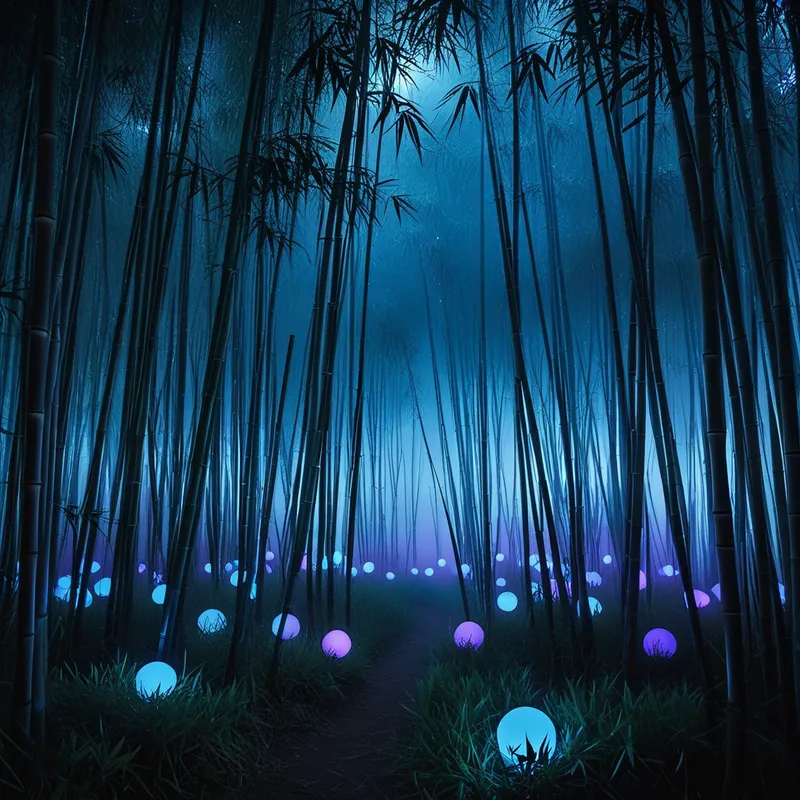
Hitodama Myth Meaning & Symbolism
A spectral blue flame, the Hitodama is the soul's brief, luminous farewell, drifting between worlds before its final dissolution or rebirth.
The Tale of Hitodama
Listen, and let the summer night draw close. The air is thick, not with heat, but with the weight of a world unseen. The cicadas have fallen silent. In the deep dark between the ancient cedars, where the path forgets itself, a soft sigh is heard—not from the wind, but from the very fabric of the twilight.
It begins not with a bang, but with a breath held too long, finally released. From the lips of the newly departed, or sometimes from the mouth of one hovering on the knife’s edge between sleep and death, a pale, cool light gathers. It is a wisp of vapor, a sigh given form, and then it coalesces. It becomes a sphere, no larger than a fist, glowing with the color of a distant star: a spectral blue, tinged with the violet of a fading bruise. This is the Hitodama.
It detaches, this captured breath, this final exhalation of the spirit. It does not fly, but drifts, as if remembering the weight of the body it has left. It floats through the graveyard, over the still-warm hearth of an empty home, down the forgotten mountain trail. It seeks water, they say, drawn to the reflective silence of wells, ponds, and riverbanks. In its passage, it illuminates nothing but the fog, casting long, dancing shadows that belong to no one.
Sometimes it is alone, a solitary wanderer on its last, silent pilgrimage. Other times, they come in mournful clusters, a procession of lost lights. They make no sound, yet the air grows colder in their wake. The animals hide. The world holds its breath. For a few moments, or perhaps an hour—time bends in their presence—they are here, and not here. They are the soul, untethered, tasting its freedom and its terror.
And then, as silently as it appeared, the light wavers. The blue deepens, dims. It may float downward, dissolving into the earth with a soft, soundless pop. It may rise, fading into the starfield above until it is indistinguishable from the heavens. Or, in the oldest tales, it may be gathered by kami of the borderlands, shepherded to its next unknown shore. The night exhales. The cicadas, tentatively, begin their song once more. The soul’s brief flame has gone out, and the world, changed and unchanged, continues.

Cultural Origins & Context
The Hitodama is not a myth of grand creation or epic heroism, but a folklore of intimate transition. Its roots are deep in the animistic soil of Shinto and the complex Buddhist conceptions of the afterlife that later intertwined with it. This is a belief born from observation and existential wonder: the will-o'-the-wisp phenomena of marsh gases, the bioluminescence of fungi, the strange optical effects of deep night. Our ancestors saw in these natural mysteries a reflection of the greatest mystery of all—the departure of the soul.
These stories were not formalized in sacred texts but lived on the lips of villagers, told by grandparents to wide-eyed children on humid evenings. They served as a natural psychology, explaining the sudden chill, the uncanny feeling of being watched in a lonely place. The Hitodama narrative functioned as a map for the unmappable journey of death, offering a visible, though fleeting, sign that the soul’s passage was a process, not an instant. It provided a cultural container for grief, allowing the living to imagine their loved ones not simply gone, but on their way, their presence still faintly luminous in the world for a little while longer.
Symbolic Architecture
At its core, the Hitodama is the soul made momentarily visible in its raw, transitional state. It is pure potential, caught between forms.
The soul’s final breath is not an end, but a seed of light cast into the dark soil of the unknown.
Psychologically, it represents the autonomous complex—a bundle of psychic energy—that breaks free from the conscious personality. This is not merely about physical death, but any profound ending: the death of a relationship, an identity, a long-held dream. The Hitodama is that glowing core of feeling and memory that detaches from the wreckage and wanders, lost and luminous, before it can be integrated or released.
Its blue flame is significant. Blue is the color of distance, of melancholy, of the intangible—the sky and the deep sea. It is cool, unlike the red heat of vital life. This is the flame of spirit, not body. Its attraction to water symbolizes a return to the unconscious, to the reflective, dissolving waters from which consciousness first emerged. The Hitodama’s silent, aimless drift is the psyche in a state of shock, after a great rupture, before it finds a new direction or accepts dissolution.

The Dreamer's Resonance
When the image of the Hitodama floats into modern dreams, it signals a profound state of psychic transition. The dreamer is not necessarily confronting physical mortality, but experiencing a psychic death. You may dream of a soft blue light in your bedroom, a floating orb following you down a dark street, or seeing your own breath turn into such a light and float away.
Somatically, this often correlates with feelings of dissociation, of being "spaced out" or untethered from daily concerns. There is a haunting loneliness to it, but also a strange peace. The psyche is announcing that a part of you—an old way of being, a buried trauma, a spent passion—has completed its life cycle and is now separating. The wandering soul-fire in the dream is that fragment of your own spirit, now autonomous, asking for acknowledgment. The dream is the liminal space, the dark grove, where this release is witnessed. The process is one of grieving and releasing an identity, allowing it to depart so that the core self can reorganize.

Alchemical Translation
The journey of the Hitodama is a perfect map for the alchemical stage of solutio, or dissolution. In the work of individuation, we must not only build and integrate but also gracefully let go.
The myth models this psychic transmutation. First, there is the detachment—the painful but necessary separation of the soul-complex from the familiar structure of the ego. This is the "death." Then comes the liminal drift—the period of wandering in the unknown. This is not pathology, but a sacred, if terrifying, incubation. The ego must surrender control, allowing the soul its solitary journey through the night. Finally, there is the dissolution or integration—the fading of the light.
The goal is not to cling to the wandering flame, but to bless its passage, trusting that its light will nourish what is to come, whether in rebirth or in peaceful void.
For the modern individual, this translates to honoring periods of fallowness after a great loss. It is the courage to not immediately "fix" the grief or "find a new purpose," but to allow the inner Hitodama to drift. To watch that blue light of sadness, memory, or lost identity with awe, not fear, knowing its journey is part of your soul’s hygiene. In doing so, you perform the ultimate alchemy: transforming the leaden weight of an ending into the subtle, spiritual light of release, making the unconscious process conscious, and finding meaning in the very act of letting go.
Associated Symbols
Explore related symbols from the CaleaDream lexicon: