
Hippocrates Myth Meaning & Symbolism
The mythic legacy of the physician Hippocrates, who received the sacred art of healing from Asclepius, transforming medicine into a sacred, ethical vocation.
The Tale of Hippocrates
Hear now a tale not of gods clashing on Olympus, but of a mortal man who walked the line between earth and the divine, between the flesh and the spirit. The air on the island of Kos is thick with the scent of salt, pine, and the bitter herbs that grow in rocky soil. In the time when the temples still hummed with presence, a boy was born into the lineage of the Asclepiads, those who claimed descent from Asclepius himself.
His name was Hippocrates. From his first breath, the shadow of the serpent-entwined staff fell upon his cradle. He did not play with wooden swords, but with dried roots and polished bones. His lullabies were the murmured prayers of the sick who came to the Asclepieion, seeking the god’s touch in their sleep. As a youth, he wandered not the fields, but the porticoes of the sanctuary, watching, listening. He saw fevers break and wounds fester. He heard the desperate pleas and the grateful weeping. And in the sacred silence, he heard a deeper call—not from the statue of the god, but from the suffering itself.
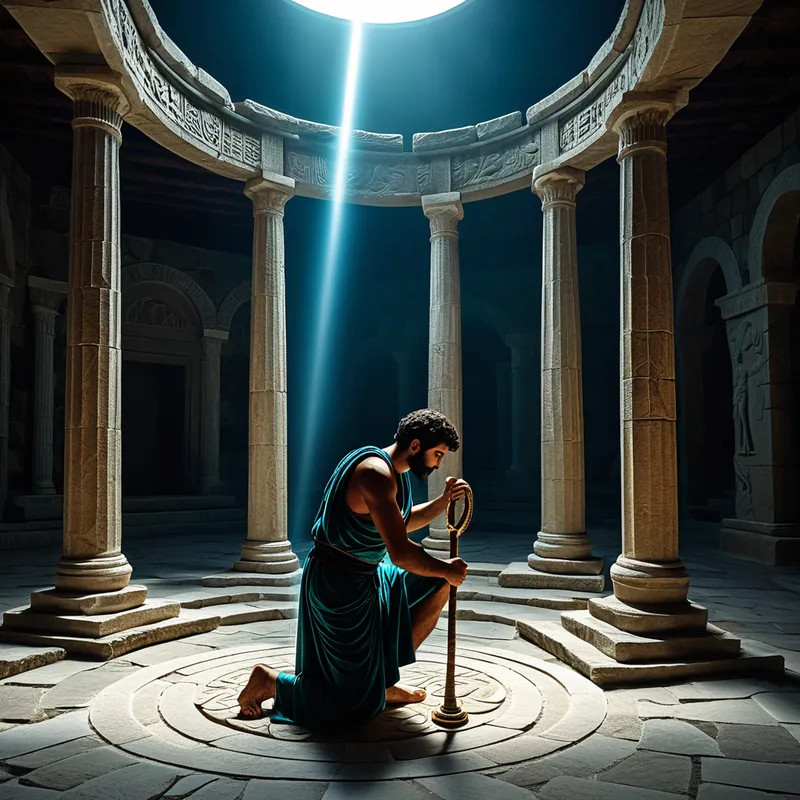
One night, under a moon so full it bleached the marble white, the young man entered the abaton, the dreaming culture.") hall. The air was cold, heavy with incense and hope. He lay upon the skins provided, his heart a drum against his ribs. Sleep took him, not as a gentle descent, but as a drowning. In the dream, the great god Asclepius stood before him, not as stone, but as a figure of luminous, terrible compassion. In his hand, the staff pulsed with life; the serpent coiled, whispering not in words, but in knowing. The god extended his hand, and a scroll unfurled from nothingness, inscribed not with laws, but with principles written in light: First, do no harm. The art is long, life is short. Where there is love of humanity, there is love of the art.
Hippocrates awoke not with a start, but with a profound stillness. The dawn light filtering through the columns seemed different—it illuminated not just stone, but the very fabric of cause and effect in the body. He rose, and from that day, his hands held a new weight. He began to observe not just symptoms, but stories. He charted the courses of illnesses as a sailor charts the stars. He separated the sacred art from superstition, seeking causes in diet, in climate, in the balance of the humors. The myth tells that he did not work miracles, but something more enduring: he forged a covenant. He gathered his disciples and, under the same sky that had witnessed his dream, he bound them—and all who would follow—to the Oath. It was a promise not to the gods, but to the mortal across from you, vulnerable and trusting. Thus, the physician was born anew, not as a priest of Asclepius, but as a steward of the sacred trust the god had revealed.
Cultural Origins & Context
The figure of Hippocrates emerges from the fertile ground of 5th century BCE Greece, a period of profound intellectual upheaval. This was the age of Socrates, of the first historians, of a shift from explaining the world through myth alone to seeking rational principles, or logos. The historical Hippocrates of Kos was a real physician, but his life quickly became mythologized, woven into the larger cultural tapestry of Greek healing.
His legacy was transmitted not through epic poems, but through the <abbr title=""The Hippocratic Corpus," a collection of around 60 early medical works attributed to Hippocrates and his followers">Corpus Hippocraticum, a body of texts that served as the foundation of Western medicine for millennia. These were practical, observational, and revolutionary in their insistence on natural, rather than supernatural, causes for disease. The myth of his divine inspiration served a critical societal function: it legitimized this new, rational approach by grounding it in the ultimate authority—a direct revelation from the god of healing himself. It transformed the physician’s role from a tradesman or a temple attendant into a vocation with a sacred, ethical core, ensuring the art’s transmission and integrity within the polis.
Symbolic Architecture
At its heart, the myth of Hippocrates is not about the discovery of medicine, but about its consecration. It represents the moment a craft is imbued with a soul, when technique is married to ethics.
The Oath is the vessel that carries the numinous revelation into the mundane world; it is the ritual that makes the sacred sustainable.
Hippocrates himself symbolizes the liminal figure. He is the bridge: born of a sacred lineage (the Asclepiads) but operating in the profane world of flesh and blood. His dream-vision is the archetypal moment of calling. The serpent of Asclepius is a profound multivalent symbol: it represents healing (through the shedding of its skin), wisdom, and the chthonic, instinctual knowledge of the body itself—a knowledge that must be integrated, not feared.
The core conflict is between chaotic, unprincipled practice and an ordered, ethical art. Hippocrates’s triumph is the establishment of a container—the Oath and the method—that allows the powerful, often terrifying forces of disease and healing to be addressed without causing further harm. Psychologically, he represents the emergence of the observing Ego that can stand between the unconscious, instinctual drives (the serpent/illness) and the conscious world, mediating with wisdom and restraint.
The Dreamer's Resonance
When this myth stirs in the modern psyche, it rarely appears as a man in a toga. It manifests as dreams of profound responsibility, of being handed a tool or a task of immense power for which one feels both prepared and utterly inadequate.
You may dream of being in a position to "heal" or "fix"—a broken system, a relationship, a part of yourself—and feeling the weight of the scalpel in your hand. The dream environment is often a hybrid space: part temple, part laboratory, part childhood home. The somatic sensation is one of gravitas, a literal heaviness in the chest or hands. This is the psyche working through the integration of a vocation or a deep ethical dilemma. It is the Self presenting the dreamer with their own "Hippocratic moment": the recognition that knowledge or skill carries an inherent moral obligation. To dream of forgetting the oath, or of causing harm despite good intentions, points to the shadow side of the archetype—the fear of arrogance, of playing god, or of the healer’s own wound being activated.

Alchemical Translation
The alchemical journey modeled here is the transmutation of knowledge into wisdom. The base metal is raw talent, intellectual curiosity, or technical skill (the herbal lore of the Asclepiads). The divine dream is the coniunctio, the sacred marriage, where this raw material is infused with the spirit of ethical purpose (the silver of the moon, the light of the scroll).
The process is not one of purification to a sterile ideal, but of responsible integration. The serpent, the symbol of the primal, unpredictable life force (disease, instinct, passion), is not slain but coiled around the staff—contained, allied, and respected.
For the modern individual, the "Hippocratic Opus" is the lifelong work of forging one’s personal "Oath." It is the process by which we take our innate gifts, our professional training, or our personal insights and consciously bind them to a principle greater than our own ambition or comfort. The prima materia is our natural propensity; the nigredo is the confrontation with suffering, limitation, and our own ignorance; the albedo is the clear, moonlit revelation of ethical principle; and the rubedo is the red, living commitment to enact that principle daily, to become a vessel for a healing that is both practical and sacred. The goal is not to become a god, but to become a true human—a bridge between the realm of ideal forms (the dream of health, justice, truth) and the flawed, suffering, beautiful reality of the world.
Associated Symbols
Explore related symbols from the CaleaDream lexicon: