Hexagonal Stone Circles Myth Meaning & Symbolism
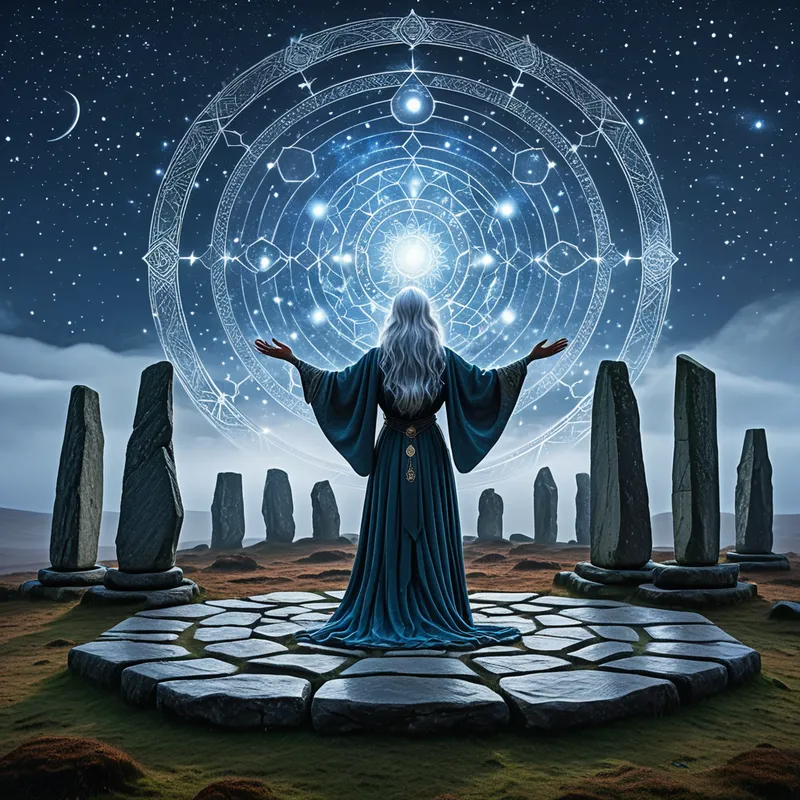
A myth of the goddess Danu forging a hexagonal stone circle to weave the world's patterns, a symbol of cosmic order and the human psyche's structure.
The Tale of Hexagonal Stone Circles
Listen, and let the peat-smoke carry you back. Before the first iron was smelted, when [the world](/myths/the-world “Myth from Tarot culture.”/) was a song half-sung, the Danu walked the raw, green flesh of [the earth](/myths/the-earth “Myth from Hindu culture.”/). It was a time of beautiful chaos. Rivers ran where they pleased, mountains shrugged and settled in their sleep, and the stars above wheeled in a glorious, untamed dance. But in the heart of Danu, a longing stirred—not for stillness, but for a pattern. A memory of the first note from which the song sprang.
She journeyed to a high, wind-scoured moor, a place where [the veil](/myths/the-veil “Myth from Various culture.”/) between the land and [the sky](/myths/the-sky “Myth from Persian culture.”/) was thin as a moth’s wing. Here, the six great winds converged, howling from the six directions: North’s bitter breath, South’s fertile sigh, East’s dawn whisper, West’s twilight lament, the Ceiling of Stars’ cold song, and [the Foundation Stone](/myths/the-foundation-stone “Myth from Mesopotamian culture.”/)‘s deep hum. Their conflict was constant, a cacophony that tore at the fabric of things.
For six days and six nights, Danu sat in the center of the tumult, her spirit listening. She heard not just noise, but the individual voice of each wind—its desire, its terror, its power. On the seventh dawn, she rose. With a touch that could gentle a storm, she reached into the bones of the earth. From the bedrock, she called six pillars of living granite. Not with violence, but with a slow, tectonic persuasion, she drew them forth.
Each stone was placed not as a barrier, but as a listener. The North Stone she set to hold the memory of ice. The South Stone to dream of growth. East to greet the sun, West to honor its rest. One she raised to mirror the heavens, another to root in [the abyss](/myths/the-abyss “Myth from Kabbalistic culture.”/). As the final stone settled, a profound silence fell, deeper than any quiet before it. The winds did not cease, but as they met the stones, they were compelled to speak through them. The North Wind’s blast became a resonant hum against its stone. The South’s sigh a warm vibration.
Then Danu began to weave. From her fingertips flowed threads of starlight, of flowing [water](/myths/water “Myth from Chinese culture.”/), of root-tendril and bird-flight. She walked the path between the stones, connecting them not with walls, but with these luminous lines of force. With each pass, a hum grew—a single, complex chord composed of the six winds’ harmonies. The chaotic forces were not defeated; they were orchestrated. Where once was dissonance, now stood a sanctuary of resonant order. The Hexagonal Circle was complete, a loom upon which the world’s patterns could be woven with intention, a sacred geometry singing the first law of the universe: that chaos contains its own perfect form.
Cultural Origins & Context
The motif of the stone circle is, of course, central to the Neolithic and Bronze Age landscapes of the British Isles and Brittany, long predating the cultures we term “Celtic.” The hexagonal form, however, is a rarer and more specialized pattern within the later mythological imagination of the insular Celtic world. This myth likely emerged not as a literal explanation for megalithic sites, but as a poetic and philosophical framework developed by the Druids and bards to articulate a cosmic principle.
It is a myth of the intellect and the spirit, told not around common hearths but in the training of seers and poets. Its function was pedagogical. It served as a mental template for understanding sovereignty, law, and the structure of reality itself. The king or queen, in Celtic sacral kingship, was seen as the center of the tribe’s “circle,” responsible for maintaining harmony between the different realms and forces (human, natural, divine), much like Danu at the center of the six winds. The myth encoded the idea that true power lies not in domination, but in the conscious arrangement of relationships, in creating a vessel strong enough to hold opposing forces and transmute their conflict into music.
Symbolic Architecture
The [hexagon](/symbols/hexagon “Symbol: The Hexagon often symbolizes harmony and balance, reflecting the interconnectedness of relationships and structures in life.”/) is the shape of the [honeycomb](/symbols/honeycomb “Symbol: Honeycomb symbolizes productivity, community, and the sweetness of life.”/), [nature](/symbols/nature “Symbol: Nature symbolizes growth, connectivity, and the primal forces of existence.”/)’s most efficient [structure](/symbols/structure “Symbol: Structure in dreams often symbolizes stability, organization, and the framework of one’s life, reflecting how one perceives their environment and personal life.”/) for holding [life](/symbols/life “Symbol: The symbol of ‘Life’ represents a journey of growth, interconnectedness, and existential meaning, encompassing both the joys and challenges that define human experience.”/). Psychologically, it represents the perfected container of [the Self](/myths/the-self “Myth from Jungian culture.”/). The six stones are not random; they are the archetypal polarities and directions that define any psychic [system](/symbols/system “Symbol: A system represents structure, organization, and interrelated components functioning together, often reflecting personal or social order.”/).
The circle is the promise of wholeness, but the hexagon is the architecture that makes it possible. It is the conscious structure of the psyche.
The six directions map onto fundamental [human](/symbols/human “Symbol: The symbol of a human represents individuality, complexity of emotions, and social relationships.”/) experiences: the conscious and the unconscious ([Heaven](/symbols/heaven “Symbol: A symbolic journey toward ultimate fulfillment, spiritual transcendence, or connection with the divine, often representing life’s highest aspirations.”/) and [Foundation](/symbols/foundation “Symbol: A foundation symbolizes the underlying support systems, values, and beliefs that shape one’s life, serving as the bedrock for growth and development.”/) Stones), the past and future (East and West), the repressed and the expressed (North and South). Danu, the [Mother](/symbols/mother “Symbol: The symbol of ‘Mother’ represents nurturing, protection, and the foundational aspect of one’s emotional being, often associated with comfort and unconditional love.”/) [Goddess](/symbols/goddess “Symbol: The goddess symbolizes feminine power, divinity, and the nurturing aspects of life, embodying creation and wisdom.”/), represents the unifying [consciousness](/symbols/consciousness “Symbol: Consciousness represents the state of awareness and perception, encompassing thoughts, feelings, and experiences.”/), [the ego](/myths/the-ego “Myth from Jungian culture.”/) that dares to sit in the center of these colossal forces without fleeing. Her act of “weaving” is the act of making connections, of building coniunctio between opposing parts of oneself. The myth tells us that our inner [chaos](/symbols/chaos “Symbol: In Arts & Music, chaos represents raw creative potential, uncontrolled expression, and the breakdown of order to forge new artistic forms.”/) is not an [error](/symbols/error “Symbol: A dream symbol representing internal conflict, perceived failure, or a mismatch between expectations and reality.”/) to be eliminated, but a [chorus](/symbols/chorus “Symbol: A chorus in dreams symbolizes unity, collaboration, and the harmony of diverse voices contributing to a greater whole.”/) of powerful, distinct voices waiting to be heard and harmonized within a stable, sacred structure of our own making.
The Dreamer’s Resonance
When the hexagonal stone circle appears in a modern dream, it rarely manifests as a literal archaeological site. More often, it is felt as a sensation of geometric clarity amid emotional turbulence. One might dream of a hexagonal room, a hexagonal pattern on the floor that stabilizes them, or six points of light arranging themselves around a central dilemma.
This dream image signals a critical phase in what Jung called the individuation process. The dreamer is likely experiencing a life situation where multiple pressures, choices, or internal conflicts (the six winds) are pulling them apart. The somatic feeling is one of fragmentation, anxiety, or being scattered. The emergence of the hexagon is the [psyche](/myths/psyche “Myth from Greek culture.”/)’s innate blueprint for sanity asserting itself. It is the unconscious presenting the solution: not to escape the pressures, but to find the six “stones”—the core, non-negotiable values, truths, or aspects of the self—that can act as pillars. The dream invites the dreamer to become their own Danu, to consciously establish these inner pillars and begin the patient work of weaving their life’s narrative between them.
Alchemical Translation
The alchemical process mirrored here is that of Coagulatio. The initial state is the solve: the dissolved, chaotic, “watery” state of the unexamined life or the psychic crisis. The six winds are these raw, unintegrated elements swirling in the [prima materia](/myths/prima-materia “Myth from Alchemical culture.”/) of the soul.
Danu’s journey to the moor is the withdrawal into introspection, the meditatio. The calling of the stones is the stage of [separatio](/myths/separatio “Myth from Alchemical culture.”/), where one identifies and distinguishes the core components of the conflict. This is arduous work, requiring one to touch the “bedrock” of one’s own nature.
The great work is not to create something from nothing, but to discover the latent, crystalline structure within the chaos of everything.
The final weaving is the coniunctio, [the sacred marriage](/myths/the-sacred-marriage “Myth from Various culture.”/) of opposites within the now-stable vessel. The resulting “chord” is [the philosopher’s stone](/myths/the-philosophers-stone “Myth from Alchemical culture.”/) of the psyche: a state of inner alignment where one’s life is no longer a battleground of competing needs, but a resonant instrument. For the modern individual, the myth models the move from a life driven by reactive chaos to a life built with conscious, sacred architecture. It teaches that our task is not to silence the inner storms, but to build a circle so true and strong that the storms must sing through us, transforming cacophony into the unique and holy music of a realized self.
Associated Symbols
Explore related symbols from the CaleaDream lexicon: