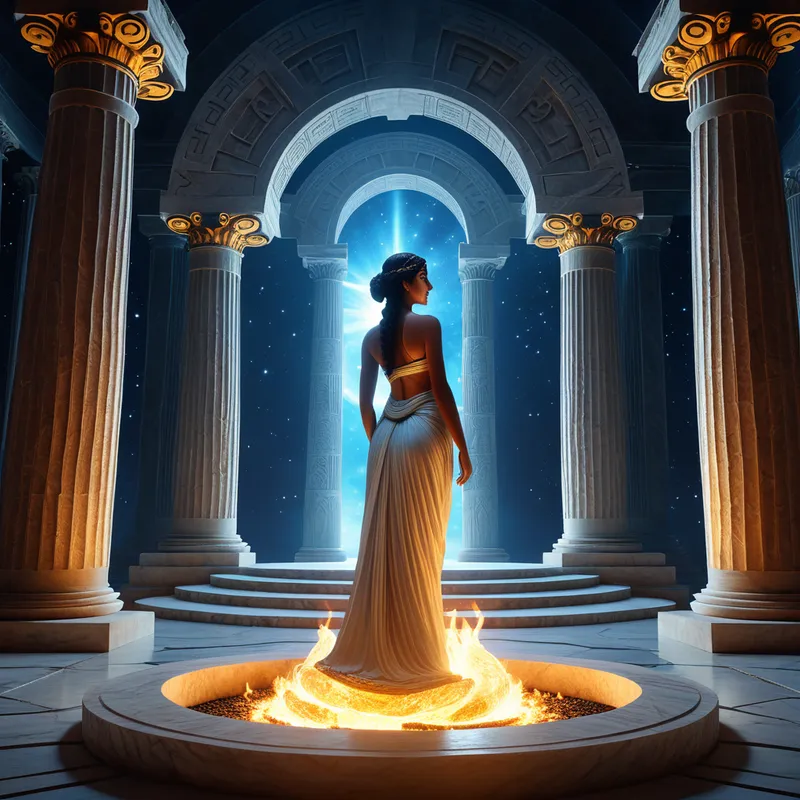
Hestia/Vesta's Hearth Myth Meaning & Symbolism
The myth of the first-born Olympian who chose the eternal, central hearth over power, becoming the sacred center of home, city, and cosmos.
The Tale of Hestia/Vesta's Hearth
In the beginning, there was a great swallowing. The Titan Kronos, fearing prophecy, consumed his children whole. One by one, the divine sparks—Demeter, Hades, Poseidon—were plunged into the dark belly of time. But the first-born, the quiet one, was the first to be taken. Her name was Hestia. She did not cry out; she held her light within, a single, unwavering ember in the absolute dark.
When the youngest, Zeus, forced the great regurgitation, the cosmos convulsed. The siblings erupted into the light, raw and roaring with newfound power, ready to claim their dominions. Thunder gathered around Zeus, the seas churned for Poseidon, the very earth groaned for Hades. But Hestia, first to enter the darkness, first to emerge, simply stepped aside. She felt no pull toward scepter or trident. She heard a different call—not to rule over, but to dwell within.
As her siblings raced to the edges of creation to stake their claims, Hestia walked to the very center of the newborn Olympus. There, with her own hands, she gathered stones. Not for a throne, but for a hearth. She knelt, and from the deepest part of her being, she breathed onto the kindling. A flame awoke—not a wild, consuming fire, but a steady, golden heart of light. Its warmth did not blaze; it radiated. It did not demand; it invited.
This hearth became the axis. To it came the powerful, smelling of ozone and salt, to warm their hands after governing the world. Here, Hera would sit in silence, her marital strife momentarily soothed. Here, weary Hephaistos would find a heat that did not burn. When a new god was welcomed to Olympus, or a mortal hero granted ambrosia, the offering was first made to Hestia’s flame. She asked for no temples of towering marble. Her sanctuary was the first fire lit in every new home, the public hearth in the prytaneion of every city-state. In Rome, they knew her as Vesta, and her flame, tended by the Vestal Virgins, was the very soul of the empire—its continuity, its safety, its sacred center. While empires rose and fell by the sword, her one duty never changed: to keep the fire alive.
Cultural Origins & Context
The myth of Hestia (Greek) and Vesta (Roman) is less a narrative of epic adventure and more a foundational cultural axiom. She appears not in grand episodic tales but in the opening lines of hymns, in the daily rituals of the household, and in the sacred laws of the state. Her story was passed down not by bards in mead-halls, but by mothers showing daughters how to tend the cooking fire, and by city magistrates performing the rites of the public hearth.
In Greece, Hestia was honored first in every sacrifice, with a simple libation poured into the family hearth. Her presence sanctified the oikos. In Rome, her cult was elevated to the highest state religion. The Temple of Vesta in the Forum housed her eternal flame, and its extinction was believed to portend disaster for Rome. The Vestals, chosen from noble families, served for thirty years, their celibacy a symbol of the inviolable, focused integrity required to maintain the center. Their person was sacrosanct; to harm them was to attack the heart of Rome itself. Thus, the myth functioned as the psychological and social bedrock: it encoded the absolute necessity of a maintained, sacred center for the survival of both family and civilization.
Symbolic Architecture
Hestia/Vesta represents the archetype of the Center. She is not the content of the home, but the container; not the drama of life, but the stage upon which it plays out. Her myth symbolizes the psychological need for an inner sanctum—a core of consciousness that remains calm, intact, and radiant amidst the chaos of internal and external conflicts.
The hearth is not the fire of passion, but the fire of presence. It is the flame that burns when all other identities are extinguished.
Her choice to relinquish an external throne for the central fire is the ultimate act of spiritual priority. It signifies the sacrifice of egoic power (the desire for dominion, recognition, and drama) for the sake of soulful integrity (wholeness, peace, and grounded being). The hearth fire is a symbol of consciousness itself—a single, fragile point of light that must be continually tended, protected, and fed. It is the "still point of the turning world," the internal altar where the sacred and the daily meet.
The Dreamer's Resonance
When this myth stirs in the modern unconscious, it often manifests in dreams of centers: a lone light in a vast darkness, a perfectly still room in a chaotic house, a warm, enclosed space (a closet, a cupboard) that feels profoundly safe. One may dream of tending a fire, of searching for a lost "home base," or of a calm, maternal figure who does not speak but simply is.
These dreams signal a somatic and psychological process of centering. The dreamer may be experiencing life as fragmented, pulled in too many directions, or devoid of a sense of inner peace. The psyche is initiating a return to the hearth. The dream is an instruction from the deep self: to stop the outward expansion, to withdraw from the periphery of one's commitments and identities, and to attend to the core. It is a call to practice the Vestal art—to protect one's inner sanctum, to sacrifice the fuel of external validation, and to nurture the simple, sustaining flame of one's own being.
Alchemical Translation
The alchemical process modeled by Hestia/Vesta is that of fixation—the operation that turns the volatile into the stable, creating the philosopher's stone at the center of the vessel. Our modern individuation journey is often obsessed with the magnum opus of transformation, heroism, and expansion. Hestia’s path is the crucial, often overlooked preceding stage: the creation of the vessel itself.
The first step is Recognizing the First-Born Self. This is the part of us that existed before our professional titles, relational roles, and accumulated traumas—the simple, essential "I am." Like Hestia, it is often swallowed by the Kronos of schedules, anxieties, and past conditioning.
Next is the Sacrifice of the Peripheral. This is the conscious, often difficult choice to decline a "throne"—a promotion that would scatter our energy, a drama that would consume our peace, an identity that moves us away from our center. We give up a form of power to claim a deeper authority.
Finally, we engage in the Eternal Tending. Individuation is not a one-time achievement but a daily ritual. The alchemical fire must not go out. This translates to modern practice as the non-negotiable daily return to center through meditation, journaling, walking in nature, or any practice that "feeds the hearth." It is the maintenance of a psychic temenos (sacred precinct) that remains inviolate.
The ultimate alchemy is not turning lead to gold, but discovering that the hearth at your center was gold all along.
In completing this process, we do not become rulers of an external kingdom, but the sovereigns of an inner one. We achieve what the ancients knew as pax deorum (the peace of the gods)—not the absence of conflict, but the unshakable presence of a sacred center that makes all of life, in its chaos and beauty, feel like home.
Associated Symbols
Explore related symbols from the CaleaDream lexicon: