Hero's Descent Myth Meaning & Symbolism
A universal myth of a hero's journey into the underworld to confront death, retrieve lost wisdom, and return transformed, symbolizing deep psychological rebirth.
The Tale of Hero's Descent
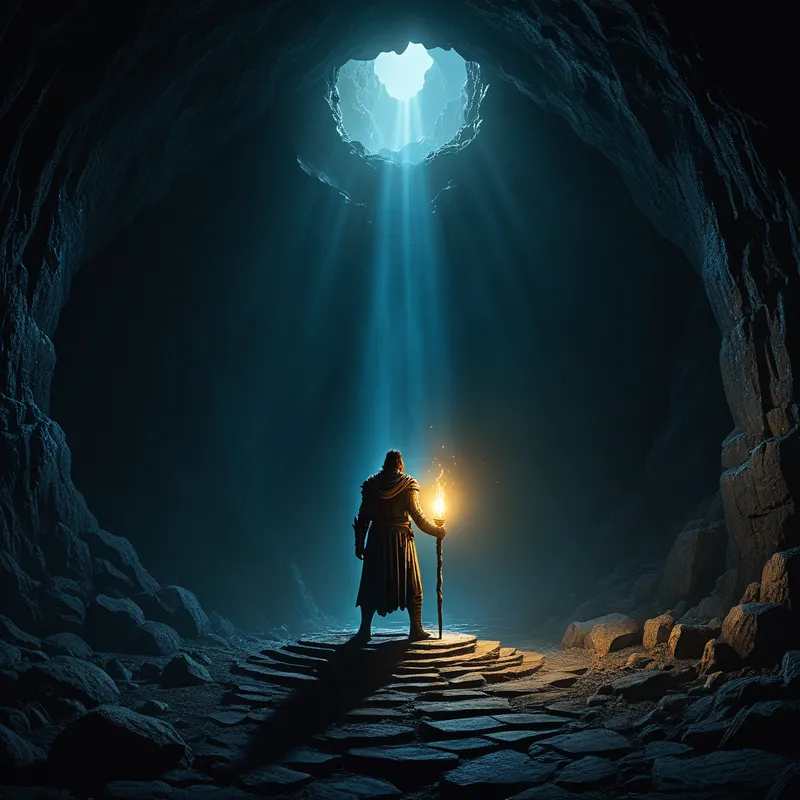
Listen. The world above grows pale and thin. The sun’s gold fades to memory, the songs of birds fall silent. This is the moment of turning, the hinge between worlds. The hero stands at the mouth of a crack in the earth—a cave, a tomb, a root-choked sinkhole. The air that breathes from it is cold and smells of damp stone and forgotten things. They have come here not for glory, but for necessity. A love has been stolen by silent riders. A truth has been swallowed by the earth. A part of their own soul has gone missing, and the world above is withering for its lack.
They descend. The last light of day is a coin shrinking to a pinprick, then gone. Darkness is not empty here; it is a substance, thick and watchful. Their torch, a tiny, defiant heart of flame, pushes back only a few paces of the gloom, revealing walls that sweat, tunnels that branch like arteries. The silence is broken by the drip of water counting eternity, by the skitter of things unseen. They pass rivers that flow without source, guarded by ferrymen whose eyes are hollow sockets. They meet shades—whispering, insubstantial crowds who reach with transparent hands, hungry for the warmth of memory.
The ruler of this place is not a monster of fang and claw, but a presence of profound stillness. Persephone, crowned in cold gems, holding a pomegranate like a stilled heart. Ereshkigal, naked in her power, radiating a terrifying, sterile sovereignty. Hades upon his shadowy throne, or Osiris, green-skinned and silent, judging the weight of hearts against a feather. The hero stands before this power, feeling their own vitality drain away, a candle guttering in a vast hall.
There is a confrontation. Not always with swords, but with words, with riddles, with raw presence. The hero must state their case, must hold their grief and purpose before a gaze that has seen a million souls pass into dust. They must bargain, often offering a piece of their time above, a promise, a part of themselves. Sometimes, they must simply sit, in the dust, and share the grief of the one who rules the dead. And in that sharing, a door opens.
They find what they seek—a beloved shade, a jewel of wisdom, a forgotten name. But the law of the deep is iron: nothing leaves unchanged. To take from the land of the dead, one must have tasted its fruit, must have lain upon its couch. The return is the final trial. The upper world seems an impossible distance. Pursuit may come—the clatter of hooves, the baying of hounds, a rising sense of dread that the light will be snatched away. They burst forth, or are cast forth, into the blinding, painful, glorious light of the living world. They are whole, and yet utterly new. They have returned, but they are no longer only of the sun. They carry the chill of the abyss in their bones, and its silent wisdom in their eyes.

Cultural Origins & Context
The descent motif is not the property of a single culture but a human constant, etched into our oldest stories. We find it in the Epic of Gilgamesh, where the king seeks his friend Enkidu in the House of Dust. It pulses in the Sumerian hymn of Inanna, who sheds her royal garments at each of the seven gates to stand naked before her sister Ereshkigal. It structures the Greek tales of Orpheus and Persephone, the Norse journey of Hermod to Hel, and the shamanic voyages recorded in cultures from Siberia to the Americas.
These stories were not mere entertainment. They were sacred narratives, performed ritually, often tied to cycles of agriculture, kingship, and initiation. To hear the story of the descent was to participate in a mystery. It explained the turn of the seasons (Persephone’s return), validated the authority of rulers who metaphorically conquered death (Gilgamesh), and provided a map for the soul’s journey after life (the Egyptian Book of the Dead). The storyteller—bard, priest, or shaman—was a psychopomp, guiding the community through a symbolic encounter with the ultimate unknown.
Symbolic Architecture
At its core, the descent is not a geographical journey but a psychological and spiritual one. The "underworld" is the unconscious, the realm of all we have repressed, forgotten, feared, or lost. The hero represents the conscious ego, that part of us which identifies with light, order, and known territory.
The descent is the ego’s necessary, terrifying pilgrimage into the country of the self it has disowned.
The stolen beloved (Eurydice, Enkidu, the sun god trapped in the Kur) symbolizes a vital psychic value—love, instinct, joy, creativity—that has been lost to the depths of trauma, neglect, or societal conditioning. The lord or lady of the dead is the archetypal ruler of this inner realm, often personifying the Great Mother in her transformative, devouring aspect, or the Senex, the principle of immutable law and structure. They are not "evil," but absolute. They represent the psyche’s own incorruptible truth, which cannot be flattered or fought with earthly weapons.
The act of sitting with the ruler, of sharing their grief or stillness, is the key. It symbolizes the ego’s surrender of its superiority, its willingness to be humbled and taught by the very forces it feared. The retrieved treasure is then the integrated complex: the reclaimed passion, the acknowledged shadow, the hard-won self-knowledge that can only be forged in darkness.
The Dreamer's Resonance
When this myth stirs in the modern dreamer, it announces a profound interior process. You may dream of basements flooding, of elevators plunging past their floors, of finding hidden rooms in your childhood home, or of being lost in subterranean tunnels. The somatic feeling is one of weight, pressure, and visceral dread—a literal "heavy heart."
This is the psyche initiating its own descent. The conscious mind may be experiencing a depression, a creative block, a life crisis, or a simple, nagging sense of emptiness. The dream underworld is the psyche’s workshop, where the broken pieces are gathered. To dream of meeting a dead relative or a mysterious, imposing figure in such a place is to encounter a aspect of your own inner truth or history. The process feels like a dissolution because it is. The old ego-structure, ill-equipped to handle the emerging material from the deep, must soften and yield.
The dream-descent is not a pathology, but a somatization of the soul’s gravity, pulling you toward your own missing center.
Alchemical Translation
In the alchemy of individuation—Jung’s term for psychic wholeness—the descent is the nigredo, the blackening. It is the essential first stage where the prima materia, the crude stuff of the personality, is plunged into darkness and seemingly ruined. All certainty rots away. This is not a mistake, but the operation itself.
The modern individual lives this when their career collapses, a relationship shatters, or a long-held identity proves false. The "heroic" task is not to climb out immediately, but to consent to the dark. It is to stop applying positive thinking as a bleach to the darkness and instead to ask, "What truth lives here, in this ruin?" The confrontation with the inner Hades or Ereshkigal is the moment of staring unflinchingly at one’s own depression, rage, or grief without seeking to pathologize or escape it.
The retrieved treasure is the lapis philosophorum, the philosopher’s stone of the Self. Translated, it is the newfound capacity to hold paradox: to be both light and dark, strong and vulnerable, mortal and eternal in essence. The one who returns from such a journey does not get their "old life" back. They are inaugurated into a larger life. They carry an authority that comes not from worldly power, but from having known the foundations of the world. They have met the ruler of the dead, and in doing so, have learned how to truly live.
The ultimate triumph of the descent is not in the retrieval of what was lost, but in the transformation of the one who dared to look for it.
Associated Symbols
Explore related symbols from the CaleaDream lexicon: