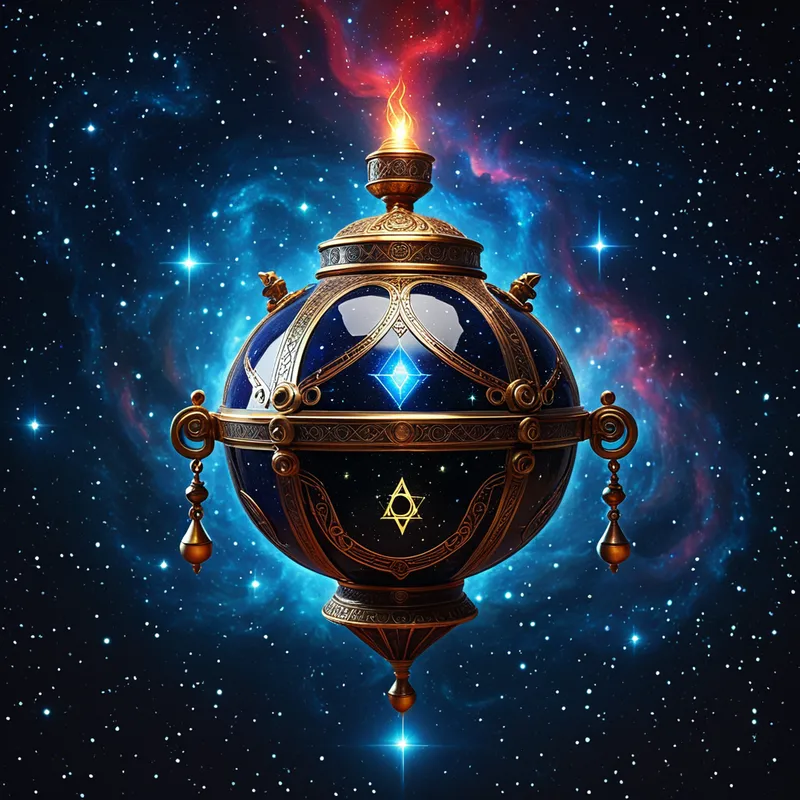
Hermetic Vessel Myth Meaning & Symbolism
The myth of the sealed vessel where opposing forces are contained, sacrificed, and ultimately united to birth a new, incorruptible state of being.
The Tale of the Hermetic Vessel
Listen, and I will tell you of the great work that is not done with hands, but with the soul. In the time before time was measured, when the world was a broth of potential, the Nous gazed upon the chaos of matter and spirit, forever at war. From this divine intellect stepped forth the figure of the Hermes Trismegistus, thrice-great, who saw that the world suffered from its own divisions.
He descended not to a mountain, but to the very workshop of existence. There, he did not gather elements, but the principles themselves: the volatile, ascending spirit, quick as quicksilver and hungry for the heavens; and the fixed, descending soul, heavy as lead and yearning for the earth. They raged against one another, a storm of contradiction—fire against water, king against queen, soul against spirit. Their conflict threatened to tear the fabric of the nascent world asunder, a perpetual civil war within the heart of creation.
Hermes knew he could not command them to peace. Such a union could not be forced, only invited within a sacred space of absolute necessity. So, from the silence at the center of his being, he fashioned a vessel. It was not of common clay or glass, but forged from the concept of boundary itself—a perfect, sealed Vas Hermeticum. Its walls were the unbreakable law of process; its seal was the will to become whole.
With a gesture that was both an act of compassion and immense daring, he drew the warring principles into the vessel. The spirit shrieked against its confinement, a bright, desperate flame. The soul groaned, a deep, tectonic pressure. Hermes sealed the vessel. Outside, all fell silent. Inside, a terrible and magnificent drama began.
Deprived of escape, denied the easy victory of destroying the other, the opposites were forced into a dreadful intimacy. The fire, with nothing else to consume, began to lick at the waters of the soul. The heavy waters, with nowhere to sink, began to drown the fire. This was the Nigredo, the profound blackness, the death of their old, separate natures. For ages within the vessel, they wrestled, dissolved, and decomposed into a uniform, primordial murk.
Yet, within that absolute darkness, a new tension was born—not of conflict, but of longing. From the ashes of their war, a subtle heat arose, not the fire of anger but the gentle, persistent warmth of incubation. This was the Albedo. A pearlescent light began to glow within the murk, a single tear of moonlight condensed from their shared suffering. The heat grew, becoming a radiant, golden dawn—the Citrinitas. Finally, from the heart of the golden glow, an impossible, stable, and everlasting ruby light burst forth—the Rubedo.
Hermes unsealed the vessel. What emerged was not two, but one: the Rebis, a being of serene, radiant unity. It was the child of the struggle, the Philosopher's Stone incarnate. The war was over, not by conquest, but by a marriage forged in the sealed dark. The vessel, now empty, remained—a silent testament to the law that holds the tension where transformation is born.
Cultural Origins & Context
The myth of the Hermetic Vessel is not a folktale with a single origin, but the foundational narrative of Western alchemy, a tradition spanning from Hellenistic Egypt through the Islamic Golden Age to the Renaissance courts of Europe. It was passed down not by bards, but through encrypted texts like the Tabula Smaragdina and the cryptic illustrations of Splendor Solis. Its tellers were philosophers, monks, and proto-scientists working in secret laboratories and scriptoriums.
Its societal function was dual. Exoterically, it provided a metaphorical framework for early chemical processes—distillation, fermentation, purification—guarding practical knowledge in allegory. Esoterically, and more profoundly, it served as a spiritual roadmap for a select few. In an age where the human psyche was often seen as a battleground between divine spirit and sinful flesh, the myth offered a third way: not rejection, but sacred containment and transmutation. It was a guide for the individual's "Great Work" of inner unification, promising that from the chaos of one's own nature, a state of spiritual incorruptibility could be born.
Symbolic Architecture
The myth is a perfect symbolic map of the psyche's journey toward wholeness. The warring King (Sol, Sulfur) and Queen (Luna, Mercury) represent the fundamental opposites within the human soul: conscious and unconscious, rational and intuitive, active and receptive, spirit and body. Their eternal conflict is the source of our neuroses, our inner civil war.
The Vessel is the conscious ego's most sacred and difficult task: not to act out the conflict, but to create a container strong enough to hold it.
The Vas Hermeticum itself is the central symbol. It represents the temenos, the sacred space of the therapeutic container, the focused attention of meditation, or the disciplined framework of any deep creative or psychological work. Its seal is the commitment to see the process through, refusing to let the tension escape prematurely into distraction or dissociation. The horrific Nigredo symbolizes the necessary descent into the shadow, depression, and the dissolution of the old personality—the "dark night of the soul." The subsequent stages (Albedo, Citrinitas, Rubedo) chart the gradual purification, illumination, and final integration, resulting in the Rebis—the Self, Jung's concept of the total, integrated personality.
The Dreamer's Resonance
When this myth stirs in the modern dreamer, it often manifests as dreams of crucial containment. You may dream of being sealed in a room, a pod, a diving bell, or a glass sphere during a storm. You might be caring for a volatile, sealed container in a lab, or trying to repair a cracked vase holding two different colored liquids. The somatic feeling is one of pressurized incubation—a sense of being "in the works," where external action is impossible but internal activity is frenetic.
Psychologically, this dream pattern signals that the ego is attempting to perform the vessel's function. A powerful inner tension—perhaps between a career ambition (King) and a need for relationship (Queen), or between a rigid belief and a emerging intuition—has reached a critical mass. The psyche is forcing a coniunctio oppositorum (union of opposites) by symbolically sealing you in. The dream is an expression of the Self's autoregulatory process, initiating a necessary period of introversion, suffering, and inner alchemy to prevent a destructive outward enactment of the conflict.

Alchemical Translation
For the modern individual, the myth models the non-linear, often painful process of individuation—becoming who you fundamentally are. Our instinct is to identify with one pole of our inner opposites and reject the other (e.g., "I am spiritual, not material"). Or, we let the conflict play out chaotically in our lives through indecision, procrastination, or sabotaging relationships.
The alchemical instruction is clear: we must become the vessel. This means developing the psychological capacity to hold our contradictions without immediately reacting to them. In practice, this could be:
- In meditation, observing angry thoughts without becoming them.
- In therapy, exploring a painful memory without fleeing into rationalization.
- In a creative block, sitting with the frustration instead of abandoning the project.
- In a relationship conflict, containing the urge to blame and instead feeling the full complexity of your own position and your partner's.
The birth of the new consciousness is always preceded by the death of the old in the sealed dark. There is no shortcut around the Nigredo.
The "seal" is our conscious commitment to this process—a vow to stay with the discomfort, the doubt, and the darkness until it transforms of its own accord. The triumphant emergence of the Lapis Philosophorum is not the acquisition of a magical power, but the realization of a steadfast, resilient, and compassionate consciousness that has integrated its own warring natures. You are no longer ruled by the conflict; you are the space in which it transforms, the vessel that made the stone.
Associated Symbols
Explore related symbols from the CaleaDream lexicon: