Hermes' Talariaand Caduceus Myth Meaning & Symbolism
The myth of the messenger god's winged sandals and serpent-entwined staff, symbols of swift movement, healing, and the alchemy of opposites.
The Tale of Hermes’ Talariaand Caduceus
Before the first rooster crowed, in the deep violet hour when night clings to [the world](/myths/the-world “Myth from Tarot culture.”/)’s edge, he was born. Not in a palace of cloud, but in a shadowy cave on Mount Cyllene. His mother, the starry nymph Maia, slept, exhausted. But the infant [Hermes](/myths/hermes “Myth from Global/Universal culture.”/) did not cry. His eyes, old as the roads, opened and saw [the world](/myths/the-world “Myth from Tarot culture.”/) not as a crib, but as a frontier.
He slipped from his swaddling bands, a laugh like wind chimes escaping his lips. His feet, touched with a divine itch, carried him to [the cave](/myths/the-cave “Myth from Platonic culture.”/)’s mouth. There, he saw a [tortoise](/myths/tortoise “Myth from Greek culture.”/), slow and ancient. A spark, a flash of cunning—the first creative theft. With a god’s effortless skill, he hollowed the shell, strung it with gut, and invented the first lyre. Its music was the sound of possibility itself.
But the itch in his feet grew. It was a hunger for [the horizon](/myths/the-horizon “Myth from Various culture.”/). He left the cave and found the sun-drenched pastures of Apollo, where fifty sacred cattle lowed. With a cleverness that bent perception, Hermes drove them backwards, weaving a spell so their hoofprints pointed toward the cave, not away. He slaughtered two, offering a portion to the gods—a gesture of startling diplomacy from a thief—and hid the rest.
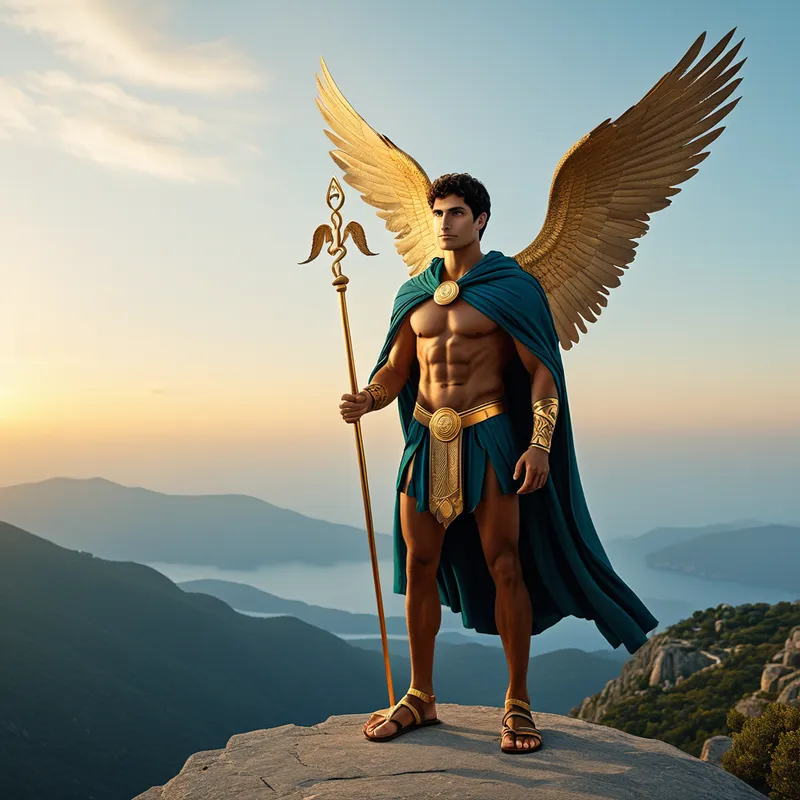
When the furious Apollo, his divine sight piercing the deception, confronted the babe in the cradle, Hermes did not deny. Instead, he offered the lyre. The moment Apollo’s fingers touched the strings, his anger melted into awe. The conflict was resolved not by force, but by an exchange of gifts. In recognition of his son’s unparalleled speed and guile, Zeus bestowed upon him two sacred objects: the [Talaria](/myths/talaria “Myth from Greek culture.”/), sandals forged with golden wings that granted flight over land and sea, and the Caduceus, a [herald](/myths/herald “Myth from Greek culture.”/)’s staff.
Yet this was no ordinary rod. In one version of his tale, Hermes came upon two serpents locked in mortal combat. Thrusting his staff between them, he did not kill, but mediated. The serpents ceased their strife, winding themselves around the wood in a helix of reconciled opposition. Thus, the messenger was equipped: wings for the journey, and the entwined serpents for the message itself.
Cultural Origins & Context
The myths of Hermes are among the oldest strata of Greek storytelling, emerging from a pre-Olympian world of boundary stones, roadside markers, and the deep, human anxiety about transitions. He was the god of the herm, a simple stone pile that marked [the threshold](/myths/the-threshold “Myth from Folklore culture.”/) between one field and the next, one town and another, the known and the unknown. His stories were not confined to grand epic but lived in the daily travels of merchants, the clever retorts of shepherds, and the sudden, unexpected luck of a find.
These tales were passed down in a fluid oral tradition, told at crossroads and in marketplaces. They served a vital societal function: Hermes embodied the necessary skills for survival in an interconnected world. He was the patron of commerce (requiring communication), diplomacy (requiring cunning), and travel (requiring protection). His myths taught that the rigid, hierarchical order of Zeus or the fiery truth of Apollo could be navigated, even manipulated, through wit, speed, and a willingness to exchange. He was the divine principle of the deal, the connection, and the lucky break.
Symbolic Architecture
The Talaria and [Caduceus](/symbols/caduceus “Symbol: A winged staff entwined by two serpents, symbolizing healing, commerce, and divine messenger status.”/) are not mere tools; they are a complete symbolic [system](/symbols/system “Symbol: A system represents structure, organization, and interrelated components functioning together, often reflecting personal or social order.”/) for the [psyche](/myths/psyche “Myth from Greek culture.”/) in [motion](/symbols/motion “Symbol: Represents change, progress, or the flow of life energy. Often signifies transition, personal growth, or the passage of time.”/). The Talaria represent the liberation of [consciousness](/symbols/consciousness “Symbol: Consciousness represents the state of awareness and perception, encompassing thoughts, feelings, and experiences.”/) from the heavy, literal ground of habit and fixed [identity](/symbols/identity “Symbol: Identity represents the sense of self, encompassing personal beliefs, cultural background, and social roles.”/). They are the [capacity](/symbols/capacity “Symbol: A measure of one’s potential, limits, or ability to contain, process, or achieve something, often reflecting self-assessment or external demands.”/) for swift thought, for psychological mobility, for seeing one’s [life](/symbols/life “Symbol: The symbol of ‘Life’ represents a journey of growth, interconnectedness, and existential meaning, encompassing both the joys and challenges that define human experience.”/) from a higher, more objective vantage point.
The winged sandal is the soul’s sudden ability to depart from the scene of its own suffering, to gain perspective where once there was only immersion.
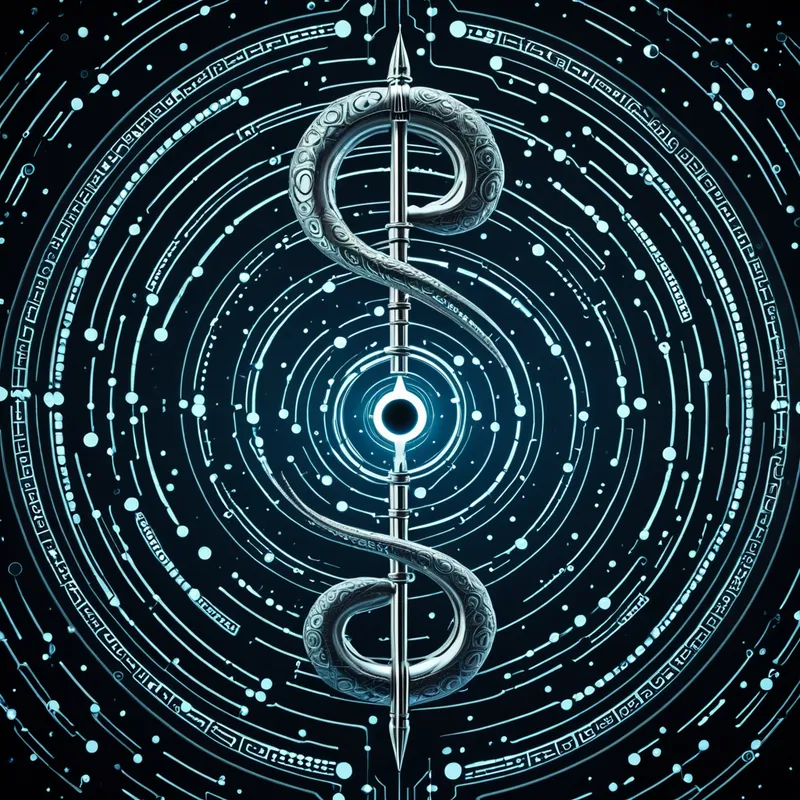
[The Caduceus](/myths/the-caduceus “Myth from Greek culture.”/) is far more complex. The staff itself is the [axis](/symbols/axis “Symbol: A central line or principle around which things revolve, representing stability, orientation, and the fundamental structure of reality or consciousness.”/) mundi, the central, stabilizing pillar of [the self](/myths/the-self “Myth from Jungian culture.”/). The two serpents are the primal opposites that define [human](/symbols/human “Symbol: The symbol of a human represents individuality, complexity of emotions, and social relationships.”/) experience: [body](/symbols/body “Symbol: The body in dreams often symbolizes the dreamer’s self-identity, personal health, and the relationship they have with their physical existence.”/) and [spirit](/symbols/spirit “Symbol: Spirit symbolizes the essence of life, vitality, and the spiritual journey of the individual.”/), conscious and unconscious, life and [death](/symbols/death “Symbol: Symbolizes transformation, endings, and new beginnings; often associated with fear of the unknown.”/), poison and [medicine](/symbols/medicine “Symbol: Medicine symbolizes healing, transformation, and the pursuit of knowledge, addressing both physical and spiritual health.”/). Their combat is the inner conflict that tears us apart. Hermes’ act is not to choose a side, but to introduce a third [thing](/myths/thing “Myth from Norse culture.”/)—the mediating staff. The resulting entwined [helix](/symbols/helix “Symbol: A spiral structure representing evolution, growth, and the fundamental patterns of life and consciousness.”/) is the [symbol](/symbols/symbol “Symbol: A symbol can represent an idea, concept, or belief, serving as a powerful tool for communication and understanding.”/) of dynamic [equilibrium](/symbols/equilibrium “Symbol: A state of balance, stability, or harmony between opposing forces, often representing inner peace or external order.”/), of healed duality. It is the very [pattern](/symbols/pattern “Symbol: A ‘Pattern’ in dreams often signifies the underlying structure of experiences and thoughts, representing both order and the repetitiveness of life’s situations.”/) of DNA, of the nervous system, and of reconciled conflict becoming the [source](/symbols/source “Symbol: The origin point of something, often representing beginnings, nourishment, or the fundamental cause behind phenomena.”/) of vitality and wholeness. This is why, through a later syncretism, [the Caduceus](/myths/the-caduceus “Myth from Greek culture.”/) became an [emblem](/symbols/emblem “Symbol: A symbolic design representing identity, authority, or ideals, often used in heraldry, logos, or artistic expression.”/) of healing—not the healing that eliminates [disease](/symbols/disease “Symbol: Disease represents turmoil, issues of control, or unresolved personal conflicts manifesting as physical or emotional suffering.”/), but the healing that integrates [shadow](/symbols/shadow “Symbol: The ‘shadow’ embodies the unconscious, repressed aspects of the self and often represents fears or hidden emotions.”/).
The Dreamer’s Resonance
When these symbols surface in modern dreams, the dreamer is at a psychological threshold. To dream of winged shoes, especially if one is wearing them or they are beckoning, signals a powerful urge for escape or a necessary psychological flight. It may feel like an imperative to “rise above” a stagnant situation, a toxic argument, or a depressive state. The somatic sensation is often one of lightness, tingling in the feet, or the thrilling vertigo of potential movement.
To dream of the entwined serpents, particularly around a central rod or spine, indicates a process of deep inner negotiation. The dreamer is likely caught between two irreconcilable demands, identities, or loyalties. The dream presents the Caduceus as the potential solution: not victory for one side, but the creation of a new, more complex structure that can hold the tension. This can manifest somatically as a feeling of central alignment, a release of tension in the spine, or the resolution of a psychosomatic symptom that originated from internal conflict. The dream Hermes arrives when we need to deliver a difficult message to ourselves, or when we must find a clever path through an impossible bind.

Alchemical Translation
In the alchemical journey of individuation, the myth of Hermes models the crucial “Mercurial” phase. This is not the hero’s brutal conquest, but [the trickster](/myths/the-trickster “Myth from Various culture.”/)’s intelligent navigation. The process begins with the theft—the recognition and claiming of one’s own innate, perhaps hidden, talents (the lyre from the tortoise). This is an act of self-birth, often against the inertia of one’s upbringing.
The ensuing conflict with Apollo represents the clash with the established, brilliant, but sometimes tyrannical order of one’s own conscious values or superego. The alchemical [triumph](/myths/triumph “Myth from Roman culture.”/) is the gift exchange: the raw, stolen instinct (the cattle) is transformed and offered as a creative work (the lyre), which in turn pacifies and enriches the ruling consciousness. Psychic energy is circulated, not hoarded.
Individuation is not a war won, but a negotiation successfully concluded, where opposing forces agree to a treaty that benefits the entire psyche.
Finally, the bestowal of the Talaria and Caduceus signifies the internalization of this mercurial function. The individual gains the permanent capacity for psychological travel (insight, reflection, perspective) and the sacred tool for mediating all future inner conflicts. The healed serpents on the staff represent the ultimate alchemical goal: the coniunctio oppositorum, the marriage of opposites, where what was once divisive poison becomes the circulating elixir of a more complete, fluid, and resilient self. One becomes, in essence, one’s own messenger, healer, and guide across life’s endless thresholds.
Associated Symbols
Explore related symbols from the CaleaDream lexicon: