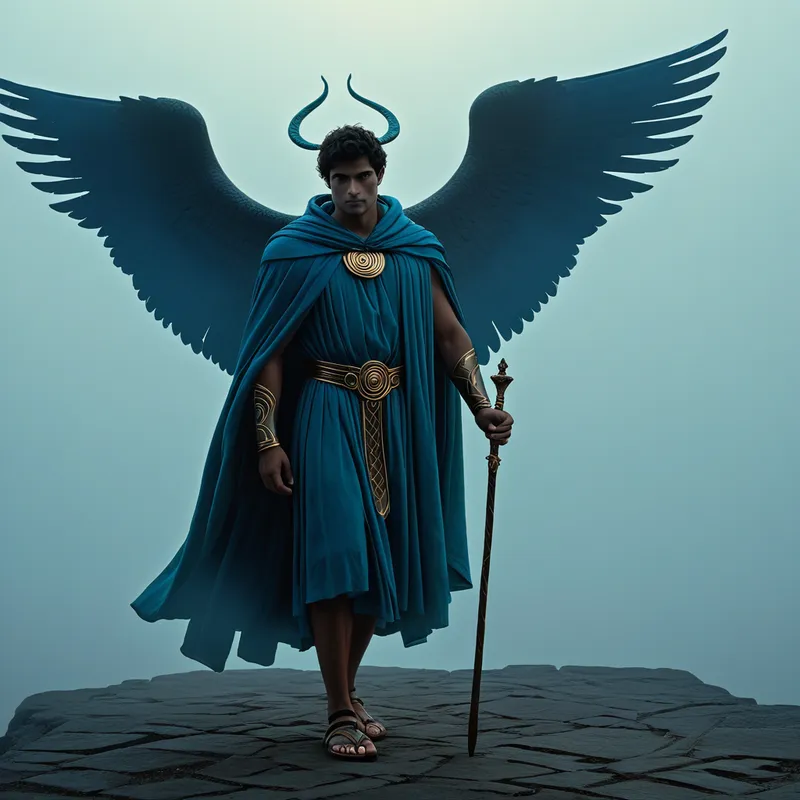
Hermes Psychopomp Myth Meaning & Symbolism
The myth of Hermes, the winged messenger who guides departed souls to the Underworld, embodying the principle of transition, communication, and the liminal journey.
The Tale of Hermes Psychopomp
Listen, and let the fire’s glow carry you to a place that is and is not. It is the hour when the sun has drowned in the wine-dark sea, and the world holds its breath between day and night. This is the hour of Hermes.
He moves not with the thunder of his brother Zeus, nor the earth-shaking tread of Hades. His step is a whisper on dusty roads, a rustle in the olive groves. On his feet are the talaria, wings beating a silent rhythm against his ankles. In his hand is the caduceus, a staff that can charm awake or lull to sleep. His broad-brimmed traveler’s hat, the petasos, shadows a face that is young and old, kind and remote.
He is called. Not by a shout, but by a cessation—the last sigh leaving a body, the final beat of a heart grown still. In the dim room, where mourners weep and oil lamps flicker, something new and fragile stirs. It is the psyche, untethered, a wisp of memory and fear, clinging to the familiar scent of home.
And he is there. A presence at the threshold, neither inside nor out. He does not startle. His voice, when it comes, is like the sound of a distant stream. “It is time,” it seems to say, though his lips may not move. “The road awaits.”
The newly dead soul looks upon him—this graceful, ambiguous figure—and feels not terror, but a profound recognition. This is the Guide. The One Who Crosses Over. The Psychopomp.
Together, they step into the deepening twilight. The solid world of the upper world begins to soften at its edges. Colors drain to shades of grey and silver. The path is no longer a road of stone and dirt, but a way of intention, leading always downward, toward the realm of Hades.
They pass the weeping leuke trees, their leaves whispering forgotten names. They come to a shore where mist coils like serpents on the black water. This is the Acheron, or perhaps the Cocytus. A boat, old and grey as driftwood, waits. The ferryman, Charon, eyes the soul, then the god. Hermes offers the traditional obol—a small, cold coin for passage. The transaction is silent, sacred.
Across the water lies the final gate, guarded by the great, three-headed hound Cerberus. The beast growls, a sound that echoes in the chest of the living and the dead alike. But Hermes raises his caduceus. The serpents seem to stir. He speaks a word, or perhaps simply exudes an authority that even the guardian of the dead must heed. The way opens.
With a final, gentle gesture, Hermes presents the soul to the vast, silent halls of Hades. His task is complete. He does not linger in the land of the dead. He turns, and with the same effortless grace, retraces his steps—back through the gate, past the silent ferry, up the fading path—returning to the world of the living, of messages, of thieves and travelers, of the lively, thrumming boundary between all things. He is already gone, a shimmer in the air, leaving the soul to its new, eternal home.

Cultural Origins & Context
The figure of Hermes Psychopomp is woven into the very fabric of ancient Greek thought on death, a process managed not by a single, grim reaper, but by a nuanced divine bureaucracy. This role is not his only function—he is also the god of boundaries, commerce, luck, and cunning—but it is perhaps his most profound. The myths were not centralized scripture but a living tradition, passed down by poets like Homer and Hesiod, elaborated in hymns, and depicted on countless funeral lekythoi.
His psychopomp function served a critical societal and psychological need. The Greek view of the afterlife was often bleak and shadowy; the journey to the Asphodel Meadows was fraught with peril. Hermes provided a necessary escort, ensuring the soul did not become a lost, wandering, and potentially vengeful spirit—a phasma. His guidance ritualized the transition, offering comfort to the living that their loved one was not abandoned at the ultimate threshold. He was the divine diplomat, smoothing the passage between the realms of Zeus and Hades, maintaining the cosmic order.
Symbolic Architecture
Hermes Psychopomp is the archetypal embodiment of the liminal—the in-between space where transformation occurs. He is not the origin nor the destination, but the essential process of movement itself.
He is the principle that no state is final, that every ending contains the seed of a passage, and every threshold demands a guide.
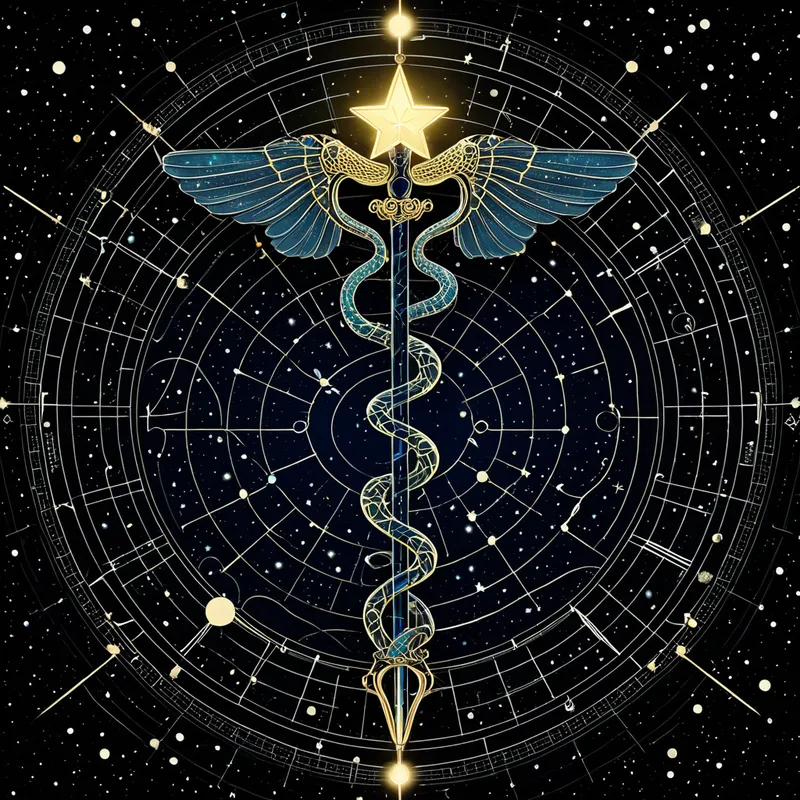
His symbols are a lexicon of transition: the caduceus (reconciliation of opposites, healing), the talaria (speed, transcendence of earthly limits), and the petasos (protection in unknown lands). As Psychopomp, he represents the part of the psyche that can navigate deep, unconscious territory—the personal Hades of repressed memories, trauma, and forgotten potential. He does not fight the darkness; he converses with it, pays its toll, and secures safe passage. He is the function of consciousness that can approach the shadow without being consumed by it, facilitating an inner dialogue between the ego and the contents of the unconscious.
The Dreamer’s Resonance
When the archetype of the Psychopomp stirs in modern dreams, it often manifests during periods of profound life transition: the end of a relationship, a career change, a spiritual crisis, or the processing of grief. The dreamer may find themselves in labyrinthine spaces—empty subways, endless hallways, or fog-bound landscapes. The appearance of a guide figure is key: it may be a mysterious stranger, a known person acting out of character, or even an animal that leads the way.
The somatic experience is one of liminal anxiety mixed with a pull forward. There is the fear of the unknown, of the “death” of an old identity, coupled with a deep, intuitive knowledge that one must keep moving. The Psychopomp dream does not offer solutions; it offers direction. It confirms that the dreamer is in a process, and that the psyche itself is providing the escort service through its own underworld. The resolution comes not from escaping the journey, but from the act of following.

Alchemical Translation
For the individual engaged in the process of individuation, the myth of Hermes Psychopomp models the essential art of psychic navigation. The “soul” that needs guiding is any complex, charged, or buried content of the unconscious—a childhood wound, a denied talent, a powerful emotion like rage or sorrow.
The alchemical work is not to slay the inner Cerberus, but to learn the word or gesture that allows one to pass by with respect.
First, one must acknowledge the “death”—the end of an old attitude or self-concept. Then, invoking the Hermetic function, we consciously escort this content to the threshold of awareness. This is the “payment of the obol”—the offering of conscious attention and respect. We listen to the lament by the riverbank (confront the emotion), we confront the guardian of the gate (face the resistance), and with the caduceus of reconciling insight, we integrate this lost soul into the broader ecology of the self.
The triumph is not in reaching a heavenly Elysium, but in completing the journey itself. Hermes always returns to the world above, enriched by the journey below. So too, after navigating a deep inner transition, the individual returns to daily life not as they were, but as someone who has successfully traversed the shadowlands and gained the wisdom of the guide. They become, in a sense, their own Psychopomp.
Associated Symbols
Explore related symbols from the CaleaDream lexicon: