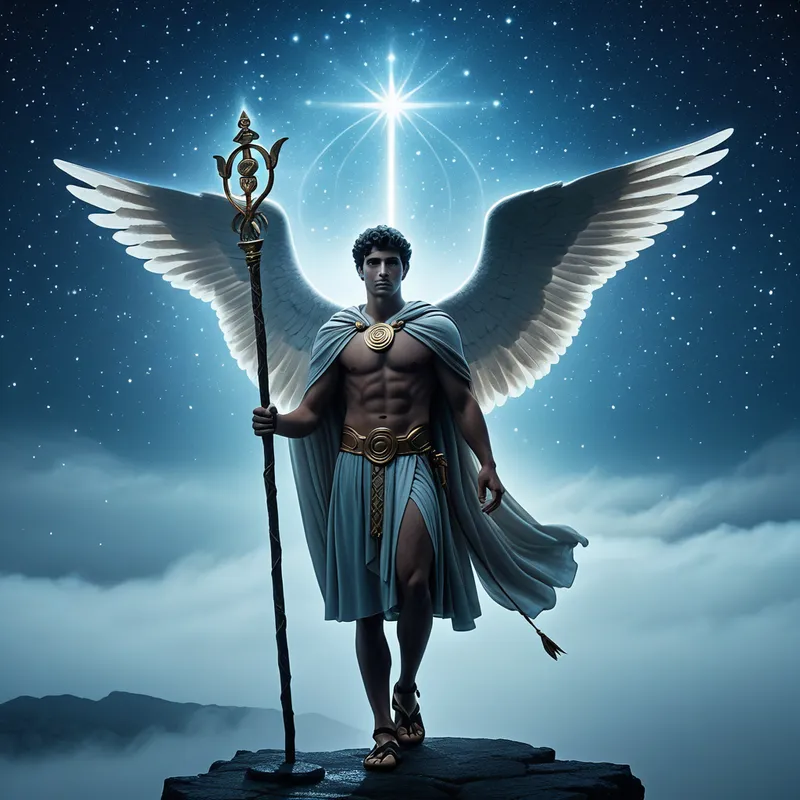
Hermes as Psychopomp Myth Meaning & Symbolism
The myth of the winged messenger who guides the newly dead through the liminal darkness to the shores of the afterlife.
The Tale of Hermes as Psychopomp
Listen. The air grows still. The final breath, a sigh that is not a sigh, escapes the lips and hangs in the space between the living and the dead. It is in this silence, thick as wool and cold as a mountain stream, that he arrives.
You do not hear his step, for the sandals on his feet are winged, whispering over [the threshold](/myths/the-threshold “Myth from Folklore culture.”/) of [the world](/myths/the-world “Myth from Tarot culture.”/). You only feel a shift, a gentle pressure in the atmosphere, like the air before a storm. He is there, a presence both young and ancient. A traveler’s cloak drapes his shoulders, and in his hand, he carries the caduceus—not a weapon, but a key, its twin serpents asleep in the wood.
He does not speak with a mortal tongue. His voice is the rustle of olive leaves, the distant chime of a bell on a stray goat, the echo in a [labyrinth](/myths/labyrinth “Myth from Various culture.”/). “Come,” it says, not as a command, but as an invitation to a journey long written in the stars. The newly dead soul, a wisp of memory and fear, clings to the fading warmth of [the hearth](/myths/the-hearth “Myth from Norse culture.”/), the scent of [thyme](/myths/thyme “Myth from Greek culture.”/), the touch of a hand. It is lost, a coin dropped in deep [water](/myths/water “Myth from Chinese culture.”/).
[Hermes](/myths/hermes “Myth from Global/Universal culture.”/) reaches out. His touch is cool, not cold. It is the touch of moonlight on stone. “The road is waiting,” his silence says. And he turns, and the soul, compelled by a gravity older than grief, follows.
Together, they step into the liminal. The familiar walls of the home dissolve into gray mist. The ground beneath becomes uncertain, a path known only to the guide. They walk through shadows that are not cast by any sun, through whispers that are the echoes of a million other farewells. This is the Hodos Chthonia, [the Earth](/myths/the-earth “Myth from Hindu culture.”/)-Road, and it winds through the roots of the world.
The soul may tremble, remembering the stories of the Cerberus, of judges and torments. Hermes does not offer false comfort. He offers presence. [The caduceus](/myths/the-caduceus “Myth from Greek culture.”/) in his hand casts a soft, silver light, just enough to see the next step, a circle of safety in the formless dark. He is the companion in the ultimate solitude.
At last, the sound of water—slow, deep, and endless. [The mist](/myths/the-mist “Myth from Celtic culture.”/) parts to reveal the black expanse of the Acheron, or perhaps the Cocytus. On the far shore, shapes move in a perpetual twilight. And there, at the water’s edge, the ferry waits. The boatman, Charon, eyes like chips of obsidian, holds out a skeletal hand for the coin.
Hermes, the intermediary, the diplomat of gods and ghosts, ensures the passage is paid. He delivers the soul to the boat with a final, slight nod—a blessing, a completion of contract. His work is not to judge, nor to console, but to deliver. As the ferry pushes off into the current, Hermes stands on the bank, already fading back into the mist from which he came. His task is complete. Another soul has been escorted from the shore of life to the shore of death. He turns, and the darkness swallows him, until the next breath hangs in the air, and he is needed once more.

Cultural Origins & Context
The figure of Hermes as [psychopomp](/myths/psychopomp “Myth from Greek culture.”/) is a foundational strand in the complex tapestry of Greek mythology, emerging from a culture deeply preoccupied with proper rites and the fate of the soul. This role is not his only function—he is also the god of thieves, commerce, language, and travel—but it is perhaps his most profound. The myths were not formal scriptures but living stories, passed down by bards and woven into epic poetry like [Homer](/myths/homer “Myth from Greek culture.”/)’s Odyssey, where Hermes is sent to guide the slain suitors to [Hades](/myths/hades “Myth from Greek culture.”/).
His function as psychopomp served a critical societal and psychological need. In a world without a single, dogmatic doctrine of the afterlife, the journey to Hades was fraught with peril. A soul unburied, un-mourned, or unguided was thought to wander eternally, a restless and potentially vengeful shade. Hermes’ guided passage provided a ritual structure for death itself. He personified the community’s duty to ensure a proper transition, transforming a chaotic, terrifying event into a navigable process with a divine escort. He was the mythic assurance that even in the ultimate unknown, one did not have to go alone.
Symbolic Architecture
At its core, the myth of [Hermes Psychopomp](/myths/hermes-psychopomp “Myth from Greek culture.”/) is a masterful symbolic map of transition. Hermes himself is the embodiment of the liminal. He belongs neither wholly to [Olympus](/symbols/olympus “Symbol: In Greek mythology, Mount Olympus is the divine home of the gods, representing ultimate power, perfection, and spiritual transcendence.”/) nor to [Hades](/symbols/hades “Symbol: Greek god of the underworld, representing death, the unconscious, and hidden aspects of existence.”/), but operates in the [space](/symbols/space “Symbol: Dreaming of ‘Space’ often symbolizes the vastness of potential, personal freedom, or feelings of isolation and exploration in one’s life.”/) between. His symbols are all tools of [connection](/symbols/connection “Symbol: Connection symbolizes relationships, communication, and bonds among individuals.”/) and transition: the winged sandals (speed between realms), the [traveler](/symbols/traveler “Symbol: A person on a journey, representing movement, transition, and the search for new experiences or self-discovery.”/)’s hat (invisibility/adaptability), and the [caduceus](/symbols/caduceus “Symbol: A winged staff entwined by two serpents, symbolizing healing, commerce, and divine messenger status.”/) (a staff of negotiation and healing, later confused with [the rod of Asclepius](/myths/the-rod-of-asclepius “Myth from Greek culture.”/)).
The psychopomp does not create the journey; he makes it conscious. He is the personification of awareness in the midst of life’s most profound change.
Psychologically, Hermes represents the guiding function of the [psyche](/myths/psyche “Myth from Greek culture.”/) itself when faced with a major [death](/symbols/death “Symbol: Symbolizes transformation, endings, and new beginnings; often associated with fear of the unknown.”/)—not just physical death, but the death of an [identity](/symbols/identity “Symbol: Identity represents the sense of self, encompassing personal beliefs, cultural background, and social roles.”/), a [relationship](/symbols/relationship “Symbol: A representation of connections we have with others in our lives, often reflecting our emotional state.”/), a [career](/symbols/career “Symbol: The dream symbol of ‘career’ often represents one’s ambitions, goals, and personal identity in a professional context.”/), or a deeply held belief. He is the inner [capacity](/symbols/capacity “Symbol: A measure of one’s potential, limits, or ability to contain, process, or achieve something, often reflecting self-assessment or external demands.”/) to navigate uncertainty, to find the [path](/symbols/path “Symbol: The ‘path’ symbolizes a journey, choices, and the direction one’s life is taking, often representing individual growth and exploration.”/) through [grief](/symbols/grief “Symbol: A profound emotional response to loss, often manifesting as deep sorrow, yearning, and a sense of emptiness.”/), depression, or existential [confusion](/symbols/confusion “Symbol: A state of mental uncertainty or disorientation, often reflecting internal conflict, lack of clarity, or overwhelming choices in waking life.”/). The Hades he guides us to is not a place of [punishment](/symbols/punishment “Symbol: A dream symbol representing consequences for actions, often tied to guilt, societal rules, or internal moral conflicts.”/), but the unconscious itself—the [realm](/symbols/realm “Symbol: The symbol of ‘Realm’ often signifies the boundaries of one’s consciousness, experiences, or emotional states, suggesting aspects of reality that are either explored or ignored.”/) of [shadow](/symbols/shadow “Symbol: The ‘shadow’ embodies the unconscious, repressed aspects of the self and often represents fears or hidden emotions.”/), forgotten [memory](/symbols/memory “Symbol: Memory symbolizes the past, lessons learned, and the narratives we construct about our identities.”/), and potential [rebirth](/symbols/rebirth “Symbol: A profound transformation where old aspects of self or life die, making way for new beginnings, growth, and renewal.”/). The coin for Charon symbolizes the necessary [payment](/symbols/payment “Symbol: Symbolizes exchange, obligation, and value. Represents what one gives to receive something in return, often tied to fairness, debt, or spiritual balance.”/), the conscious sacrifice or acknowledgment we must offer to cross from one state of being into another.
The Dreamer’s Resonance
When this myth activates in the modern dreamscape, it often signals a profound interior transition. To dream of a guide in a misty landscape, of crossing a threshold or a dark river, is to experience [the psychopomp](/myths/the-psychopomp “Myth from Various culture.”/) archetype at work. The guide in the dream may not look like Hermes; it could be a stranger, an animal, a known figure, or simply a compelling presence.
Somatically, this process can feel like a low-grade fever of the soul—a sense of being betwixt and between, ungrounded, and disoriented. Psychologically, it is [the ego](/myths/the-ego “Myth from Jungian culture.”/)’s experience of dissolution as an old self-structure dies. The dream guide appears precisely because the conscious mind is lost. The Hermes function emerges from the deeper psyche to provide a holding presence, ensuring the dreamer does not become trapped in the limbo of their own resistance. The journey in the dream is rarely comfortable, but the presence of the guide implies a deep, instinctual process is underway, moving essential psychic material from one state to another.
Alchemical Translation
The alchemical opus, the journey of individuation, is mirrored perfectly in Hermes’ nightly task. Individuation requires a series of deaths and rebirths, a descent into the massa confusa of the unconscious to retrieve and integrate lost parts of [the self](/myths/the-self “Myth from Jungian culture.”/).
To be guided is not to be spared the journey. It is to have the journey made meaningful.
In this inner work, we are both the bewildered soul and the god who guides. First, we must experience the death—the ending, the loss, the crushing doubt. We must feel the cold mist of the liminal and the terror of the unformed path. This is the [nigredo](/myths/nigredo “Myth from Alchemical culture.”/). Then, we must call upon, or rather, allow the Hermes within to activate. This is the part of us that can observe the process with curiosity rather than panic, that can hold the caduceus of paradoxical insight (the entwined serpents of conscious and unconscious) to light the next step.
The payment to Charon is the crucial act of conscious sacrifice—letting go of an old attitude, a cherished grievance, a comfortable story about ourselves. Without this payment, we circle the shore forever. Hermes’ role is to facilitate that transaction, to ensure the passage is valid. His final delivery of the soul to the ferry is the moment of surrender, where we commit to the currents of the deep psyche, trusting that the journey itself is the transformation. We cross our own Acheron not to be punished, but to be reconstituted on the far shore, where the work of understanding—the audience with the rulers of the inner world—can begin. In this way, the myth becomes an eternal model: every ending, properly guided and consecrated, contains the seed of a new beginning.
Associated Symbols
Explore related symbols from the CaleaDream lexicon: