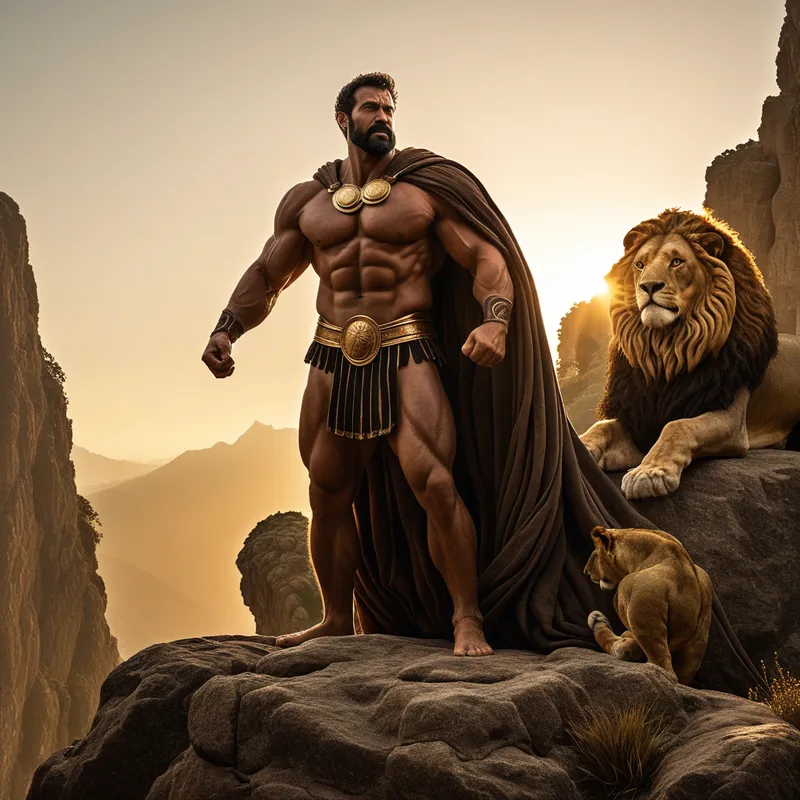
Hercules Myth Meaning & Symbolism
A demigod's epic atonement for a crime of madness, transforming monstrous labors into the ultimate journey of self-mastery and apotheosis.
The Tale of Hercules
Hear now the tale of the strongest man who ever lived, a tale written not in ink, but in sweat, blood, and stars. It begins not with glory, but with a divine grudge. From his first breath, the son of Zeus and the mortal Alcmene was marked for death by the Queen of Heaven, Hera. She sent serpents to his crib, which the infant Hercules strangled with laughing hands. Thus was his strength foretold.
He grew into a hero of might and fury, yet Hera’s poison seeped into his mind. In a fit of madness sent by the goddess, he saw not his beloved wife Megara and their children, but monstrous shapes. When the fog lifted, he stood amidst a horror of his own making. The blood was real. The crime was his. To purify this unforgivable stain, he journeyed to the sacred oracle at Delphi. The voice of the god did not offer forgiveness, but a path: he must enter the service of his lesser cousin, Eurystheus, and perform ten labors. Ten impossible feats.
And so the labors unfolded, a brutal poetry of confrontation. In the sun-baked hills of Nemea, he wrestled a lion whose hide turned bronze in the sunlight, choking the life from it with his own arms. In the fetid swamps of Lerna, he faced the Hydra, whose heads doubled with each strike, until he seared the necks with fire, turning multiplication to ash. He chased the Ceryneian Hind for a year, a pursuit of patience, and captured the Erymanthian Boar in deep snow. He cleansed the stables of King Augeas by moving rivers, and drove away the Stymphalian Birds with deafening bronze clappers.
He journeyed to the edge of the world and beyond. To the west, he seized the girdle of the Amazon queen. To the south, he herded the cattle of the monster Geryon under a blazing sun. He descended into darkness itself, to the realm of Hades, to drag the three-headed hound Cerberus up to the blinding light of day. And from the far garden of the Hesperides, he took the golden apples of immortality, tricking the titan Atlas to shoulder the sky once more.
Through betrayal and added labors, the count reached twelve. When the last was done, a man stood where a monster had been. The labors were complete, but the journey was not. After further trials, a final, agonizing betrayal saw him consumed by a poisoned cloak. Upon a great pyre on Mount Oeta, as the flames took his mortal frame, a thunderclap sounded. From the smoke and ash, Heracles ascended, purified by fire, welcomed at last by Hera herself, and given a place among the eternal stars.
Cultural Origins & Context
The myth of Hercules is not a single, fixed story but a sprawling epic tradition that coalesced around a pan-Hellenic, pre-Olympian figure of immense strength. His tales were foundational to Greek identity, told and retold by bards like those who composed the Homeric Hymns, and later systematized by writers such as Hesiod and the playwrights of Athens. He was a demigod who belonged to the people, a hero who cleared the land of primordial monsters, making the world safe for civilization and the order of the Olympian gods. His cult was one of the most widespread in the ancient world, with major centers of worship and athletic games held in his honor. The myth served a crucial societal function: it modeled the concept of miasma and its cleansing through incredible effort (ponos). Hercules demonstrated that even the most horrific guilt could be atoned for, not through easy prayer, but through service and world-altering deeds that ultimately benefited all of humanity.
Symbolic Architecture
At its core, the myth is a masterclass in the psychology of the shadow and the process of integration. Hercules does not begin as a conscious hero; he begins as an unconscious powerhouse, a bundle of divine potential poisoned by irrational rage (ate). The murder of his family represents the ultimate act of the unintegrated psyche turning its destructive power on what it holds most dear—its own creations, its own future.
The labors are not punishments, but prescriptions. They are the ego, under the command of a feeble king (the limited conscious mind), sent to confront the archetypal contents of the unconscious.
Each beast is a facet of the inner world. The Nemean Lion is the raw, indomitable power of the animal Self that must be embraced and worn as a skin. The Lernean Hydra is the problem of repression—cut off one head (one symptom, one bad habit), and two more arise; only the application of conscious "fire" (insight) can cauterize the root. Cleaning the Augean stables symbolizes the Herculean task of cleansing a lifetime of accumulated psychic filth and neglected duties. Journeying to the underworld to fetch Cerberus is the ultimate descent into the psyche's darkest depths to retrieve and integrate the primal, guarding instinct. The entire sequence is an alchemical nigredo, a systematic breaking down of the old, monstrous self.
The Dreamer's Resonance
When the pattern of Hercules stirs in the modern dreamer, it signals a profound call to engage with one's own "labors." This is not about daily tasks, but about the foundational, often terrifying, work of psychological transformation. Dreaming of being tasked with an impossible chore by a weak or foolish authority may reflect the soul's mandate to grow beyond the ego's limited plans. Confronting multiplying monsters, being chased by a relentless beast, or finding oneself in a filthy, neglected space that must be cleaned, all echo the Herculean ordeal.
Somatically, this process can feel like a deep, grinding exhaustion—not of the body, but of the spirit—coupled with a strange, resilient strength. It is the feeling of being "sentenced" to one's own growth. The dreamer is going through a process of atonement in the truest sense: becoming "at-one" with the powerful, chaotic, and potentially destructive forces they have disowned. The madness of Hercules is the psychosis that arises when these forces break through unchecked; the labors are the conscious, disciplined channeling of that same immense energy.
Alchemical Translation
The myth of Hercules provides a complete map for the individuation process. It begins with the fatal inflation of the ego (divine birth) and its catastrophic fall (the murderous madness). The oracle's decree initiates the heroic ego's submission to a process larger than itself. The twelve labors correspond to the stages of confronting and integrating the contents of the personal and collective unconscious, a zodiac of inner trials.
The apotheosis on Mount Oeta is the final transmutation: the mortal ego, having consciously endured and contained the fires of its own suffering and effort, is incinerated. What rises is the Self—no longer Heracles the striving son of Zeus, but Heracles the god, reconciled even with his former persecutor, Hera.
For the modern individual, this translates to a life path where one's greatest curse—be it rage, ambition, a traumatic past, or a "monstrous" complex—is not medicated into submission or spiritualized away, but is instead taken up as the very material of salvation. The "Eurystheus" we serve may be a job, a relationship, or an inner critic, but it provides the container for the work. Each labor we complete—facing a deep fear, cleaning up a psychological mess, retrieving a lost talent from our personal underworld—does not just solve a problem. It forges the soul. The goal is not to become a perfect, sinless being, but to become so whole that even our darkest aspects are redeemed and our life, in its totality, becomes a testament to the strength required to bear the full weight of being human.
Associated Symbols
Explore related symbols from the CaleaDream lexicon: