Hera's Garden of the Hesperides Myth Meaning & Symbolism
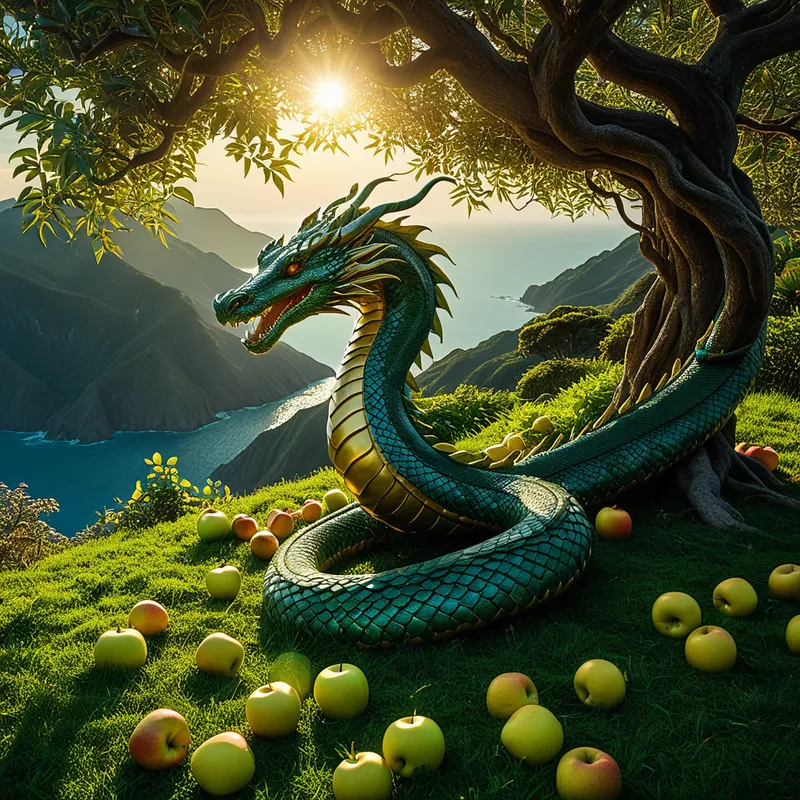
A sacred grove of golden apples guarded by a dragon, representing the ultimate treasure of the psyche, protected by the formidable power of the unconscious.
The Tale of Hera’s Garden of the Hesperides
Listen, and hear of a place that is not a place, a garden that exists at the very rim of [the world](/myths/the-world “Myth from Tarot culture.”/). It lies where the [Helios](/myths/helios “Myth from Greek culture.”/) finishes his daily journey and dips his chariot into the wine-dark sea, painting [the sky](/myths/the-sky “Myth from Persian culture.”/) with the colors of a fading bruise. This is the Garden of the [Hesperides](/myths/hesperides “Myth from Greek culture.”/), a wedding gift from [the Earth](/myths/the-earth “Myth from Hindu culture.”/) herself, Gaia, to the great Queen Hera, on the day she wed [the sky](/myths/the-sky “Myth from Persian culture.”/)-father, Zeus.
Within this twilight sanctuary grow trees that bear fruit not of common seed, but of celestial fire. Their apples are pure, hammered gold, and their flesh promises not sustenance, but immortality. They are the ultimate treasure, the unspoken desire of gods and mortals alike. To guard this heart of her domain, Hera appointed her most loyal wardens: the three Hesperides, [nymphs](/myths/nymphs “Myth from Greek culture.”/) of the gentle, glowing evening, whose songs could lull the very winds to sleep. And because even song can be deceived, she set a more formidable sentinel. From the depths of the primordial dark, she placed [the dragon](/myths/the-dragon “Myth from Chinese culture.”/) [Ladon](/myths/ladon “Myth from Greek culture.”/), a creature coiled endlessly around the apple tree’s trunk. His hundred heads never slept in unison; his eyes were a constellation of unwavering vigilance. His breath was not fire, but a deadly, whispering poison. The garden was perfect, sealed, and silent save for the [nymphs](/myths/nymphs “Myth from Greek culture.”/)’ soft melodies and the dry rustle of [Ladon](/myths/ladon “Myth from Greek culture.”/)’s scales.
But a crack in the perfect world was destined to appear. It came in the form of a labor, the eleventh of twelve impossible tasks imposed upon the hero [Heracles](/myths/heracles “Myth from Greek culture.”/). The task: fetch the golden apples. No mortal knew the garden’s path, for it was hidden beyond the known maps of ocean and sky. [Heracles](/myths/heracles “Myth from Greek culture.”/) wandered, a brute force seeking a subtle secret. He wrestled the shape-shifting sea-god Nereus until the deity, exhausted, revealed [the way](/myths/the-way “Myth from Taoist culture.”/). He crossed the Libyan desert and battled the giant Antaeus, whose strength was renewed by contact with his mother Earth. He journeyed to the Caucasus and freed the tortured [Prometheus](/myths/prometheus “Myth from Greek culture.”/), earning a cryptic gratitude.
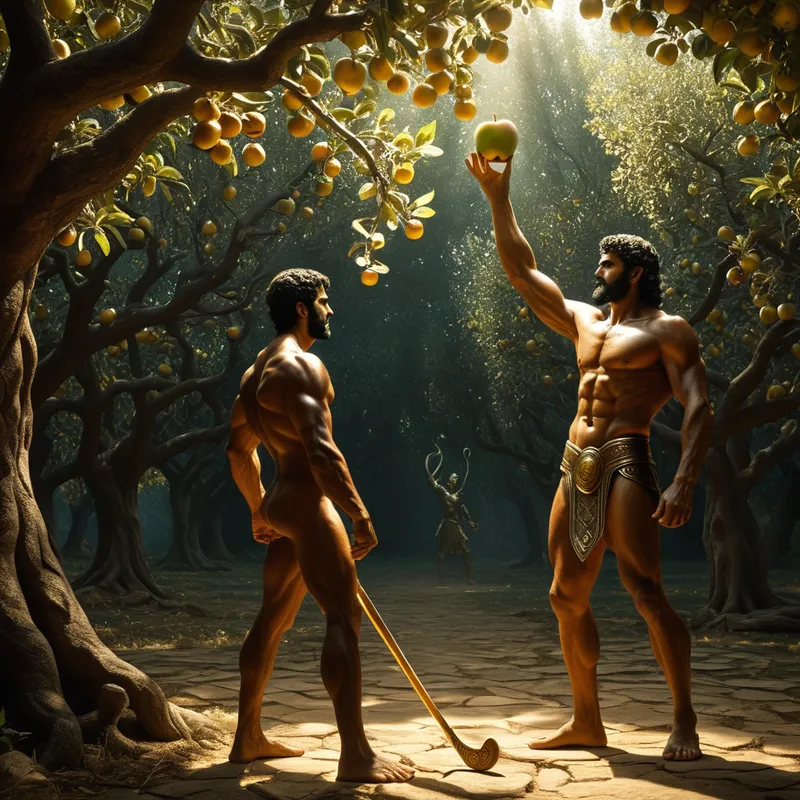
Finally, at the world’s end, he found it. The air was thick with the scent of ambrosia and the perfume of unknown flowers. The light was liquid gold. He saw the tree, and he saw Ladon. This was no battle for a club or brute strength; it was a confrontation with an eternal principle of guardianship. In some tellings, Heracles slew the great dragon with a well-aimed arrow over the garden wall. In others, he received the apples from the Hesperides themselves, or from the Titan Atlas, whom he temporarily relieved of his burden. However the apples were obtained, the deed was done. The treasure was taken, the guardian was overcome. Heracles presented the apples to his taskmaster, Eurystheus, but they could not remain in the mortal realm. They were returned, sacred and dangerous, to the goddess Athena, who restored them to their rightful place in the garden. The serpent Ladon was placed among the stars as the constellation Draco, a eternal watchman in the night sky. The garden, wounded, healed its borders, retreating once more into the mythic twilight, its song a little sadder, its treasure forever marked by the touch of a mortal hand.
Cultural Origins & Context
The myth of [the Garden of the Hesperides](/myths/the-garden-of-the-hesperides “Myth from Global/Universal culture.”/) is a late-blooming flower in the rich soil of Greek mythology, with roots stretching deep into pre-Greek, likely Near Eastern, conceptions of a divine, inaccessible orchard of life. It is not a single, canonical story but a tapestry woven from threads in Hesiod’s Theogony, fragments of lost epics, and the myriad local traditions compiled by later writers like Apollodorus. Its societal function was multifaceted. On one level, it was an aetiological myth, explaining the existence of the constellation Draco and reinforcing the concept of the world’s edge. More profoundly, it served as a narrative anchor for the ultimate heroic quest, integrated into the cycle of Heracles’s labors—a cycle that itself functioned as a parable for overcoming impossible trials to achieve purification and apotheosis.
The tale was told by bards and poets not merely as adventure, but as a meditation on boundaries. The garden represents the absolute property and power of the Olympian order, specifically Hera’s domain. Its violation by Heracles, a son of Zeus hated by Hera, underscores the tumultuous politics of Olympus and the inevitable encroachment of heroic (and human) striving upon the static perfection of the divine. It was a story that acknowledged a deep truth: even the most perfectly guarded treasures of the cosmos are subject to the narrative of change, struggle, and desire.
Symbolic Architecture
The Garden is the ultimate [symbol](/symbols/symbol “Symbol: A symbol can represent an idea, concept, or belief, serving as a powerful tool for communication and understanding.”/) of the Self in its pristine, potential state—a wholeness that promises immortality. It is the innermost sanctum of the [psyche](/myths/psyche “Myth from Greek culture.”/), the core of one’s authentic being and potential, often felt as a distant, radiant [memory](/symbols/memory “Symbol: Memory symbolizes the past, lessons learned, and the narratives we construct about our identities.”/) of completeness.
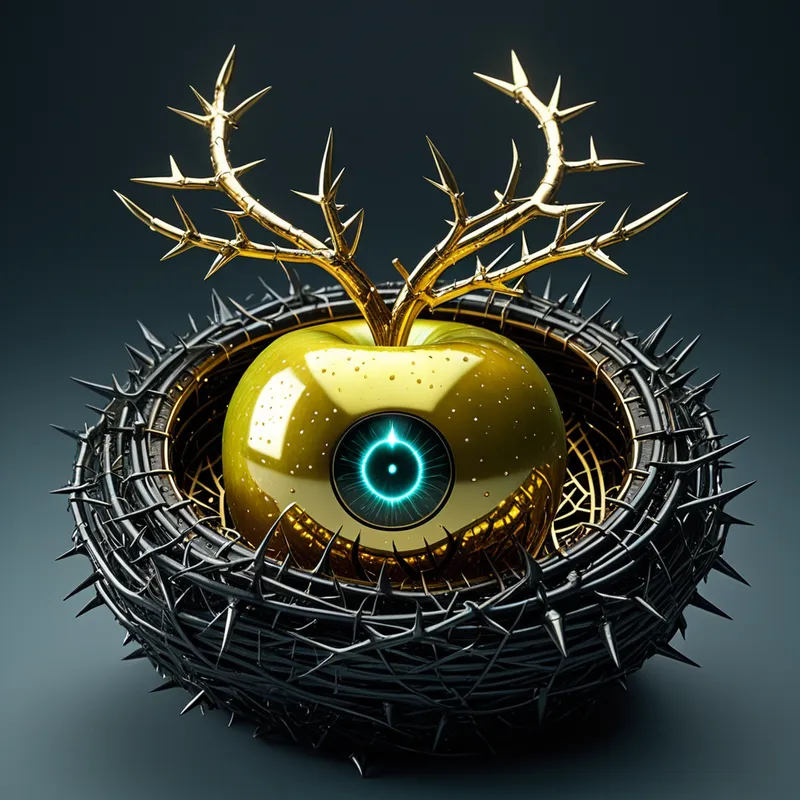
The golden apple is not merely a fruit, but a condensation of sunlight and time—the hard-won fruit of conscious realization, the integrated insight that carries the spark of the eternal.
The Hesperides, the “Daughters of the Evening,” represent the alluring, numinous, and often passive aspects of the unconscious that tend the treasures of the [soul](/symbols/soul “Symbol: The soul represents the essence of a person, encompassing their spirit, identity, and connection to the universe.”/). Their song is the [siren](/symbols/siren “Symbol: The siren symbolizes temptation, danger, and the duality of beauty and peril, often representing alluring yet treacherous situations.”/) call of inner wisdom, beautiful but insubstantial without direct engagement.
The true power lies with Ladon. He is the mythic embodiment of the psychic [defense](/symbols/defense “Symbol: A protective mechanism or barrier against perceived threats, representing boundaries, security, and resistance to external or internal challenges.”/) [system](/symbols/system “Symbol: A system represents structure, organization, and interrelated components functioning together, often reflecting personal or social order.”/). His hundred heads signify the multifaceted, vigilant, and often paranoid [nature](/symbols/nature “Symbol: Nature symbolizes growth, connectivity, and the primal forces of existence.”/) of the psyche’s self-protection. He is not evil, but necessary. He is the [resistance](/symbols/resistance “Symbol: An object or tool representing opposition, struggle, or the act of pushing back against external forces or internal changes.”/) to change, the fear that guards our deepest wounds and greatest gifts from being plundered by a clumsy, ego-driven [consciousness](/symbols/consciousness “Symbol: Consciousness represents the state of awareness and perception, encompassing thoughts, feelings, and experiences.”/) (represented by the initial, brute-force approach of Heracles). To simply slay this [guardian](/symbols/guardian “Symbol: A protector figure representing safety, authority, and guidance, often embodying parental, societal, or spiritual oversight.”/) is to risk psychic catastrophe; one must negotiate, transform, or integrate its function.
The Dreamer’s Resonance
When this mythic pattern stirs in the modern dreamer, it signals a profound approach to the core of [the Self](/myths/the-self “Myth from Jungian culture.”/). Dreaming of a beautiful, walled garden one is forbidden to enter speaks to a sense of potential just out of reach, guarded by personal history or fear. The golden apples may appear as literal radiant fruit, or as any perfect, glowing object of immense desire and value.
The appearance of the serpentine guardian is crucial. It may manifest as a multi-headed creature, a locked door that feels alive, a forbidding parent-figure, or a pervasive atmosphere of anxiety surrounding the treasure. Somatically, the dreamer may experience this as a tightening in the chest, a literal feeling of being bound or watched, or a thrilling yet terrifying pull toward the center. This is the psyche’s immune response activating. The dreamer is nearing something integral—a repressed talent, a core identity, a traumatic memory that holds a key to healing—and the entire unconscious system mobilizes to maintain the status quo. The dream is [the threshold](/myths/the-threshold “Myth from Folklore culture.”/) where the questing ego-hero stands before the dragon, and the outcome is not yet written.
Alchemical Translation
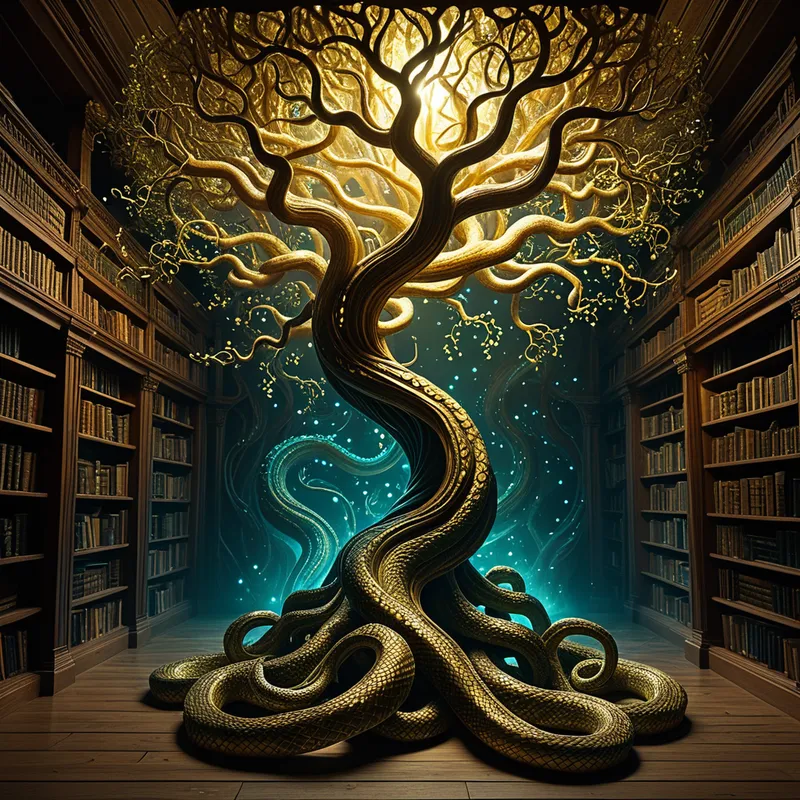
The labor of Heracles to obtain the apples is a masterful map for the alchemical process of individuation. The initial, direct assault ([nigredo](/myths/nigredo “Myth from Alchemical culture.”/), the blackening, the confrontation with [the shadow](/myths/the-shadow “Myth from Jungian culture.”/)) fails; Heracles cannot simply storm the garden. He must first undertake a circuitous journey of preparation—wrestling with the shape-shifting Nereus (confronting the fluid, deceptive nature of the unconscious), overcoming Antaeus (separating from the overwhelming, engulfing power of the personal and collective mother-complex), and freeing Prometheus (integrating the rebellious, foresight-giving spirit that was once chained by the ruling attitude of the psyche, or the super-ego).
The treasure is never truly stolen, only borrowed for the purpose of transformation. Its return to the divine signifies that the integrated Self does not become a possession of the ego, but elevates the ego into alignment with a transcendent order.
This preparatory work represents the albedo, the whitening, the gaining of insight and guidance. Only then can he approach the garden. The confrontation with Ladon is the [rubedo](/myths/rubedo “Myth from Alchemical culture.”/), the reddening, the final, fiery ordeal of integration. One does not destroy one’s defenses; one must transform one’s relationship to them, see their necessity, and find a way to respectfully pass, often with the aid of the very forces (the Hesperides) they were meant to keep out. The retrieval of the apple is the moment of psychic synthesis, where a piece of [the immortal](/myths/the-immortal “Myth from Taoist culture.”/) Self is brought into conscious life. Yet, crucially, the apples are returned. For the modern individual, this translates to a profound realization: the ultimate treasure—wholeness, authenticity, a taste of immortality through meaning—is not something to be owned and displayed by [the ego](/myths/the-ego “Myth from Jungian culture.”/). It is a state of being that, once consciously integrated, must be honored as a sacred, ongoing process within the greater ecology of the soul. The garden remains, the guardian is transformed (placed in the heavens as a guiding constellation), and the seeker is forever changed, carrying the golden light within.
Associated Symbols
Explore related symbols from the CaleaDream lexicon: