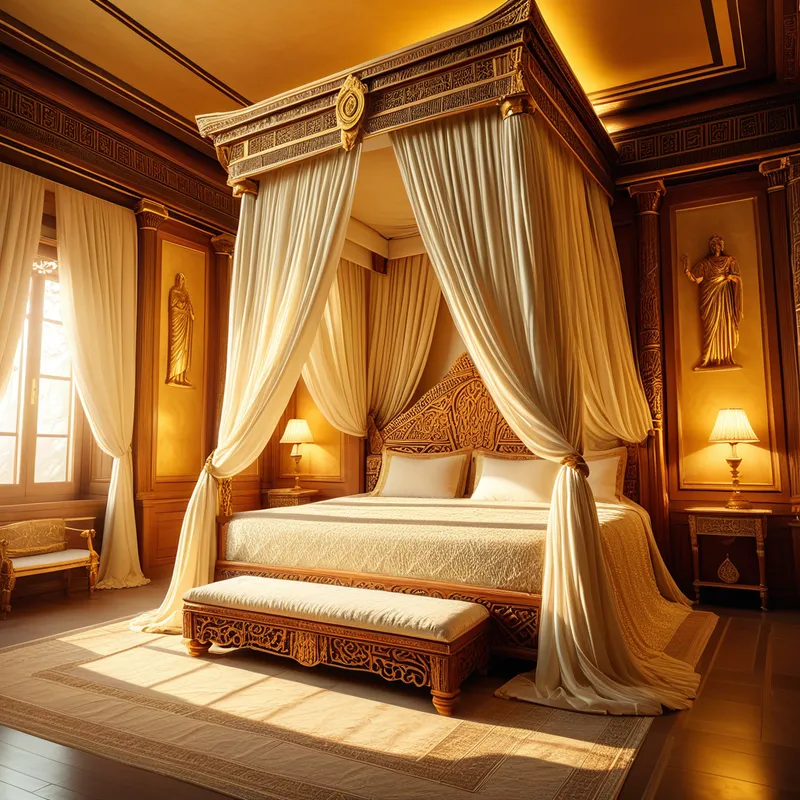
Hera's Bedchamber Myth Meaning & Symbolism
A myth of Aphrodite's magical girdle, Zeus's seduction, and the inviolable sanctuary of the marriage bed, revealing the sacred architecture of relationship.
The Tale of Hera's Bedchamber
Hear now of the chamber where the world’s order was woven in whispers and where the Queen of Heaven held her most profound power. Not in the thunderous halls where Zeus hurled his lightning, nor in the sun-drenched courts where the gods feasted, but in a room veiled in quiet majesty on the highest peak of Olympus.
This was the domain of Hera. The air within was thick with the scent of myrrh and the crushed petals of sacred lilies. The walls, if one could see them through the soft haze, were of polished cedar, and the great bed itself was a testament to the craft of Hephaestus—a frame of ivory and gold, draped with fabrics that held the colors of twilight and deep sea. Here, in this sanctuary, the sacred marriage of Heaven and Earth, of King and Queen, was ritually renewed. Here, Hera was not merely consort; she was sovereign.
But a shadow fell upon this sanctum. A great war raged on the plains below Olympus, the Trojan War, and Zeus had forbidden the gods from intervening. Hera, whose heart favored the Achaeans, burned with a plan. To sway the tide of battle, she must sway her husband. Not with reason, for his decree was law. Not with force, for his might was supreme. She would use the oldest, most potent magic: desire itself.
She journeyed to her rival, Aphrodite, and with cunning words, borrowed her most potent artifact: the Cestus. Woven not just of thread but of longing, persuasion, and whispered passion, it held the power to make any heart burn. Hera fastened it secretly beneath her robes. She then visited Hypnos, extracting a fearful oath to lull Zeus into a deep, untroubled slumber once her design was complete.
Adorned with the Cestus and anointing herself with ambrosial oil, Hera approached Zeus where he sat upon his throne, gazing upon the distant war. The enchantment was immediate and overwhelming. The Lord of the Sky, seeing his wife, felt a desire more potent than any since the first days of their union. He spoke of leaving, of finding a private place. Hera, feigning modesty and concern for the eyes of the world, suggested a place far from prying immortals—the peak of Mount Ida, shrouded in a golden cloud.
Yet, in his enchanted state, Zeus proclaimed a greater wish. "Let us go," he said, his voice thick with the magic of the girdle, "to that place where we first knew love. To your bedchamber, where the bonds of our union are sacred." The request struck Hera’s heart. It was a return not to a secret bower, but to the very heart of her authority, the sanctum of their shared sovereignty. There, upon the bed of cedar and ivory, beneath the cloud Hypnos poured over them, the world’s ruler was subdued not by rebellion, but by the sacred allure of his own marriage bed. And as he slept, Hera, her purpose clear, stepped from the chamber, its sanctity momentarily used as a vessel for her will, and directed the battle far below.

Cultural Origins & Context
This myth, primarily recounted in Homer’s Iliad (Book XIV), served a complex function in ancient Greek culture. It was not a simple folktale but a theological and social narrative performed by bards within an epic concerning honor, fate, and divine caprice. The audience would have understood the profound tensions at play: the sanctity of the marital bond (Hieros Gamos) versus the political machinations of the gods.
Hera’s bedchamber represented the idealized core of the Greek oikos (household), elevated to a cosmic scale. The marriage of Zeus and Hera was the divine prototype for all human marriages, fraught with conflict yet fundamentally constitutive of social order. The myth acknowledges the wife’s power within her designated sphere—the domestic, intimate space—and shows how that power could, through cunning and sacred artifacts, influence the wider, male-dominated realm of war and decree. It was a story that validated both the sanctity of the marital bed and the potent, often subversive, agency of the goddess who presided over it.
Symbolic Architecture
The bedchamber is far more than a room; it is a psychic temenos, a sacred precinct. It symbolizes the inviolable core of a relationship or an individual’s inner sovereignty. It is the place where contraries—male and female, power and vulnerability, rule and submission—are ritually united and from which new order is born.
The true sanctuary is not where one is alone, but where the paradox of union is held sacred.
Hera’s strategy is deeply symbolic. She does not storm the throne room; she uses the very essence of her domain—the allure of the sacred marriage—to achieve her ends. The Cestus represents not base seduction, but the irresistible power of connected desire, the magnetic force that draws disparate elements into wholeness. Zeus’s insistence on returning to the bedchamber, even under enchantment, signifies a deep, archetypal pull toward this place of primal union and reconciliation. The bedchamber, therefore, is the symbol of the container strong enough to hold the full spectrum of a relationship, including its strategies and manipulations, within its sacred bounds.

The Dreamer's Resonance
To dream of Hera’s Bedchamber is to encounter the psyche’s own inner sanctum of relationship. One might dream of a beautifully made bed in a vast, empty castle, a locked room one is afraid to enter, or a marital bed transformed into a negotiating table.
Such dreams often surface during periods of relational crisis or deep introspection about partnership and personal sovereignty. The somatic feeling can be one of profound tension—between the desire for intimate merging and the need for autonomous will. The dream asks: Where is your sacred space? What enchantments (old patterns, borrowed scripts, manipulations) are you using to gain entry to another’s will or to protect your own? The bedchamber in dreams challenges the dreamer to examine the health of their inner and outer "marriage"—the union between conscious and unconscious, self and other. It points to where the sacred has become a strategy, or where strategy needs to be made sacred again.

Alchemical Translation
The myth models the alchemical stage of coniunctio, the sacred marriage. For the modern individual pursuing individuation, the journey is not to conquer the outer world or a partner, but to consciously integrate the inner opposites symbolized by Zeus (conscious authority, logos, will) and Hera (the relational principle, eros, the sanctity of the vessel).
Individuation requires not just a throne for the king, but a consecrated bedchamber for the royal marriage.
The first step is recognizing one’s own "bedchamber"—the inner space where one’s deepest values and capacity for connection reside. Often, we, like Hera, loan this space out, using our core relationships as tactical grounds for external victories. The alchemical work is to cleanse the chamber, to reclaim it as a place for genuine coniunctio, not manipulation. This involves surrendering the "borrowed girdle" of others’ desires and facing the raw, authentic longing for union. The "sleep of Zeus" that follows is the necessary temporary suspension of rigid, controlling consciousness, allowing a new, more holistic order to emerge from the sacred space. The ultimate triumph is not Hera’s temporary victory on the battlefield, but the reaffirmation of the chamber itself as the source of true, transformative power. In the psyche’s olympus, wholeness is achieved when the ruler and the queen recognize that their shared sanctuary is the foundation of all sovereignty.
Associated Symbols
Explore related symbols from the CaleaDream lexicon: