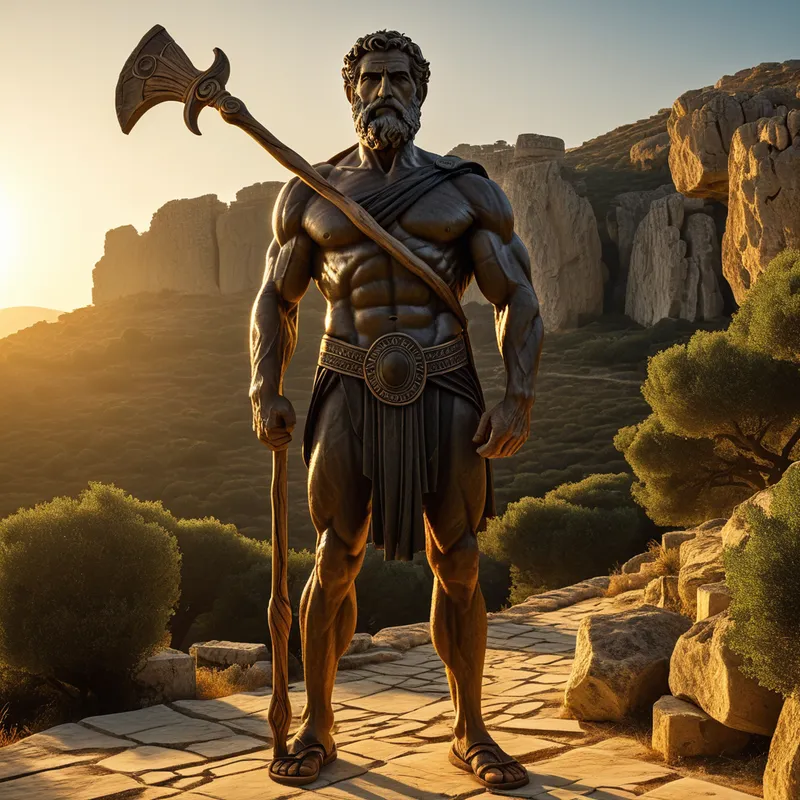
Heracles' Club Myth Meaning & Symbolism
The story of Heracles' first weapon, a crude olive-wood club, representing the raw, untamed force that must be mastered to become a true instrument of destiny.
The Tale of Heracles’ Club
Listen. Before the twelve labors, before the lion’s pelt and the fame that shook the pillars of the world, there was a young man and a tree.
The air in the wilds of Thebes was thick with the scent of pine and the promise of violence. Heracles, cursed by a goddess’s wrath, his mind clouded with a fire not his own, had done the unthinkable. Now, exiled, he stood at the mouth of a lonely grove, the weight of his grief a heavier burden than any physical chain. The gods were silent. The world was vast, hostile, and waiting. He had nothing but the strength in his limbs and a rage that threatened to consume him from the inside out.
He wandered until his feet found the slope of a sacred hill. There, ancient and twisting towards the sky, stood an olive tree. It was not a cultivated thing from a garden, but a wild one, its trunk thick and gnarled by centuries of wind, its roots clawing deep into the rocky earth. It was a tree of stubborn life. In that moment, Heracles did not see a symbol of peace or wisdom. He saw resistance. He saw an opponent that would not yield.
With a roar that scattered birds from miles around, he laid his hands upon it. Not to pray, but to conquer. Muscles, gifted by his father Zeus and tempered by mortal suffering, corded and strained. The earth trembled. The wood groaned, a sound like a dying giant. With a final, catastrophic crack that echoed through the valleys, he tore a whole limb—a branch as thick as a man’s torso—from the living tree. He stripped it of its smaller branches and leaves with brutal, efficient motions, his hands bleeding sap and bark. What remained was no crafted spear, no honed sword of bronze. It was a crude, monstrous cudgel, heavier than any weapon a normal man could hope to lift, its head a knotty, brutal mass of wood.
This was his first companion in exile. This club became his voice. When the wolves of Cithaeron came with glowing eyes, it was the club that met them, crushing bone and silencing snarls. When the Gigantes later rose, it was this same olive-wood that shattered their rocky limbs. It was an extension of his own untamed nature—raw, destructive, potent. He did not merely carry it; he wielded it as one wields a part of one’s own soul. Through countless battles, the wood grew stained, not with polish, but with the grime of earth, the ichor of monsters, and the sweat of a hero not yet born, but being forged blow by terrible blow.

Cultural Origins & Context
The myth of Heracles’ Club is not a single, codified tale from one source, but a foundational element woven into the very fabric of his legend. It appears in the earliest strands of Greek storytelling, from the epic cycles to the works of poets like Homer and Pindar. Unlike the meticulously detailed labors, the acquisition of the club is often treated as a given, a presupposition of his identity. This tells us something crucial: for the ancient Greek audience, the club was not just a weapon; it was an intrinsic attribute, as fundamental as his lion-skin cloak.
Bards would have sung of it in symposia and public festivals, its description a shorthand for Heracles’ unique, borderline-barbaric power. He was the hero who operated outside the polished civility of the city-state, the polis. His club represented a pre-civilized, raw force of nature that civilization needed but could not itself produce. It was a tool of boundary-pushing, of confronting the chaos that lay beyond the walls. In a society that valued the crafted (the spear, the shield, the lyre), Heracles’ club stood as a testament to the efficacy of the uncrafted—power in its most direct, unadulterated form. It served a societal function by embodying the terrifying yet necessary wildness that must be harnessed to protect the order of home and hearth.
Symbolic Architecture
The club is the primordial symbol of undifferentiated power. It is not a precision instrument; it is blunt force trauma given form. Psychologically, it represents the raw, chaotic energy of the psyche—the unmediated anger, the explosive passion, the sheer life force that exists before socialization shapes it into acceptable channels.
The first task is not to find a weapon, but to recognize that the weapon is already there, growing wild within you.
The olive tree is key. The olive is sacred to Athena, symbolizing wisdom, peace, and civilization. Heracles does not take a cultivated branch from a garden; he wrests it from a wild tree. This is the act of taking a potential symbol of order and peace and forging it, through an act of violent necessity, into an instrument of chaotic defense. The club thus becomes a paradox: it is civilized material (olive wood) used in a pre-civilized way (a crude club). This mirrors Heracles’ own nature as a figure caught between the divine and the bestial, the civilizer who is himself uncivilized.
The club is his shadow made manifest and usable. Instead of repressing his monstrous strength and rage (which led to his initial tragedy), he externalizes it into this tool. He makes his shadow his companion. It is his first and most honest step toward integration—not by becoming gentle, but by consciously directing his ferocity outward, against the literal and metaphorical monsters of the world.

The Dreamer’s Resonance
To dream of a club, especially one that is crude, heavy, or made of living wood, is to encounter the dreamer’s own unintegrated power. This is not a dream of finesse or strategy, but of primal impact.
Somatically, the dreamer may awaken with a feeling of tension in the shoulders and arms, a clenched jaw, or a surging energy with no clear outlet. Psychologically, they are likely in a phase where a raw, instinctual part of themselves is demanding recognition. This could manifest as repressed anger seeking expression, a creative impulse that feels too forceful or “unrefined,” or a profound need to set a boundary in a way that feels brutally simple. The dream asks: What in your life requires a blunt instrument? Where are you being too polite, too refined, while a wild part of you knows that only a decisive, forceful action will clear the path? The club in a dream does not advocate for violence, but for the honest, powerful assertion of one’s fundamental presence in the face of obstruction.

Alchemical Translation
The journey of Heracles’ Club is a perfect model for the early, crucial stage of psychic alchemy: the nigredo, or blackening. This is the stage of confronting the raw, dark, chaotic material of the unconscious. Heracles, in his grief and exile, is in the nigredo. His act of creating the club is the first alchemical operation.
He takes the prima materia—the wild olive wood, symbol of his own tangled, suffering, potent nature—and, through a violent act of will (the separatio), isolates a piece of it. He does not yet refine it into gold. He merely shapes it into a tool that can interact with the world. This is the beginning of individuation: making the unconscious conscious enough to be used.
The club is the ego’s first, clumsy handle on the immense weight of the Self.
For the modern individual, the “alchemical translation” is this: before you can perform your great labors, before you can achieve refined wisdom (symbolized by Athena’s later patronage), you must acknowledge and weaponize your own crude power. You must find your “club”—the unpolished, perhaps shameful, but immensely potent aspect of your character that you have neglected or feared. This might be a stubborn will, a capacity for righteous anger, or an unconventional way of thinking. The process is not about immediately civilizing this force, but about first learning to wield it with purpose. You must carry it, get used to its weight, and use it to clear the initial, monstrous obstacles from your path. Only after this raw power has proven its worth can it be later transformed, through the trials of the labors, into something more sacred—just as the hero himself is transformed. The club is the beginning of the work, the tangible proof that one has decided to engage with one’s own depths, no matter how rough the first tool may be.
Associated Symbols
Explore related symbols from the CaleaDream lexicon: