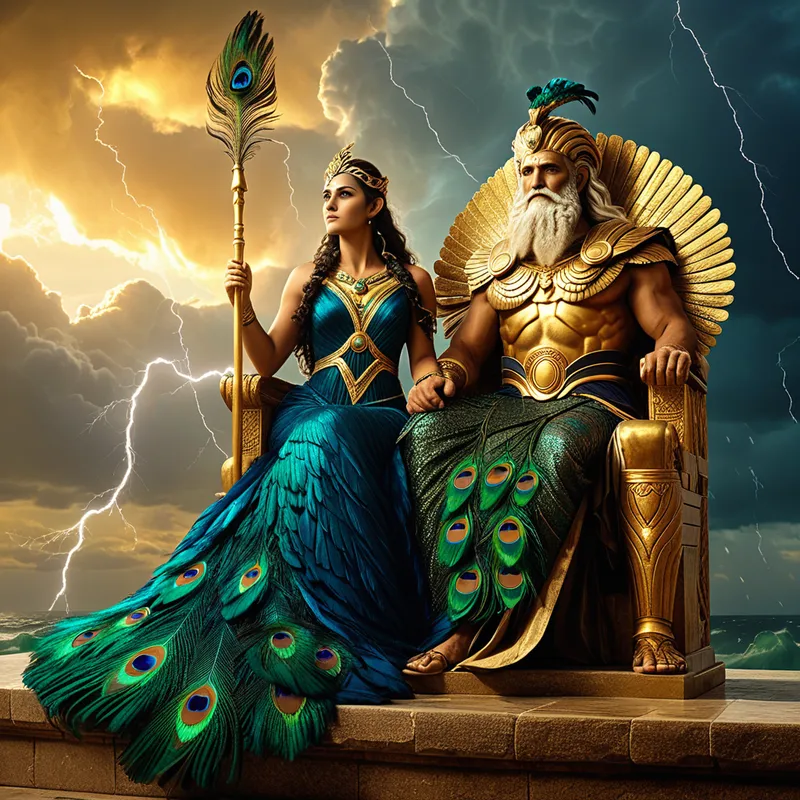
Hera and Zeus Myth Meaning & Symbolism
The tumultuous divine marriage embodying the eternal tension between sovereignty and union, order and passion, wounding and reconciliation.
The Tale of Hera and Zeus
Hear now the story of the first marriage, the binding of the heavens and the ordering of the world, a union forged in desire and tempered in strife. Before the age of heroes, when the earth was still young beneath the gaze of the Titans, the King of the Gods beheld his sister.
He was Zeus, the Thunderer, whose will was the storm and whose breath was the wind. She was Hera, whose eyes held the depth of a still lake and whose bearing was the unshakable mountain. He saw in her not a conquest, but a counterpart—a majesty to match his own, a will that could not be broken, only won. Or so he thought.
He courted her with guile, for direct force would never sway her. Transforming himself into a bedraggled, shivering cuckoo, he flew to her on a chill, rain-lashed day. Taking pity on the fragile creature, Hera gathered the bird to her breast to warm it. In that instant of compassion, Zeus resumed his divine form and claimed her. Some say it was a violation of trust; others, the first and most cunning of his seductions. Regardless, from this paradoxical act—a deception wrapped in an appeal to her innate nature—the great wedding was proclaimed.
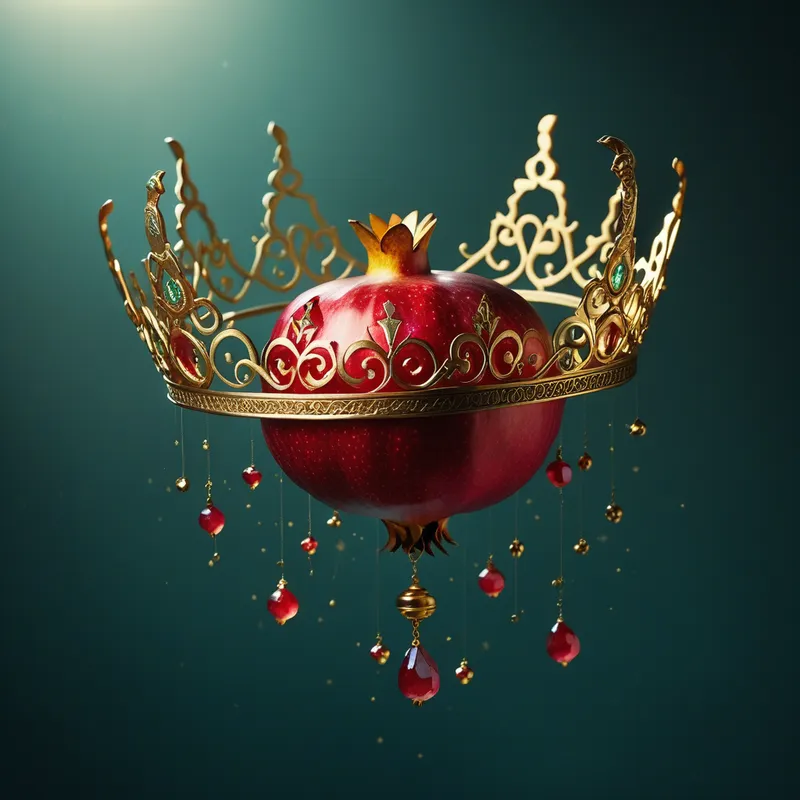
The Hieros Gamos was celebrated with such splendor that time itself paused. The earth gifted them the golden apples of the Hesperides. For three hundred years, the world knew only the harmony of their reign. But the Thunderer’s nature was restless, his sovereignty expressed through boundless creation and possession. The Queen’s nature was consolidating, her sovereignty expressed through the sanctity of oath and boundary. His eye wandered to nymph, mortal, and goddess alike. Each betrayal was a lightning strike upon the fortress of her dignity.
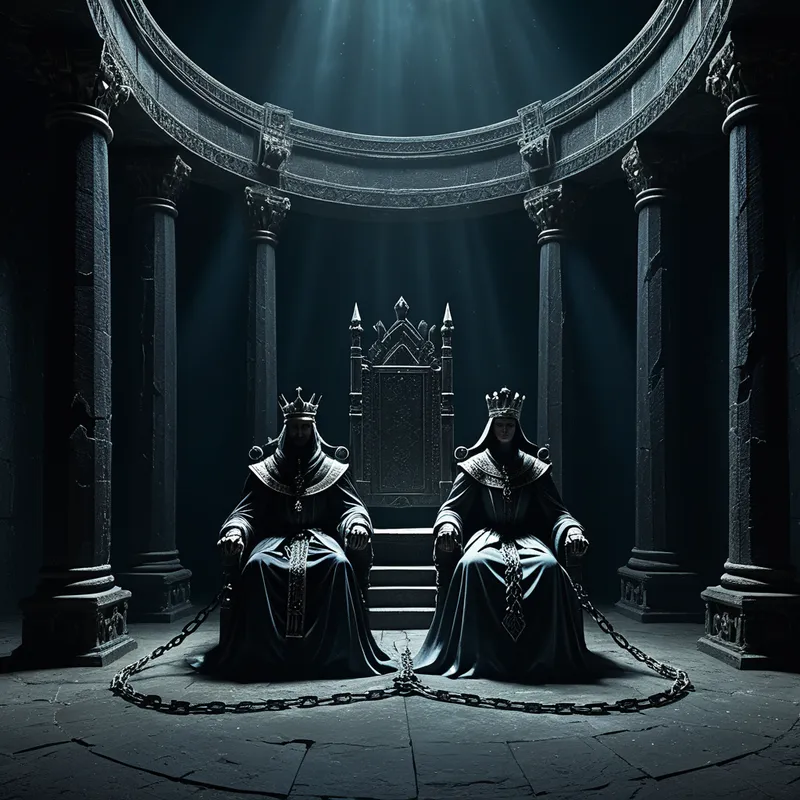
Her wrath was not the hot flash of anger, but a cold, strategic, and eternal force. She unleashed monsters upon his illegitimate children, like the serpent sent to haunt Alcmene. She engineered trials and torments, most famously driving the hero Heracles to madness. She once led a rebellion of the gods, chaining Zeus in his sleep—a fleeting, shocking inversion of power, until the hundred-handed Briareus was summoned to free him.
In one profound tale, her fury reached its zenith. She withdrew from Olympus, retreating to the mountains, declaring the marriage void. To lure her back, Zeus devised a ruse. He staged a false wedding with a carved wooden statue, draped in veils. Hearing of this new, ultimate insult, Hera descended in a fury, only to tear the veil away and find a lifeless effigy. The absurdity of the trick, the revelation of his theatrical desperation, broke the deadly stalemate. Laughter erupted—first among the gods, then, reluctantly, from Hera herself. In that shared, unexpected laughter, a fragile peace was restored. Not forgiveness, but an acknowledgment of an eternal, inextricable bond. Their conflict was the weather of the cosmos itself.

Cultural Origins & Context
This foundational myth was not a singular story but a vast tapestry of local cult narratives, epic poetry, and ritual practice woven across the Greek world. It was perpetuated by poets like Homer and Hesiod, who gave the Olympian family its canonical, if dysfunctional, structure. Hera’s worship was ancient and powerful, with major cult centers at Argos and Samos, often predating Zeus’s prominence. Her title as “Hera Teleia” (Hera the Fulfilled) celebrated her as the goddess of the completed marriage, a social institution paramount to Greek civic order.
The myth served a crucial societal function. It explained the nature of authority and the chaos inherent in power. The royal marriage was a divine model for human kingship and the patriarchal household, yet it simultaneously displayed its profound flaws. It gave a sacred, if tumultuous, narrative to the very real tensions around fidelity, legitimacy, and the clash of wills within the “oikos” (household). The gods’ strife was a mirror held up to human conflict, legitimizing it as part of the cosmic order.
Symbolic Architecture
At its core, the myth of Hera and Zeus is the archetypal drama of Consciousness (Zeus) and Eros (Hera), not as lovers, but as co-rulers. Zeus represents the sovereign, skyward impulse: expansion, law, generative force, and the dispersal of energy. Hera represents the sovereign, earthy impulse: containment, covenant, memory, and the preservation of form.
Their marriage is the psyche’s attempt to wed the principle of creative possibility with the principle of meaningful structure.
Zeus’s infidelities are not merely moral failings but symbolic of the creative mind’s necessary wandering, its need to seek new vessels for its inspirations. Hera’s vengeance is the inevitable, brutal backlash of the neglected structure, the personal and collective pain that arises when commitments are shattered. The wooden statue episode is a masterful symbolic moment: it represents the hollow, dead form a relationship becomes when stripped of genuine feeling, and the shocking, healing power of absurdity to break a pathological cycle.
The Dreamer's Resonance
When this mythic pattern stirs in the modern dreamscape, it often manifests as profound relational conflict at an archetypal level. Dreaming of a powerful but unfaithful partner, or of being a vengeful, plotting spouse, rarely points to literal infidelity. Instead, it signals a civil war within the dreamer’s own psyche.
The “Zeus” dream may involve scenes of exhilarating escape, seducing new projects or identities, or wielding great power chaotically. The “Hera” dream may involve discovering a betrayal, crafting intricate plans of revenge, or feeling bound and humiliated. Somatically, one might feel the expansive, electric rush of Zeus-energy or the cold, contracting, visceral knot of Hera-wrath. This is the psyche processing the tension between one’s need for sovereign freedom and one’s need for sovereign commitment—to a partner, a career, a creative work, or to the self.
Alchemical Translation
The individuation process modeled here is not about choosing one deity over the other, but about enduring the crucible of their eternal conflict until a third, reconciling principle emerges. The initial hieros gamos is the naive, unconscious identification with a perfect union—the “honeymoon phase” of any major life commitment. The ensuing betrayals and wars are the painful, necessary separatio, where the complexes of boundless creativity and rigid structure are fully differentiated and experienced in their raw power.
The alchemical gold is not the cessation of conflict, but the capacity to hold the tension of opposites without being torn asunder.
The laughter at the wooden statue is the key. It represents the transcendent function—the unexpected, symbolic resolution that comes not from victory, but from seeing the absurdity of the deadlock. For the modern individual, this translates to moving beyond blaming either the “inner Zeus” for its restlessness or the “inner Hera” for its rigidity. It is to recognize both as essential, sovereign rulers of different domains of the soul. The goal is to become the throne room itself, capable of containing the storm and the law, allowing for creative infidelity to inspiration while honoring the sacred covenants that give life stable form. The reconciled myth points toward a mature sovereignty where commitment does not mean imprisonment, and creativity does not mean betrayal.
Associated Symbols
Explore related symbols from the CaleaDream lexicon: