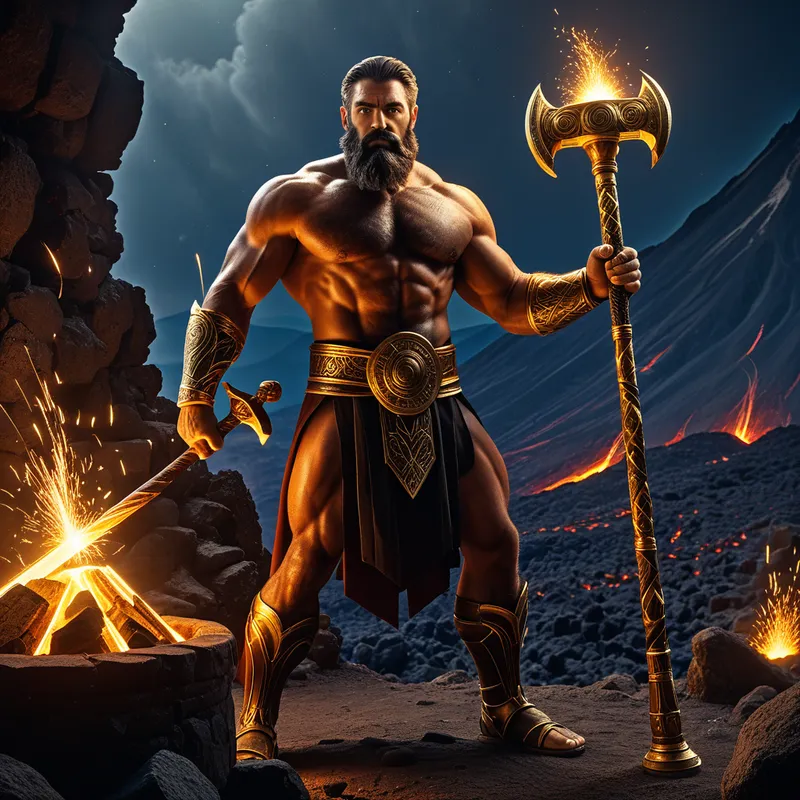
Hephaestus's Tools Myth Meaning & Symbolism
The story of the god cast out for his imperfection, who forges divine tools from his pain, becoming the architect of Olympus and his own wholeness.
The Tale of Hephaestus's Tools
Hear now the tale not of thunder, but of the fire beneath the mountain. It begins not with a cry of triumph, but with a scream of revulsion. On the sun-drenched peaks of Olympus, Hera beheld her newborn son. But this was no perfect, golden child. He was small, his limbs twisted, his gait a painful shuffle. In a moment of divine shame, a flaw in the fabric of perfection, the queen of heaven seized the infant and hurled him from the sacred heights.
He fell for a day and a night, a tiny, burning star of disgrace, plunging through the cool air and into the wine-dark sea. The Nereids, Thetis among them, took pity. They caught the broken god-child and bore him to a secret, submerged grotto. There, in the echoing silence of the deep, the seed of his genius was planted in the dark soil of abandonment.
Years passed in the hidden cavern. While his kin basked in celestial light, the castaway god learned the language of the earth. He listened to the groan of tectonic plates, felt the patient pressure that turns stone to crystal, and heard the molten song of the world’s heart. With nothing but his hands and his fierce, burning will, he began to craft. From coral and basalt, from the bones of leviathans and veins of ore, he fashioned his first tools: a hammer that could sing on the anvil, tongs that could grasp the heart of a star, and a bellows that breathed with the rhythm of the tides.
His creations were not mere objects; they were prayers made solid, answers to his own loneliness. He built golden maidens who could walk and speak to keep him company. Word of these marvels, born from the deep and the broken, eventually drifted up to Olympus. A throne of such cunning artifice was sent to Hera—a gift from a forgotten son. When she sat upon it, invisible fetters clasped her fast. The outcast had ensnared the queen of heaven. Only Dionysus, with his disarming wine and laughter, could coax the smith to return and release her.
And so Hephaestus ascended, not as a scorned child, but as a power. He returned to a mountain that once rejected him, and they built for him a forge greater than any throne: the fiery heart of Mount Etna. There, amid the eternal fire and clamor, his tools—born from his fall—gave birth to wonders. He shaped Aphrodite’s perfect girdle, Apollo’s chariot of the sun, and the unbreakable armor of Achilles. The lame god, the rejected one, became the architect of Olympus’s splendor, his hammer-strokes the steady heartbeat of a world built on perfection’s fragile edge.

Cultural Origins & Context
This myth echoes from the Bronze Age, a time when metallurgy was not a craft but a form of sacred, dangerous magic. The smith, working with primal elements of earth and fire to create objects of immense power (weapons, crowns, ritual objects), occupied a liminal space in society—respected and feared. Hephaestus’s myth likely coalesced from these real-world figures, his lameness perhaps a folk memory of the physical toll of the forge (arsenic poisoning, injuries) or a symbolic representation of the smith’s often-isolated, "crippled" social status.
The primary sources are the epic poems of Homer and the later Homeric Hymns. In the Iliad, he is a vital, active deity, crafting the epic’s most pivotal artifacts. His story was not confined to formal recitation but lived in the collective imagination, explaining the origin of craftsmanship, the presence of suffering in creation, and the paradoxical truth that the foundation of a seemingly perfect order (Olympus) was laid by the one it deemed imperfect. His cult centers, like Athens where he shared a temple with Athena, celebrated the civic necessity of skilled labor and the divine sanction for transforming raw material into civilized form.
Symbolic Architecture
Hephaestus is the archetype of the wounded healer on a cosmic scale. His tools are not separate from his wound; they are its direct manifestation and transcendence.
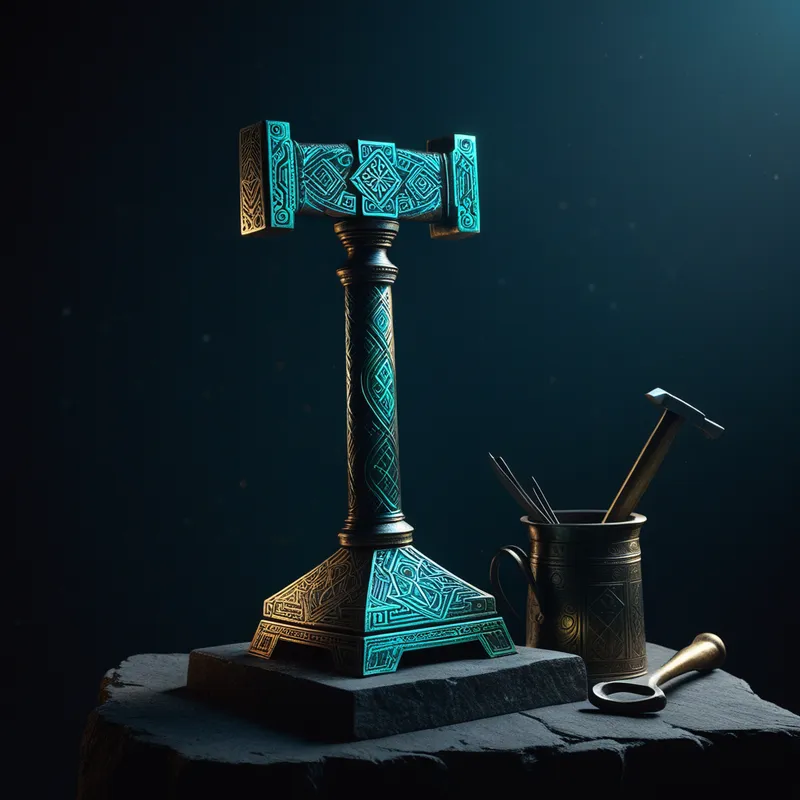
The anvil is the resistant world, the unyielding reality of our suffering and limitation. The hammer is the conscious will, the focused application of spirit that shapes meaning through repeated, deliberate blows.
His lameness symbolizes the foundational wound, the perceived flaw that exiles us from the "perfect" world of naive consciousness. His fall is the necessary descent into the unconscious, the watery realm of the psyche where raw material awaits. The submarine grotto is the incubatory space of isolation, where the ego is dissolved enough for the Self to begin its work. The tools he forges there represent the nascent capacities of the psyche—resilience (hammer), discernment (tongs), and inspiration (bellows)—fashioned specifically to work on the material of his own life.
His return and binding of Hera is a profound psychological truth: the rejected complex (the wounded child) eventually forces a confrontation with the ruling authority (the perfect mother/ego). Integration is not a gentle request; it is often a necessary capture, a crisis that forces the psyche to acknowledge the power of what it discarded.
The Dreamer's Resonance
To dream of Hephaestus’s tools is to dream in the key of transformation. It signals a somatic and psychological process of creative integration.
You may dream of a heavy, beautiful hammer you cannot lift, feeling the frustration of potential energy with no outlet—this is the will not yet aligned with its purpose. Dreaming of a forge in a basement, a cave, or a forgotten room of your house points to the discovery of a latent, fiery creative power in the depths of your own unconscious. The act of striking hot metal in a dream can correlate somatically with the release of tension, the physical feeling of shaping a stubborn emotion or situation. A dream of crafting a delicate object with massive, crude tools speaks to the soul’s attempt to refine a subtle insight (a relationship, an idea) using only the raw strength of will, a call to forge finer instruments of the psyche.
These dreams often arrive during periods of convalescence, after a failure, or when feeling socially or professionally "lame"—cast out from a previous identity. The tools in the dream are the nascent psychic organs being formed to rebuild your world from this new, fractured ground.
Alchemical Translation
The myth of Hephaestus’s tools is a complete map of the individuation process. It models the alchemical opus: solve et coagula (dissolve and coagulate).
First, the solve: the brutal dissolution of the original, "divine" identity. He is thrown from the known world (consciousness) into the sea (the unconscious). This is the necessary humiliation, the dark night that strips away false perfection. In the grotto, in the nigredo or blackening, he endures the isolation where the old self rots to compost.
Then, the coagula: the forging of the tools. This is the albedo (whitening), where insight begins to gleam in the dark. He does not pray for rescue; he uses what the deep gives him to make the means of his own salvation. His tools are the conscious functions (thinking, feeling, sensation, intuition) being tempered and specialized for the unique task of his life’s work.
The ultimate creation is not the throne, the armor, or the automaton. It is the forged Self—a consciousness that has integrated its flaw, its fiery anger, and its profound creativity into a cohesive, purposeful whole.
His return to Olympus is not a regression, but an arrival of a new order. He does not become "perfect"; he installs his forge, his method, at the center of the world. The individuated self becomes the hidden, creative engine of the personality, the smith who continually repairs and beautifies the realm of the conscious ego, turning the base metal of experience into the gold of meaning. We are all, in our deepest work, apprenticed to the lame god, learning to build our tools from the very ore of our falls.
Associated Symbols
Explore related symbols from the CaleaDream lexicon: