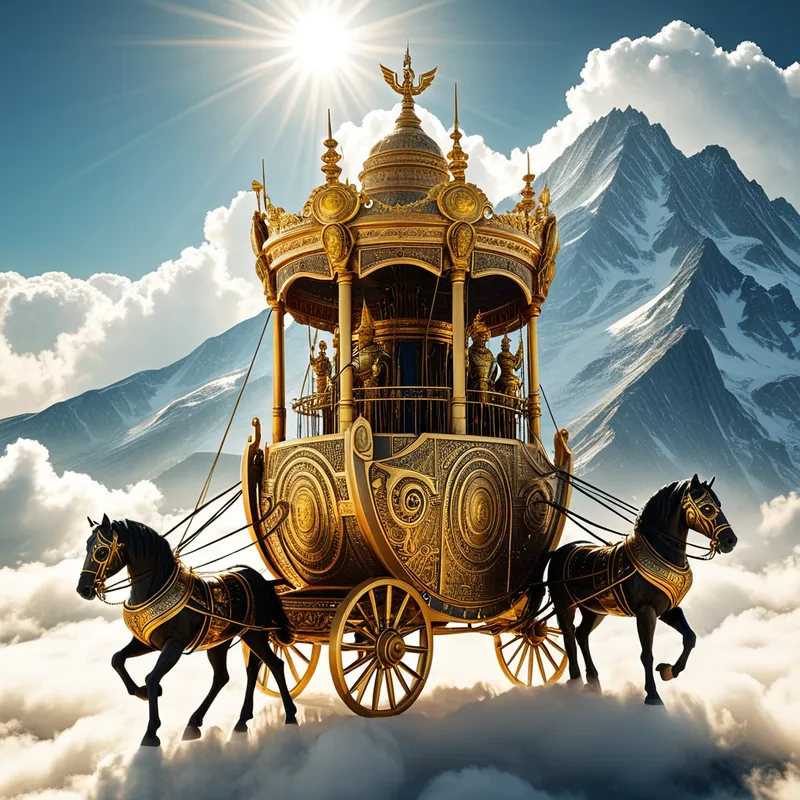
Hephaestus's Golden Chariot Myth Meaning & Symbolism
The exiled god Hephaestus forges a miraculous golden chariot to return to Olympus, transforming his physical pain and rejection into divine, mobile artistry.
The Tale of Hephaestus's Golden Chariot
Hear now of the fall and the glorious, clanking return. Not with thunder, like his father, nor with the cruel beauty of his mother, but with a sound the world had never known: the chiming of perfect, self-forged gold.
It began with a cry that echoed in the halls of Olympus. The infant Hephaestus, born to Hera alone in her jealous rage, was flawed. His foot was twisted. To the queen of heaven, this was an unbearable stain on her perfection. In a moment of divine cruelty, she seized her son and cast him from the high, cloud-wreathed gates. He fell for a day and a night, a tiny, burning star of potential, until the wine-dark sea received him with a cold embrace.
He did not drown. The sea-nymphs Thetis and Eurynome found him in the deeps. In a grotto lined with coral and pearls, they nursed the broken godling. For nine years, he dwelled in that submarine twilight, the ache of rejection a cold stone in his chest, the fire in his soul banked but not extinguished. It was there, amidst the sighing currents, that his fingers first learned their truth. He shaped shells into cunning locks, coaxed heat from the earth's underwater vents, and began to make.
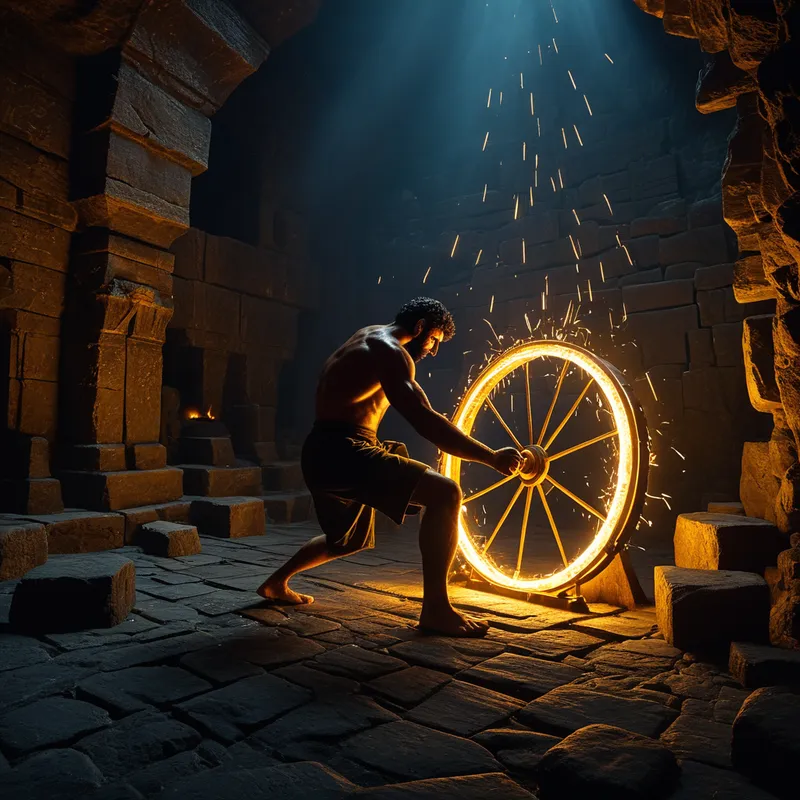
His exile found a new home on the island of Lemnos, within the heart of its sleeping volcano. Here, the fire met the forge. The pain in his leg became the rhythm of his hammer; the loneliness of the deep became the focus for his mind. He did not walk the world. He would make the world come to him. His hands, stained with soot and shining with sweat, became instruments of a will that would not be denied. He built automatons of bronze to serve him, their movements a graceful, clattering ballet. He made jewels that held the light of stars and traps of cunning wit.
But the memory of Olympus was a phantom limb. The laughter of the gods, distant and cruel, still rang in his ears. A plan, slow and meticulous as the cooling of a casting, formed in his heart. He would not crawl back. He would not be petitioned for. He would arrive.
So he labored. He mined the secret gold of the sunken rivers. He captured the essence of speed from the west wind. In the roaring belly of the mountain, he forged not a weapon, but a vessel. A chariot, entirely of gold, so intricate it seemed woven of light. Its wheels were perfect circles, needing no axle, turning on a thought. And before it, he fashioned horses—not of flesh, but of living metal. Their hides were plates of gold, their eyes glowing gems, their breath the steam of divine mechanism. They were alive with his art, bound to his will.
When the work was done, the volcano itself seemed to hold its breath. Hephaestus, the soot-streaked god, mounted his creation. With a command that was more a sigh of release, the golden horses surged forward. They did not gallop; they flowed up the mountain path, leaving sparks of celestial fire on the stone. They ascended into the sky, a brilliant, chiming constellation moving against the blue.
He breached the clouds. The gates of Olympus lay before him, and the gods spilled forth, not in wrath, but in stunned awe. Here was no supplicant, but a sovereign of a new domain. He rode into their midst on a sunrise of his own making, the clangor of his passage the fanfare for a king of ingenuity. His mother Hera looked upon the son she had discarded, now radiant in the glow of his own genius, and in that moment, the old wound was transcended by a new, undeniable power. The exile had returned, not healed, but transformed. He had built his own road home.
Cultural Origins & Context
The myth of Hephaestus’s golden chariot is woven into the broader tapestry of his exile and return, primarily recounted in the Homeric Hymn to Apollo and referenced in Homer’s Iliad. It is a myth born from the oral tradition, told by bards and poets at feasts and gatherings. Its function was multifaceted. On one level, it explained the presence of the lame god among the perfect Olympians, resolving a theological tension. More importantly, it served as a foundational narrative for the ancient Greek artisan class.
Hephaestus was the divine patron of smiths, potters, sculptors, and all who worked with fire and earth to create. His myth validated their social station. It said: your labor is not mere toil; it is a divine craft. Your physical suffering or social marginalization can be the very crucible for producing something that commands the respect of kings and gods. The chariot itself is the ultimate argument from skill. In a culture that prized physical beauty and martial prowess, the story elevated techne—practical skill, art, cunning intelligence—to an Olympian virtue. It was a myth that comforted the broken and empowered the maker, asserting that value is not given but forged.
Symbolic Architecture
At its core, this is a myth of psychic alchemy. Hephaestus represents the wounded creator archetype. His lameness is not merely physical; it is the symbol of a fundamental sense of inadequacy, rejection, and "otherness" imprinted by the primary caregiver—here, the Mother Goddess herself. His fall from Olympus is the primal trauma of abandonment, the descent of consciousness into the unconscious, watery depths (cared for by sea nymphs, figures of the nurturing unconscious).
The forge is the sealed vessel of transformation, where the base metal of pain is subjected to the intense heat of focused attention.
The golden chariot is the masterpiece born from this process. It is not a cure for the lameness, but its transcendence. Gold symbolizes the achieved Self, the integrated psyche that has consciously worked on its own contents. The self-moving, living-metal horses represent instinctual energy (the horse) now sublimated and directed by conscious artistry (the metal, the crafting). They are raw life force harnessed and beautified by will.
His return to Olympus is not a revenge fantasy but a symbolic integration. The once-rejected part of the psyche—the wounded, creative, persistent artisan—now takes its rightful place at the council of the gods (the totality of the psyche). He returns not to fit in, but to change the very atmosphere of the place with the evidence of his transformative work.
The Dreamer's Resonance
When this myth stirs in the modern dreamer, it often signals a profound process of reclaiming agency from a place of perceived brokenness or exile. Dreaming of a magnificent, self-built vehicle—a car, a ship, a complex machine—that carries one from a dark, isolated place (a cave, an island, a basement workshop) toward a place of recognition or light, is a classic manifestation.
Somatically, this may correlate with a period of intense focus on a creative or reparative project that follows a time of depression, illness, or rejection. The body might feel the "hammer's rhythm"—a driven, almost compulsive energy to make or fix. Psychologically, the dreamer is in the "forge phase." They are consciously using the heat of their emotional pain—the anger of abandonment, the cold weight of inadequacy—not as something to be merely endured, but as the very fuel for creation. The dream chariot is the emerging symbol of the new psychic structure being built: a means of locomotion that bypasses the old, wounded way of "walking" in the world.

Alchemical Translation
The journey of Hephaestus is a precise map for the individuation process. The initial state is one of identification with the wound ("I am the lame one, the cast-out one"). The alchemical operation begins with the descensus—the acceptance of the fall into the depths of one's pain and history (the sea, the grotto). This is not wallowing, but the necessary gathering of raw prima materia.
The long exile on Lemnos is the stage of solutio and coagulatio—dissolving the old identity in the fires of suffering and effort, and repeatedly re-forming it through disciplined work. The god does not pray for rescue; he builds helpers (automatons), representing the development of auxiliary psychological functions that support the conscious ego.
The creation of the chariot is the rubedo, the reddening, the culmination of the work where spirit and matter, intention and skill, fully unite.
For the modern individual, this translates to the dedicated crafting of one's unique "vehicle"—be it a body of art, a healed relationship, a business, a philosophy, or a simply a stable, authentic self. This vehicle is specifically designed to carry one's particular wound, not to hide it. The final ascent and return is integration. The healed creator does not seek to destroy the inner "Olympus" (the internalized critical parents, the perfect ideals) but arrives before it in such undeniable wholeness that it must be acknowledged. The system itself is altered by the presence of the once-rejected part, now returned as a sovereign creator. The myth teaches that wholeness is not the absence of the flaw, but the genius that grows in its shadow.
Associated Symbols
Explore related symbols from the CaleaDream lexicon: