Hephaestus's Forge Myth Meaning & Symbolism
The myth of the crippled god who forged divine wonders in his volcanic forge, transforming rejection and pain into objects of sublime power and beauty.
The Tale of Hephaestus's Forge
Hear now the tale of the fire in the mountain’s heart, and the god who was its master. It begins not with a cry of triumph, but with a fall—a long, silent, shattering descent from the gleaming heights of Olympus. Cast out by his own mother, Hera, for his perceived imperfection, Hephaestus plunged into the wine-dark sea. His body, broken, was salvaged not by gods, but by the ancient sea-nymphs Thetis and Eurynome. In their hidden grotto, he learned his first arts—not of war or thunder, but of shell and coral, fashioning beauty from the deep’s quiet gifts.
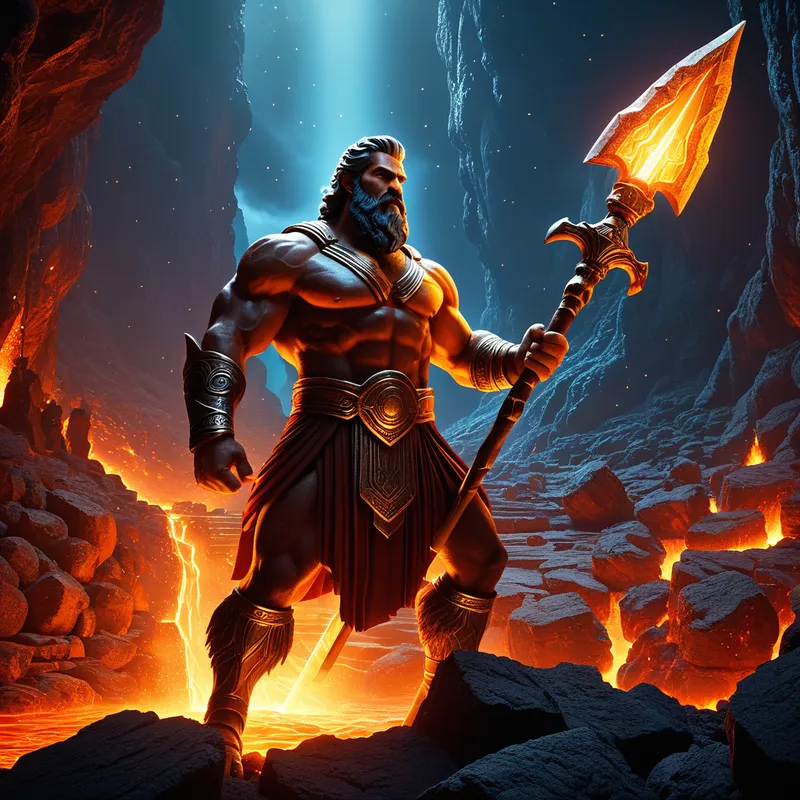
But the fire in him was not quenched. It called him to the world’s bones, to the places where the earth bleeds molten stone. He claimed a mountain, hollowed it out, and built his kingdom there. This was no golden hall. This was the Forge. Here, the air shimmered with a heat that could soften diamond. Rivers of lava pulsed like arteries, lighting the cavern in a hellish, glorious glow. The rhythmic clang-clang-clang of hammer on divine metal was its heartbeat. Here, the lame god walked with perfect authority.
His hands, gnarled and strong, became instruments of a will that could compel form from chaos. He did not just make weapons; he birthed wonders. For Zeus, he forged the unbreakable adamantine chains. For Athena, he shaped her brilliant armor. He crafted Helios’s chariot to ride the sky, and for himself, he made maidens of gold, thinking, moving automata to attend him. His masterpiece was a throne of inconceivable cunning, sent to Hera—a gift that was also a trap, binding her fast the moment she sat, a silent, intricate revenge for that first, unforgotten cruelty.
Yet, his greatest and most terrible creation was born from a command, not inspiration. At Zeus’s order, to punish mankind for the gift of fire, Hephaestus took earth and water and shaped the first woman, Pandora. He molded her form to be breathtakingly beautiful, a living statue. Aphrodite gave her grace, Hermes gave her a cunning voice and a curious mind. But it was Hephaestus who sealed her fate, crafting the famed jar that held all the world’s evils. In that act, the god of making became the unwilling architect of humanity’s sorrow, his art the vessel for a divine vengeance he did not devise. The Forge’s fire gave light and destruction in equal measure, and its master, though a god, was bound to the wills and wars of others, his genius both a salvation and a curse.
Cultural Origins & Context
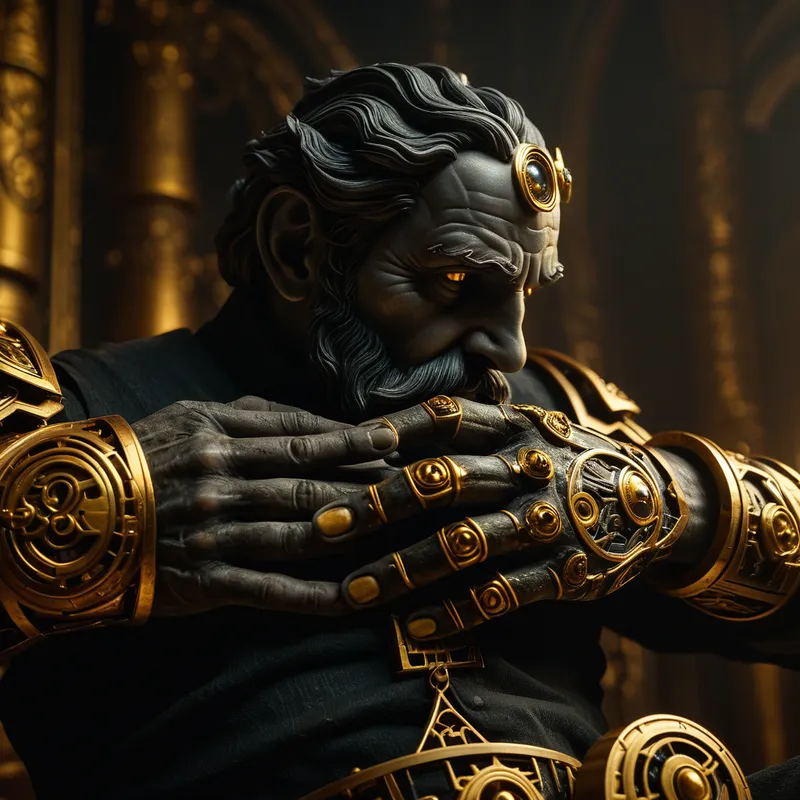
The myths of Hephaestus are woven into the earliest strands of Greek storytelling, appearing in the epic verses of Homer’s Iliad and Odyssey, and later elaborated by poets like Hesiod. He was a god of profound importance to a society transitioning from the Bronze Age into the Iron Age, where the smith’s art was not a mere craft but a form of potent, almost magical technology. His worship was centered in industrial hubs like Athens, where he shared a temple with Athena on the Acropolis, symbolizing the union of strategic wisdom (metis) and practical craftsmanship (techne).
The myth was not merely entertainment; it served a vital societal function. It sanctified the labor of the artisan, elevating it to a divine pursuit. It provided a narrative container for the paradox of creation: that beautiful and terrible things can emerge from the same source, and that the creator is often marked by the process. Hephaestus’s lameness, far from diminishing him, was integral to his identity—a cultural acknowledgment that power and wholeness can arise from acknowledged brokenness, and that true strength is often forged in the hidden, fiery depths away from the perfect, sunlit courts of conventional power.
Symbolic Architecture
Psychologically, Hephaestus and his Forge represent the archetypal process of creative transformation through suffering. The Forge is the psyche’s workshop, the interior crucible where raw experience—especially pain, rejection, and isolation—is subjected to the intense heat of conscious attention and the repeated blows of effort. Here, the base materials of trauma and flaw are not discarded but become the essential ore for crafting meaning.
The divine cripple teaches us that the wound is not opposite to the gift; it is often its birthplace. The limp is the signature of the fall that initiated the journey to the depths where true forging begins.
Hephaestus’s creations are symbolic of this alchemy. His automatons represent the drive to create autonomous, functioning systems from our inner chaos—the disciplined habits, the crafted personas, the “living” works of art that serve us. Pandora is the ultimate ambiguous creation: the beautiful, dangerous gift that unleashes complexity into the world. She symbolizes the inevitable shadow of creation, the unintended consequences, and the painful wisdom (Hope, left in the jar) that remains after catastrophe. The Forge itself, volcanic and subterranean, is an image of the potent, often disruptive, energy of the unconscious—a fertile, dangerous, and utterly necessary source of power.
The Dreamer's Resonance
When the motif of Hephaestus’s Forge appears in modern dreams, it signals a profound somatic and psychological process underway. The dreamer may find themselves in a basement workshop, a fiery cavern, or a high-tech lab—any space that feels both isolating and intensely productive. There is often a sense of urgent, compulsive work on a project of great personal importance, accompanied by feelings of isolation, frustration, or physical strain.
This dreamscape points to a phase of “inner forging.” The psyche is actively engaged in metabolizing a difficult experience—a rejection, a failure, a period of depression or illness. The heat and pressure in the dream mirror the emotional intensity of this process. The act of hammering or shaping represents the arduous work of integrating this experience into the structure of the self. To dream of creating a powerful but dangerous object (like a weapon or a sealed box) suggests the dreamer is grappling with bringing a potent but potentially disruptive new aspect of their creativity or power into the world, aware of its double-edged nature. The dream is an affirmation: you are in the workshop of the soul, where broken parts are being remade into tools and treasures.
Alchemical Translation
The myth of Hephaestus provides a complete model for the alchemical process of individuation—the journey toward psychological wholeness. It begins with the nigredo, the blackening: his violent ejection from Olympus, the descent into the sea, the experience of being “less than” and cast aside. This is the necessary dissolution of the old, idealized identity.
His establishment of the Forge in the volcanic depths represents the albedo, the whitening. Here, in the disciplined isolation, consciousness is applied to the raw material of the suffering. The repetitive, focused work at the anvil is the practice of introspection and conscious effort, hammering vague pains into specific understandings. The creation of the golden servants symbolizes the development of autonomous psychic functions—the ability to self-nurture, self-regulate, and attend to one’s own needs.
The final stage is not a return to Olympus on its terms, but the establishment of a sovereign realm of one’s own making. Wholeness is not the absence of the limp, but the integration of its story into the authority of the stride.
The ultimate alchemical translation is this: we are not tasked with healing our wounds to become “perfect” or “unblemished.” Rather, we are to become the Smith in our own depths. Our task is to build a capable forge within, to learn to tend its fires with respect, and to take up the hammer with conscious intent. We transform the lead of our suffering into the gold of authentic creation—not to please the gods on high, but to craft a life of resonant, forged integrity, where our very imperfections become the unique signature of our art. The fire that fell is the same fire that forges.
Associated Symbols
Explore related symbols from the CaleaDream lexicon: