Hephaestus's Forge & Aphrodite's Girdle Myth Meaning & Symbolism
The crippled smith-god forges a magical girdle of irresistible allure for his unfaithful wife, Aphrodite, binding creation to desire in an eternal, painful dance.
The Tale of Hephaestus’s Forge & Aphrodite’s Girdle
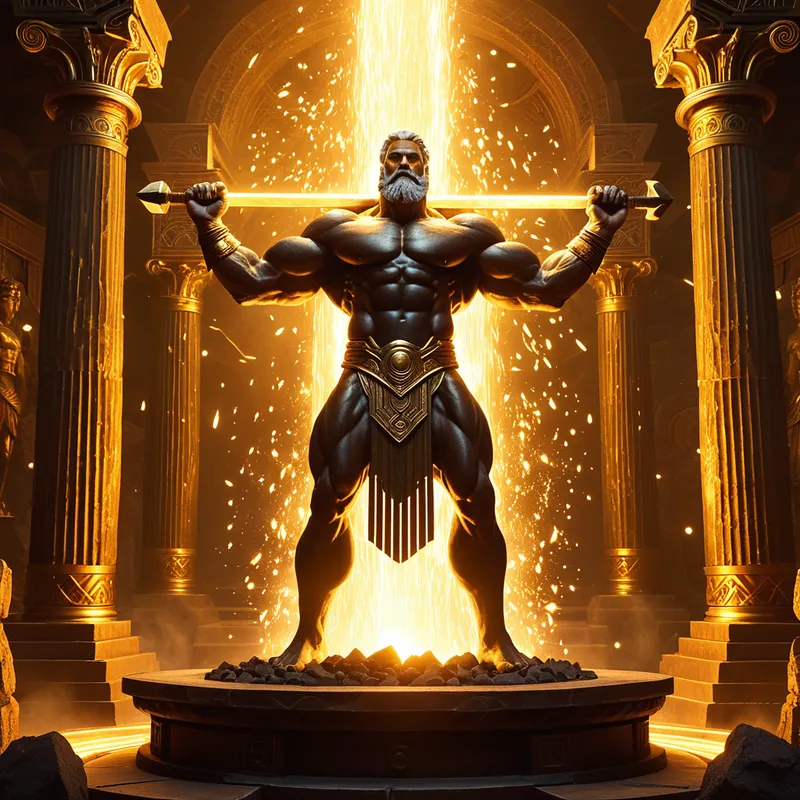
Listen. Beneath the sun-drenched peaks and marble halls of Olympus, in the deep, trembling belly of [the world](/myths/the-world “Myth from Tarot culture.”/), fire speaks. Here, in a cavern lit by [the earth](/myths/the-earth “Myth from Hindu culture.”/)’s own blood, the rhythm is not of lyre or laughter, but of hammer on anvil—a heavy, lonely, creative pulse. This is the realm of [Hephaestus](/myths/hephaestus “Myth from Global/Universal culture.”/), the smith-god. Cast out from heaven for his lameness, he found his kingdom in the dark, where raw ore yields to will and flame. His form is powerful, shoulders broad from eternal labor, yet his leg is twisted, a reminder of a fall from grace. His companions are not muses but Cyclopes, and his children are wonders of animated bronze and gold.
Above, in the light-drenched courts, moves his wife, Aphrodite. Born from sea-foam and severed divinity, she is grace incarnate, a shimmering promise that draws the eyes of gods and mortals alike. Her laughter is the sound of attraction itself. Their union was no love match, but a bitter jest of the king of gods, a political chain linking the power of creation to [the force](/myths/the-force “Myth from Science Fiction culture.”/) of desire. It is a marriage of profound dissonance: the soot-stained artisan of the depths bound to the radiant, restless goddess of the surface.
And so, the forge becomes a crucible for more than metal. Hephaestus, the master of form, knows his wife’s nature. He hears the whispers that drift even to his smoky domain—tales of her wanderings with Ares, the god of war, whose passion is as violent as Hephaestus’s is patient. The fire in his chest is not just from the furnace. It is a colder, more enduring ache: the pain of the maker whose most perfect creation—his devotion—is spurned.
Yet, he does not rage with war-hammers. He turns to his art, his only true language. Into the heart of his greatest fire, he places not iron or bronze, but the rarest metals, spun with moonlight and the whispered secrets of charm. For days and nights that blur in the geothermal glow, he works. His hammer falls in a rhythm of focused agony, each blow embedding not just shape, but enchantment. He is forging a paradox: a chain that liberates, a restraint that empowers.
What emerges from the quenching mist is the Cestus. It is a girdle of such exquisite, subtle craftsmanship that it seems woven from light itself. Its links are fine as [spider](/myths/spider “Myth from Native American culture.”/)-silk, strong as destiny, and within them hums the concentrated essence of allurement, grace, and sweet persuasion. It is not a weapon of force, but of inevitable surrender.
He presents it to her. The scene is thick with unspoken history. The god of [the underworld](/myths/the-underworld “Myth from Greek culture.”/), offering a jewel of the upper air to its queen. Aphrodite accepts it. Her fingers, which can stir chaos in the hearts of kings, fasten the clasp. In that moment, the fundamental tension of their myth is made material. She is now armed with a power crafted by the very one she wounds. His forge has given her the ultimate tool of her infidelity; her acceptance is the seal of their eternal, painful bond. The girdle becomes her signature, the source of her undisputed power, a masterpiece born from the ashes of marital betrayal, forever binding [the architect](/myths/the-architect “Myth from Various culture.”/) of form to the spirit of desire.

Cultural Origins & Context
This myth, primarily preserved in the epic tapestry of [Homer](/myths/homer “Myth from Greek culture.”/)’s Iliad and later elaborated by poets like Hesiod, was not mere entertainment. It was a foundational narrative exploring the Greeks’ understanding of cosmic and social order. [The bard](/myths/the-bard “Myth from Celtic culture.”/), singing in a royal hall or at a religious festival, used such tales to explain the world’s inherent contradictions.
Hephaestus and Aphrodite represent fundamental, opposing yet interdependent daimonic forces in the Greek cosmos. Hephaestus embodies techne—practical skill, technology, the hard, tangible work of civilization-building. Aphrodite embodies eros—not merely romantic love, but the life force, attraction, and the compelling power that drives beings together, for creation or chaos. Their forced marriage reflects the ancient understanding that civilization (techne) is perpetually in a tense, often unhappy, but necessary marriage with primal, animating desire (eros). The myth served to validate the social role of the artisan—the often-overlooked, physically imperfect creator—while also acknowledging the terrifying, sublime power of beauty and sexuality that can undo the best-laid plans of gods and men.
Symbolic Architecture
At its core, this is a myth of the [psyche](/myths/psyche “Myth from Greek culture.”/)’s own workshop. Hephaestus is the [archetype](/symbols/archetype “Symbol: A universal, primordial pattern or prototype in the collective unconscious that shapes human experience, behavior, and creative expression.”/) of the ego that identifies solely with conscious crafting, order, and tangible [output](/symbols/output “Symbol: The result or product of a process, often representing achievement, validation, or the tangible manifestation of effort in leisure and games.”/). He is the laboring intellect, the [problem](/symbols/problem “Symbol: Dreams featuring a ‘problem’ often symbolize internal conflicts or challenging situations that require resolution and self-reflection.”/)-solver who believes anything can be fixed or forged if one applies enough skill. His lameness symbolizes the inevitable wounding or limitation of a [consciousness](/symbols/consciousness “Symbol: Consciousness represents the state of awareness and perception, encompassing thoughts, feelings, and experiences.”/) divorced from the fluid, instinctual [realm](/symbols/realm “Symbol: The symbol of ‘Realm’ often signifies the boundaries of one’s consciousness, experiences, or emotional states, suggesting aspects of reality that are either explored or ignored.”/).
Aphrodite is the archetype of the [anima](/symbols/anima “Symbol: The feminine archetype within the male unconscious, representing soul, creativity, and connection to the inner world.”/)—the [soul](/symbols/soul “Symbol: The soul represents the essence of a person, encompassing their spirit, identity, and connection to the universe.”/)-[image](/symbols/image “Symbol: An image represents perception, memories, and the visual narratives we create in our minds.”/), the world of feeling, relatedness, and uncontrollable [life](/symbols/life “Symbol: The symbol of ‘Life’ represents a journey of growth, interconnectedness, and existential meaning, encompassing both the joys and challenges that define human experience.”/) [energy](/symbols/energy “Symbol: Energy symbolizes vitality, motivation, and the drive that fuels actions and ambitions.”/). She is not “evil” for her infidelity; she represents [nature](/symbols/nature “Symbol: Nature symbolizes growth, connectivity, and the primal forces of existence.”/), which cannot be owned or bound by contract. Her affairs with Ares (raw, unchecked [passion](/symbols/passion “Symbol: Intense emotional or physical desire, often linked to love, creativity, or purpose. Represents life force and deep engagement.”/)) show what happens when the [anima](/symbols/anima “Symbol: The feminine archetype within the male unconscious, representing soul, creativity, and connection to the inner world.”/) is not integrated but is instead split off and acting autonomously.
The Cestus, then, is the supreme symbol of the complex—a psychic structure forged in the fire of deep injury, which holds immense power. It is the “girdle of compulsion” we all carry: our patterns of attraction, our wounds dressed as charms, our deepest insecurities transformed into our most captivating traits.
Hephaestus does not try to chain Aphrodite herself; he forges a tool that amplifies her essential nature. Psychologically, this is the [moment](/symbols/moment “Symbol: The symbol of a ‘moment’ embodies the significance of transient experiences that encapsulate emotional depth or pivotal transformations in life.”/) when [the ego](/myths/the-ego “Myth from Jungian culture.”/), wounded by the autonomy of the unconscious, attempts to control it not through repression, but by creating a brilliant, enchanting [mechanism](/symbols/mechanism “Symbol: Represents the body’s internal systems, emotional regulation, or psychological processes working together like a machine.”/)—a complex—that mediates our [relationship](/symbols/relationship “Symbol: A representation of connections we have with others in our lives, often reflecting our emotional state.”/) to the deep psyche, often with dazzling, destructive, or creatively fertile results.
The Dreamer’s Resonance
When this myth stirs in the modern dreamer, it signals a profound confrontation between one’s capacity for creation and one’s experience of relational wounding. To dream of a subterranean workshop might indicate a somatic process of “working through” a deep-seated sense of inadequacy or rejection (Hephaestus’s lameness and exile). The body itself becomes the forge, holding the tension.
Dreaming of a beautiful, elusive figure adorned with intricate jewelry, or of a lover receiving a gifted weapon, often points to the activation of the “Cestus complex.” The dreamer is experiencing a situation where their own crafted [persona](/myths/persona “Myth from Greek culture.”/), their “best self” offered in relationship, feels weaponized or turned against them, or where they feel irresistibly drawn to someone by a force that feels magical and beyond their control. The dream is highlighting the psychic alchemy where pain is transmuted into allure, and where one’s gifts are entangled with one’s deepest vulnerabilities.

Alchemical Translation
The individuation process modeled here is not one of healing the marriage into harmony, but of recognizing the necessary and eternal tension between these two poles of being. The goal is not for Hephaestus to walk perfectly or for Aphrodite to be faithful, but for the conscious ego to acknowledge its lameness—its limitations and wounds—as the very source of its creative power.
The alchemical fire is not for purification into purity, but for the coniunctio oppositorum—the sacred marriage of opposites held in tension. The true gold is not the girdle, but the conscious awareness that holds both the forge and the girdle within one self.
The modern individual undergoes this transmutation when they stop trying to “fix” their fundamental flaws or control their uncontrollable desires. Instead, they descend into their own “volcanic forge”—the depths of the unconscious—and, like Hephaestus, apply conscious attention (techne) to the raw material of their pain and instinct (eros). The outcome is not a happy marriage, but a creative product: a work of art, a deep insight, a new capacity for relationship that acknowledges its own inherent contradictions. One learns to forge their own “Cestus”—not to control or seduce the outer world, but to consciously carry the beautiful, burdensome, and powerful binding of their own creative spirit and desiring soul. In this act, the crippled god and the restless goddess find their only true union: within the integrated human psyche.
Associated Symbols
Explore related symbols from the CaleaDream lexicon: