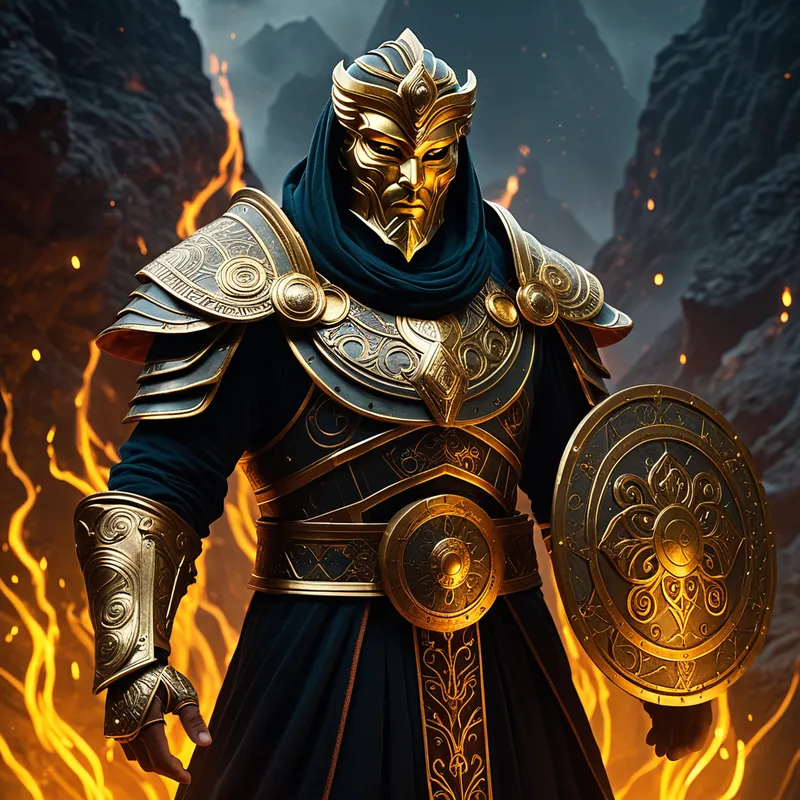
Hephaestusin Greek/R Myth Meaning & Symbolism
The myth of the divine smith, cast from Olympus, who forges beauty from pain and becomes the architect of gods and the soul's wounded creator.
The Tale of Hephaestusin Greek/R
Hear now the tale of fire in the earth and the hands that shape destiny. It begins not with a cry of birth, but with a shriek of disgust and a fall through endless sky.
In the gleaming halls of Olympus, where the air smells of nectar and the light has no shadow, the queen Hera bore a child. But when she beheld him—his limbs twisted, his gait a clumsy shuffle—a cold revulsion seized her heart. This was no image of perfect, untroubled divinity. In a moment of perfect, terrible clarity, she snatched the babe and hurled him from the sacred mountain’s edge.
He fell for a day and a night, a tiny, tumbling star of flesh and potential. The winds howled in his ears; the sea, a vast, hungry eye, rushed up to meet him. But the deep would not have him. The sea-nymphs Thetis and Eurynome caught his broken form and carried him to a secret place: a cavern at the world’s root, where the breath of the earth was fire and the bones of the planet were molten ore. For nine years, in that sunless, starless womb, the child of the fall listened. He learned the song of the hammer on the anvil, the whisper of bellows, the secret language of metal as it flows from one state to another. His lameness did not matter here; his strength was in his arms, his genius in his mind. From darkness and rejection, he forged his first wonders: exquisite jewelry for his saviors, and a throne of such cunning and beauty it seemed alive.
His name was Hephaestus. And his craft was his revenge and his return. He sent the throne to Olympus, a gift for his mother. When Hera sat upon it, invisible, unbreakable bonds snapped shut, fusing her to the divine seat. No god, not even the thunder-wielding Zeus, could pry her free. Laughter died in the golden halls. Only one being held the key: the forger himself.
Brought back to Olympus in triumph, not as a scorned son but as a indispensable power, Hephaestus walked his halting walk among the perfect gods. He built their palaces. He forged the thunderbolts that enforced divine will. He crafted the unbreakable net to ensnare lovers in their deceit. He was given Aphrodite, the most beautiful, as his wife—a cosmic joke that sealed his destiny of longing. Yet, in his smoky, subterranean forge, lit by rivers of lava, he created not just tools of power, but beings of life: the golden handmaidens who moved with thought, the giant Talos who patrolled the shores, and the very first woman, Pandora, shaped from earth and water.
His story is the echo of the hammer, a rhythm of falling and rising, of taking the raw, rejected ore of existence and, through the sacred, solitary fire within, transmuting it into a form that even the gods cannot do without.

Cultural Origins & Context
The myths of Hephaestus are woven into the earliest strands of Greek storytelling, appearing in the epic verses of Homer’s Iliad and Odyssey and elaborated by later poets like Hesiod. He is a paradox within the Olympian pantheon: the only god who labors, the only one who is physically imperfect, and the only one whose primary domain is not a force of nature or human emotion, but a human craft elevated to divine mystery.
His cult was centered in major metallurgical hubs, most notably on the volcanic island of Lemnos, and in great civic centers like Athens, where he shared a temple with Athena atop the Acropolis. This partnership was profound: Athena gave the intellectual design, the logos of the craft, while Hephaestus provided the fiery, physical manifestation. His myths functioned as sacred justification for the smith’s vital, yet often socially marginalized, role. The smith worked with dangerous, chthonic elements (earth and fire), his workshops were on the outskirts of town, and his power to transform raw material was seen as bordering on magic. Hephaestus’s myth dignified this work, making it a divine, creative, and fundamentally civilizing act, essential to the order of both heaven and earth.
Symbolic Architecture
Hephaestus is the archetype of the wounded creator. His lameness is not a weakness but the signature of his depth. Cast from the realm of idealized forms (Olympus), he descends into the underworld of raw material and primal fire (the forge). This is the essential journey of consciousness: from naive wholeness, through a shattering rejection (the creative ego’s birth trauma), into the fertile darkness where true synthesis occurs.
The most profound creativity is not born in the light of approval, but in the dark fire of rejection. The soul’s forge is always underground.
He represents the conjunction oppositorum—the marriage of opposites. He is divine yet a laborer; married to Beauty (Aphrodite) yet perpetually betrayed by her, symbolizing the painful but fertile tension between the drive for aesthetic, harmonious creation and the chaotic, desiring nature of life itself. His artifacts—the net, the throne, the automata—are symbols of complex, binding intelligence. They are not simple tools but systems, traps, and living mechanisms, reflecting the psyche’s own intricate and often entrapping structures of defense, creativity, and relationship.
The Dreamer's Resonance
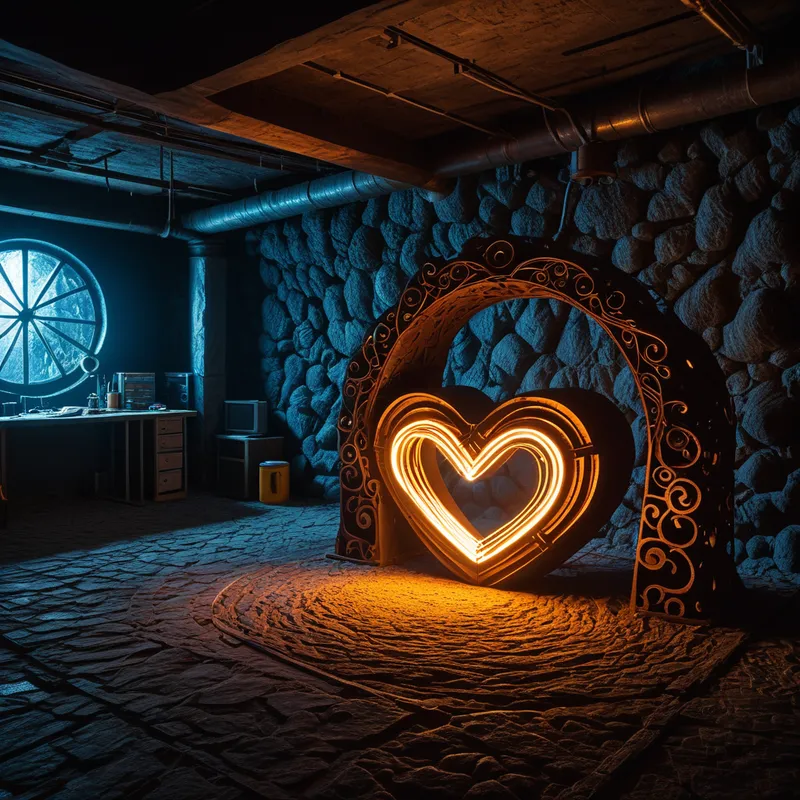
To dream of Hephaestus is to dream into the somatic reality of the creative wound. One may dream of a hidden basement workshop, a furnace in a cave, or of laboring on a complex, never-finished project while feeling isolated or physically constrained. The dream body may feel heavy, lame, or incredibly strong in the arms and hands. This is the psyche working on the level of the instinctual and the material.
Such dreams often surface during periods of felt inadequacy, after professional or personal rejection, or when one is struggling to give form to a raw, burning inner vision. The Hephaestian dream is an invitation to acknowledge the part of oneself that has been "thrown out" of the inner paradise of self-image—the flawed, the "unpresentable," the industrious but unglamorous worker. It signals a deep, often painful, process of psychic gestation where one must descend from the desire for perfect, Olympian recognition and commit to the hot, solitary, transformative work below.
Alchemical Translation
The myth of Hephaestus is a master blueprint for the alchemical process of individuation, where the base metal of the personal wound is transmuted into the gold of authentic vocation and creative power. The first stage is Nigredo: the fall, the rejection, the descent into the dark, chaotic feeling of being unloved in one’s innate nature. This is not a failure, but the necessary separatio from the collective ideal.
The nine years in the underwater cave represent the Albedo—the long, patient, lunar work of purification and learning in solitude. Here, in the unconscious, one learns the tools of one’s own transformation. The return to Olympus and the forging of divine artifacts symbolize the Rubedo and Citrinitas: the reddening and yellowing, where the transformed consciousness reintegrates with the world, not as a supplicant, but as an indispensable, creative force. The individual no longer seeks validation from the "gods" of external approval, but becomes the source of the very structures—the thrones, the nets, the lightning—that shape reality.
The goal is not to heal the limp, but to discover that the forge itself was built around it. Our deepest flaw is the cornerstone of our unique creation.
The ultimate alchemy is the realization that the rejected, wounded self and the brilliant, creative self are one. The fire that powered the fall becomes the fire of the forge. In binding his mother, Hephaestus forces the archetype of the rejecting parent to confront and be held by the creative power it spawned. For the modern individual, this translates to consciously holding and working with our core wounds, not to erase them, but to let them, through the disciplined fire of attention and craft, become the source of our most authentic and enduring works. We become, like him, the architects of our own destiny, building from the very fractures in our foundation.
Associated Symbols
Explore related symbols from the CaleaDream lexicon: