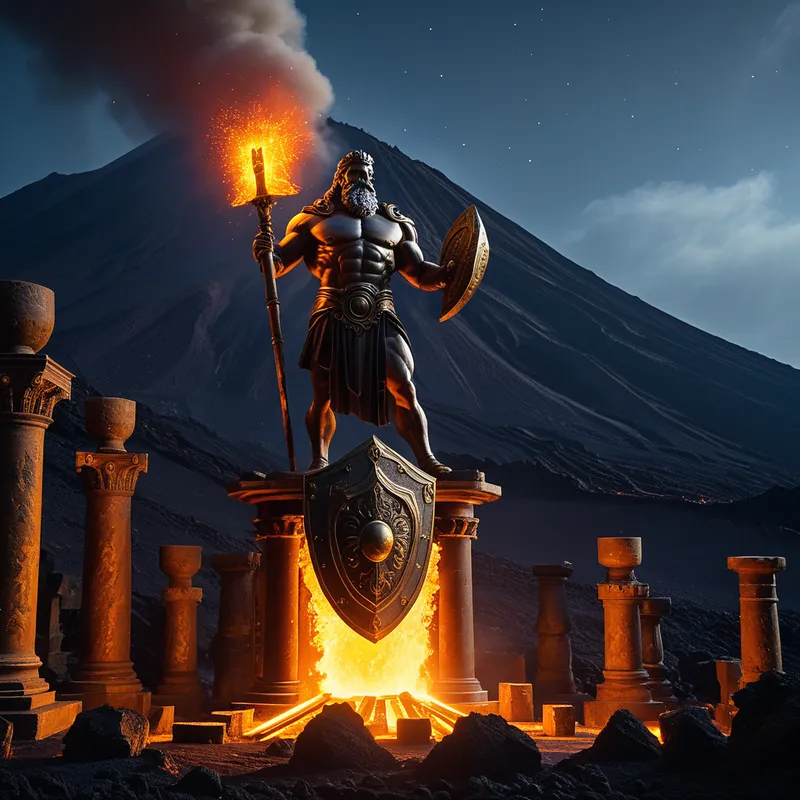
Hephaestus' Workshop Myth Meaning & Symbolism
The myth of the divine smith, cast out yet master of the subterranean forge, where raw material and profound pain are transmuted into artifacts of power and beauty.
The Tale of Hephaestus' Workshop
Hear now the tale not of sunlit Olympus, but of the world’s deep, fiery heart. It begins with a cry and a fall—a divine child, Hephaestus, hurled from the gleaming heights by a mother ashamed of his lameness. He tumbled through the vault of heaven for a day and a night, a falling star of rejected potential, before crashing into the wine-dark sea. The Nereids, Thetis and Eurynome, rescued him. In a watery grotto, they nursed the broken god, and there, in the echoing dark, his genius first stirred. With shells and coral, he crafted his first trinkets—a prelude to the symphony of creation to come.
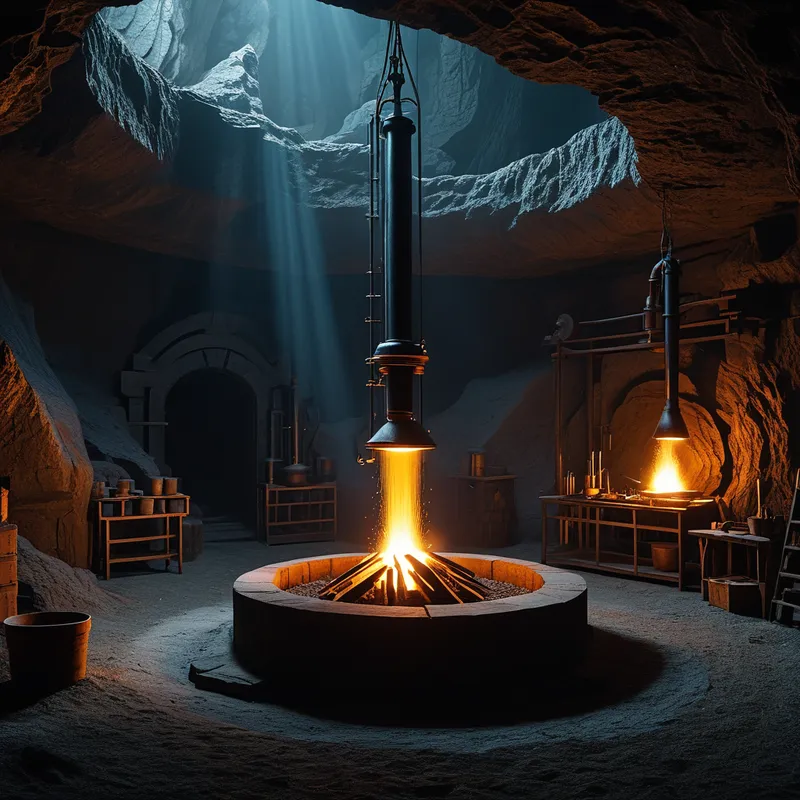
Years passed. The sea-cave could not contain the roaring vision within him. He sought a womb of earth and fire. He found it in the bellies of great mountains—Aetna, Lemnos, Lipara. Here, he built his true domain. Picture it: a cavernous hall lit not by sun, but by the pulsing, orange glow of twenty furnaces. The air shimmers with heat, thick with the scent of ozone, molten metal, and charcoal. The floor trembles with the rhythmic clang-clang-clang of divine hammers. This is no lonely hole; it is a thriving, clanging cosmos. Golden Maidens, endowed with mind and voice, move with graceful purpose, stoking fires, carrying ingots. Three-legged tables with wheels of gold trundle about on their own accord.
And at the center, the master. Hephaestus, his brow beaded with sweat that sizzles on the anvil, his powerful arms—one perhaps thicker, bearing the memory of his fall—working with a precision that makes the Fates themselves lean closer to watch. Here, under the mountain’s weight, he forges the infrastructure of reality. He creates Zeus’s terrifying thunderbolts. He sculpts Aphrodite’s irresistible girdle. He builds Apollo’s sun-chariot and Artemis’ silver bows.
But his greatest works are born from his deepest wounds. When his mother, Hera, slighted him again, he did not rage openly. He retired to his forge and wrought a masterpiece of subtle revenge: a magnificent, jeweled throne. When Hera sat upon it, invisible, unbreakable bonds snapped shut, holding her fast. The gods pleaded, threatened, but only the smith’s secret knowledge could free her. It was Dionysus, who understood the wisdom of the outcast, who descended to the workshop. He made Hephaestus drunk, draped him over a mule, and led the laughing, stumbling god back to Olympus—not as a supplicant, but as a liberator and a power in his own right. The bonds were loosed, and Hephaestus, the once-rejected, was welcomed home, his workshop now the acknowledged crucible of divine order.
Cultural Origins & Context
This myth was not a single, codified text, but a living narrative woven through the epic poetry of Homer and Hesiod, and later elaborated by lyric poets and playwrights. It was a story told by a culture navigating its own relationship with technology (techne), disability, and social integration. The Greeks, master craftsmen in stone, metal, and clay, saw their own artisan class reflected in the divine smith. His workshop was a mythological mirror for the real-world foundries and pottery kilns that were essential, yet often relegated to the smoky outskirts of the polis.
Hephaestus’ lameness and his fall were not mere details but central to his identity. In a culture that prized physical perfection (arete), his myth provided a profound counter-narrative: that power and creativity could erupt from the site of injury. His workshop, located in volcanic, liminal spaces—neither fully of the underworld nor the mortal realm—symbolized the transformative, dangerous, and essential nature of craft itself. The myth functioned to sanctify the act of making, to explain the awe-inspiring yet terrifying power of fire and metal, and to offer a complex model of the deity who, though physically “other,” was indispensable to the cosmic and social order.
Symbolic Architecture
Hephaestus is the archetype of the Wounded Creator. His lameness symbolizes a fundamental rift, a perceived inadequacy or trauma that exiles him from the “perfect” collective consciousness of Olympus. His workshop, therefore, is not just a workplace; it is the temenos, the sacred precinct of the psyche where this wound is not merely endured, but actively engaged.
The forge is the crucible of the soul, where the base ore of suffering is held in the fire of conscious attention until it becomes the shaped artifact of meaning.
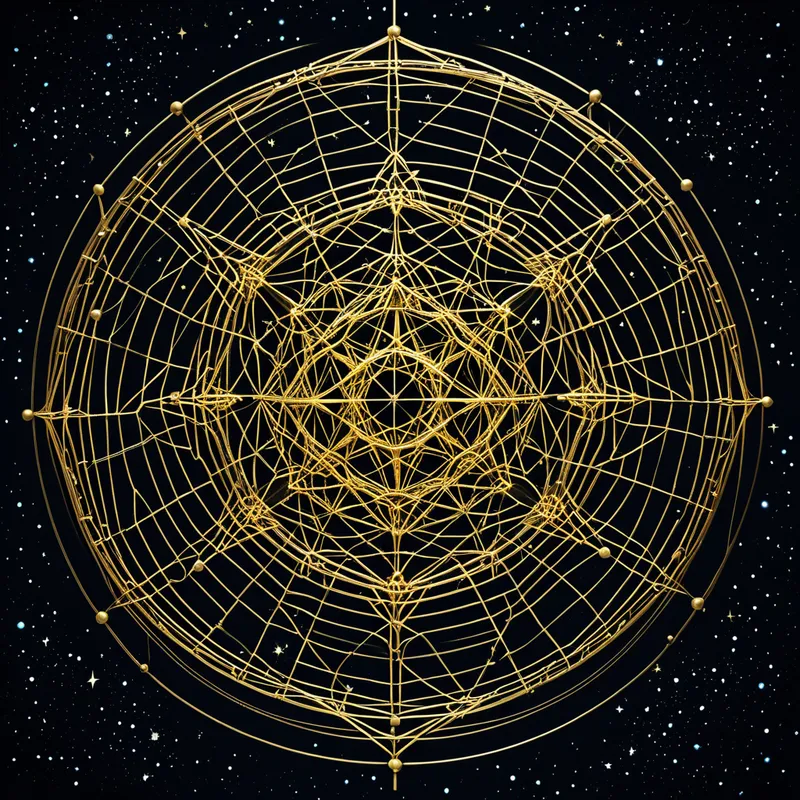
The fall from heaven represents a brutal initiation into the realm of matter, of gravity, of limitation. The golden automata are not just robots; they symbolize the god’s ability to externalize his inner faculties—thought, speech, movement—into autonomous, functioning forms. They represent the psyche’s capacity to build complex internal structures (habits, skills, sub-personalities) that can operate independently, freeing conscious attention for the masterwork. The infamous golden net, with which he trapped Aphrodite and Ares, is the ultimate symbol of his craft: it is intelligence made manifest, a web of perfect, pre-conceived design that ensnares chaotic, passionate forces.
The Dreamer's Resonance
When the motif of Hephaestus’ Workshop appears in modern dreams, it signals a profound somatic and psychological process underway. The dreamer may find themselves in a basement, a garage, a boiler room, or a cavern—any low, interior, often neglected space that hums with latent energy. This is the psyche’s workshop, the place of shadow work.
Somatically, this can correlate with a focus on the lower body, the legs, or the hands—the sites of support and manipulation. There may be a felt sense of pressure, heat, or a rhythmic, compulsive need to “work something out.” Psychologically, the dreamer is in the phase of concentration, gathering the scattered and often painful elements of their experience (the raw ore). The figure of the smith, often shadowy or with their back turned, is the emerging Self, the inner architect who knows how to work with these materials. Dreams of broken tools, stalled fires, or molten metal cooling too quickly speak to frustrations in this process—a lack of the necessary emotional heat (libido) or a fear of the transformative fire itself.
Alchemical Translation
The myth of Hephaestus models the alchemical process of individuation with stark clarity. The initial nigredo (blackening) is his fall and rejection—the descent into the abyss of shame, isolation, and identification with one’s flaw. The sea-nymphs’ grotto represents the albedo (whitening), a hidden, reflective space for cleansing and the first glimmer of conscious reflection.
The workshop itself is the stage for citrinitas (yellowing) and rubedo (reddening)—the sustained, fiery work of transformation. Here, the conscious ego (Hephaestus) must collaborate with the raw, instinctual forces of the unconscious (the volcanic fire, the brute metal). The act of forging is active imagination: holding the tension between a painful memory (the ingot) and a conscious intention (the mold, the hammer’s blow) until a third, transcendent thing (the artifact) emerges.
One does not heal the wound to return to a state before the wound. One builds the workshop around the wound, and from its very contours, learns to forge.
His return to Olympus on the back of Dionysus’ mule is the final, crucial stage. Dionysus, god of ecstasy and dissolution, represents the necessary irrationality, the “divine drunkenness” that loosens the ego’s rigid identification with its role as the suffering artisan. It is the moment of humor, release, and integration. Hephaestus does not return because he was “fixed,” but because his unique, forged power is now recognized as essential to the completeness of the psychic pantheon. The workshop remains active below, but the creator is now a welcomed part of the whole, his craft the necessary process that transmutes the base suffering of existence into the artifacts of a meaningful life.
Associated Symbols
Explore related symbols from the CaleaDream lexicon: