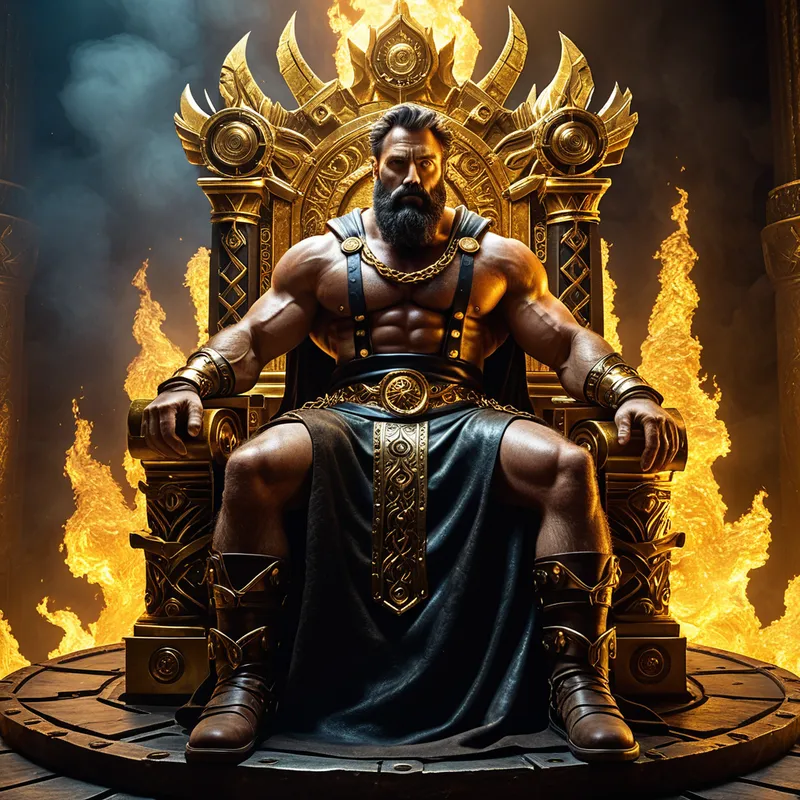
Hephaestus' Throne Myth Meaning & Symbolism
The exiled god of the forge crafts a magical throne that ensnares his mother, Hera, forcing a confrontation that renegotiates his place on Olympus.
The Tale of Hephaestus' Throne
Hear now the tale not of glorious battle or amorous conquest, but of fire, metal, and a wound that would not heal. It begins in the cold, thin air of Olympus, a realm of perfect, untouchable beauty. But perfection has its cracks, and from one such fissure was born Hephaestus. His birth was a scandal to his mother, Hera, who gazed upon her son—his leg twisted, his form deemed unworthy of the divine court—and in a moment of shame and fury, cast him from the heavenly gates.
He fell for a day and a night, a burning star of potential and pain, until the sea swallowed him whole. There, in the sun-dappled deep, the Nereids, Thetis and Eurynome, took pity. They raised him in a grotto lined with coral and pearls, and there, the spark within him kindled. The heat of his rejection found its outlet not in rage, but in rhythm: the hammer’s fall, the bellows’ sigh, the song of molten bronze. He became the unmatched Artificer, his twisted leg the foundation of a strength that moved mountains of ore.
Yet, the memory of that first, cruel rejection smoldered in his forge-heart. From this hidden fire, he conceived a masterpiece of vengeance. Not a sword or spear, but a throne. He labored in secret, pouring all his skill, his loneliness, his longing for acknowledgment into its form. It was a wonder to behold: gold inlaid with silver, studded with gems that held the light of captured stars. But within its beauty lay a cunning trap, a labyrinth of invisible bonds woven into the very artistry of the seat.
When it was complete, he sent it as a gift to Olympus, a peace offering to his mother, Hera. The Queen of Heaven, seeing its unparalleled splendor and perhaps feeling a distant pang, accepted it. She ascended the steps and took her seat upon the divine artifact. The moment her body settled into the crafted gold, the mechanism awoke. Invisible chains, gentle as silk but unbreakable as fate, coiled around her, binding her fast. No godly strength could loosen them; no command from Zeus could make them yield. The source of the trap was the trap itself, and only its creator held the key. Hera was imprisoned by a gift, a prisoner of her own son’s exquisite, wounded creativity.
Olympus was thrown into chaos. The gods pleaded, threatened, bargained. The war-god Ares stormed down to drag Hephaestus back by force, but was driven back by the artificer’s torrents of fire and clever automatons. Finally, it was Dionysus who succeeded, not through might, but through mirth. He descended with his retinue of satyrs, flooded Hephaestus’s workshop with wine and revelry, and coaxed the smith-god onto a donkey in a state of drunken good humor. Thus, the mighty craftsman returned to Olympus not as a conqueror, but in a ridiculous, Dionysian procession.
Confronted with his bound mother, the moment of triumph turned to ash. The rage dissipated, leaving only the raw, ancient wound exposed. A negotiation began, not of power, but of presence. In exchange for Hera’s release, Hephaestus demanded what he had always been denied: a rightful seat among the Olympians, recognition of his divine lineage, and the hand of Aphrodite in marriage. The terms were met. The bonds were loosed. And Hephaestus, the once-exiled, took his place at the fiery heart of the divine family, his lameness no longer a mark of shame, but the signature of the one who holds heaven and earth together with his craft.
Cultural Origins & Context
This myth comes to us primarily from the epic tradition, with versions appearing in the Iliad and elaborated upon by later poets and mythographers like Pseudo-Apollodorus. It was not a central cult myth tied to a specific festival, but rather a deeply psychological narrative that circulated in the oral and literary bloodstream of Greek culture. It functioned as an aetiology—a story explaining why things are the way they are. It explained Hephaestus’s lameness, his marriage to the beautiful but unfaithful Aphrodite, and, most importantly, his paradoxical status as both an outsider and an indispensable member of the Olympian pantheon.
Told in symposia and by rhapsodes, the story served multiple societal functions. It affirmed the value of the technē (craft, art) in a society that often prized aristocratic warrior virtues above all. It presented a complex model of conflict resolution that involved negotiation and integration rather than simple annihilation. Furthermore, it explored the fraught dynamics of the family, even the divine family, giving voice to the universal themes of parental rejection and a child’s struggle for identity and respect.
Symbolic Architecture
At its core, the Throne is not merely an object, but a psychic complex made manifest. It is the embodied result of a primal wound—rejection by the source of one’s being (the Mother/Anima archetype in its negative aspect). Hephaestus does not repress this pain; he sublimates it. He channels the fire of his humiliation into the forge of creation.
The most profound prisons are not built of stone, but crafted from our unloved gifts, presented as offerings to those who first refused them.
The throne symbolizes this dangerous alchemy. It is breathtakingly beautiful, a testament to supreme skill (the developed ego and its capacities), but its primary function is binding. It is the "negative mother complex" turned inside out: the child’s creative power used to imprison the very archetype that wounded him. Hera’s entrapment represents the state of being psychologically bound by one’s own unresolved history—the mother archetype frozen in its rejecting form, paralyzing further development.
Hephaestus’s return via Dionysus is crucial. The rational, crafting consciousness (Hephaestus) cannot resolve its own deep trauma. It requires the intervention of the irrational, instinctual, and ecstatic (Dionysus) to be loosened from its defensive posture and brought to the bargaining table of the psyche.
The Dreamer's Resonance
When this myth pattern stirs in the modern dreamer, it often signals a profound engagement with what psychologist James Hillman called the "archetype of the wounded artist" or the "rejected creator." One may dream of crafting an elaborate, ingenious device meant to win approval, only to see it malfunction or trap someone. Or one may dream of being bound by something beautiful—a piece of jewelry, a contract, a home—that has become a gilded cage.
Somatically, this can feel like a constriction in the chest or throat, a creative "block" that is charged with old resentment. Psychologically, the dreamer is at the stage where a long-nurtured grievance, often tied to family dynamics or professional disrespect, has been transformed into a sophisticated identity: "I am the brilliant but unappreciated one." This identity, like the throne, is a magnificent creation that ultimately binds the dreamer, preventing genuine connection and new growth. The dream is the psyche’s signal that the trap has been set, and the time for the Dionysian intervention—the release of emotion, instinct, or a radically new perspective—is at hand.

Alchemical Translation
The journey of Hephaestus models the individuation process of integrating the wounded, rejected parts of the self. The initial fall represents the necessary separation from the parental complex, a painful but fertile descent into the unconscious (the sea). The nurture in the grotto is the stage of tending to one’s unique talents and wounds away from the judgmental gaze of the old order.
The crafting of the throne is the negative sublimation phase, where creative energy is still in service to the old wound, creating brilliant but ultimately imprisoning structures—perfectionistic projects, careers built on proving others wrong, relationships based on old dynamics.
Individuation demands not the destruction of the throne, but the liberation of its creator from needing to use it.
The Dionysian return is the crucial enantiodromia—the swing to the opposite. The rigid, defensive ego-structure (Hephaestus the resentful smith) must be "intoxicated," loosened by the fluid forces of the unconscious (wine, emotion, instinct) to be brought back to the seat of consciousness (Olympus). The final negotiation is the integration. Hephaestus does not destroy his throne nor his mother; he uses them as leverage to secure his legitimate place. Psychologically, this means the dreamer learns to acknowledge the wound (Hera bound) not as a defining tragedy, but as a fact of their history. They then use the strength and skill forged in that fire to demand and create a new, authentic position in their own psychic pantheon. The crafted object of vengeance is transformed into the seat of acknowledged, sovereign power. The fire of rejection becomes the sustaining hearth of a hard-won self.
Associated Symbols
Explore related symbols from the CaleaDream lexicon: