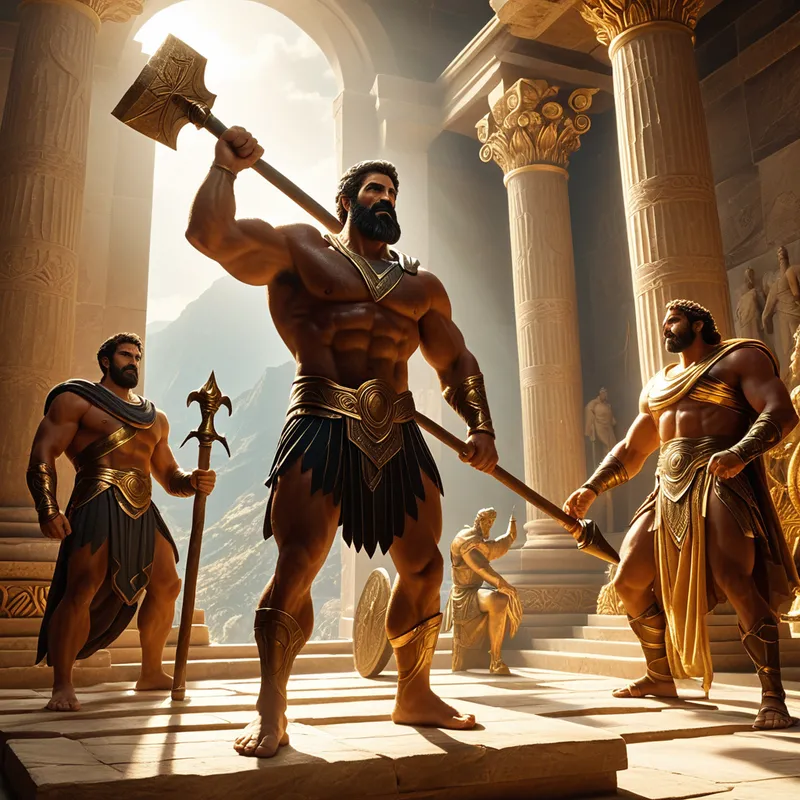
Hephaestus' Net Myth Meaning & Symbolism
The lame god Hephaestus forges an unbreakable, invisible net to ensnare his wife Aphrodite and her lover Ares, exposing divine infidelity to the Olympian court.
The Tale of Hephaestus' Net
Hear now the tale of the unbreakable snare, a story not of thunder or lightning, but of fire in the forge and ice in the heart. It begins in the smoky, rhythmic depths of Hephaestus' workshop, far from the sun-drenched peaks where the other Olympians revel. Here, the air smells of hot metal and singed earth. The god, his powerful frame supported by a sturdy staff, moves with a halting gait, but his hands—oh, his hands are the hands of a creator. They are stained with soot and scarred by sparks, yet they can coax beauty and terror from raw ore.
His heart, however, is a colder metal. He is wed to Aphrodite, born of sea foam, a creature of laughter and fleeting touch. Their union is a mismatch written in the stars: the solid, enduring earth married to the capricious, shifting sea. And while Hephaestus labors, beating form into chaos, whispers slither through the halls of Olympus. They speak of his wife and Ares, the fierce and beautiful god of war. Their passion is not a secret; it is an open wound that only Hephaestus pretends not to see.
But a craftsman’s patience is deep, and his vengeance will be a masterpiece. He does not raise a sword or a shout. Instead, he returns to his anvil. For days and nights, the rhythmic clang ceases. In its place is a subtle, almost silent work. He draws strands finer than spider’s silk from the heart of gold and adamant, weaving them not with a loom, but with divine intention. He forges a net—a web of chains so fine they are invisible, yet so strong they could bind a Titan. This is no weapon of blunt force; it is a trap of perfect, cruel geometry.
He announces a journey to his beloved forge on Lemnos. The echo of his departure has not faded before Ares slips into the marital chamber. The lovers believe themselves unseen, wrapped in their own fiery world. But Hephaestus has not left. From the hidden mechanisms in the very walls, his creation is unleashed. The net, hanging unseen above the bed, descends. It falls with a whisper, a gossamer shroud that becomes an instant, inescapable prison. It clings to every contour, a second skin of captivity. They struggle, but the more they move, the more perfectly the net constricts, until they are locked in an absurd, intimate tableau—fused together not by passion, but by impeccable craft.
Then, the doors are thrown wide. Not with rage, but with a grim, theatrical flourish, Hephaestus summons the pantheon. "Come!" he cries, his voice echoing through the halls. "Come and see! Behold the loyalty of my wife and the valor of the god of war!" One by one, the gods arrive: Zeus, frowning; Hermes, with a sly smile; Poseidon, roaring with laughter. They crowd the doorway, gazing upon the captured lovers. The air, once charged with secret passion, now crackles with exposure. Aphrodite burns with shame, Ares with impotent fury, but the net holds. It is Hephaestus’ moment of supreme, silent power. He has transformed his humiliation into a spectacle, his pain into a public proof. In the end, it is Poseidon who negotiates their release, promising a fine from Ares. The net is withdrawn, the lovers flee, but the memory of that perfect, golden trap is woven into the fabric of Olympus forever.

Cultural Origins & Context
This myth, preserved most famously in the eighth book of Homer’s Odyssey, where the blind bard Demodocus sings it in the court of the Phaeacians, served a complex function in ancient Greek society. It was not merely a divine soap opera but a narrative vessel for exploring profound social and existential tensions. The tale was told in symposia and around hearths, a cautionary and cathartic story about the limits of craft, the chaos of desire, and the volatile nature of timē.
Hephaestus, the physically imperfect god, represents the artisan class—essential, powerful in his domain, yet often socially marginalized by the aristocratic warrior ideal embodied by Ares. The net is the ultimate expression of the craftsman’s power: intelligence and skill overcoming brute strength. The public shaming ritual orchestrated by Hephaestus mirrors the ancient Greek concept of aischynē, a potent social corrective. By making the private transgression a public spectacle, he temporarily inverts the social order, forcing the beautiful, powerful gods to experience the vulnerability he lives with daily. The gods’ laughter is not just mockery; it is a recognition of the absurdity exposed and a release of social tension, acknowledging that even the divine are subject to folly and the consequences of their actions.
Symbolic Architecture
The myth’s power lies in its dense symbolic architecture, where every element is a facet of a psychological truth.
The trap is always a mirror of the trapper’s deepest need. Hephaestus does not forge a cage of iron, but a net of connection—a cruel parody of the intimate bond he was denied.
First, The Net Itself. It is not a weapon of destruction but of revelation and restraint. Symbolically, it represents the unconscious mind’s capacity to ensnare us in the patterns we ourselves have crafted—our fixed ideas, our resentments, our brilliant but imprisoning solutions. It is invisible until it is triggered, much like a complex we are unaware of until it is activated by circumstance. It is a perfect, logical, and utterly soul-killing creation.
Hephaestus embodies the wounded creator, the intellect divorced from eros. His lameness signifies a felt inadequacy, a disconnect from the instinctual, flowing world. His creative fire is channeled not into life-giving union but into a mechanism of control and exposure. He is the archetype of the mind that, when betrayed by the heart, seeks not healing but forensic proof of its injury.
Aphrodite and Ares trapped together represent the raw, unintegrated union of Love and Strife, desire and aggression. This is passion in its unconscious, compulsive form—a force that believes itself hidden and free but is ultimately bound by its own nature. Their capture is the moment the unconscious complex is brought to light, where instinctual drives are frozen and exposed to the judging gaze of consciousness (the other gods).
The Dreamer's Resonance
When this myth stirs in the modern psyche, it often manifests in dreams of exposure, intricate traps, or being caught in a compromising situation of one’s own making. To dream of Hephaestus’ Net is to encounter a moment of profound psychological exposure.
The somatic sensation is often one of constriction combined with piercing clarity—a feeling of being perfectly, helplessly seen in a state of vulnerability or shame. The dreamer may be the one caught, experiencing the hot shame of Aphrodite or the furious impotence of Ares. Alternatively, they may be Hephaestus, orchestrating a complex scenario to reveal a truth about another, fueled by a cold, righteous anger. The dream signals that a hidden dynamic—a betrayal of self or by another, a secret passion, a long-nursed resentment—has reached a point of critical mass. The unconscious has constructed its own “net” and sprung the trap, forcing what was hidden into the open of conscious awareness. It is a painful but necessary stage in shadow integration, where the parts of ourselves or our relationships we have refused to acknowledge can no longer be ignored.

Alchemical Translation
The alchemical journey modeled here is the transmutation of wounded intellect into integrated wisdom. Hephaestus begins in the nigredo: the black despair of betrayal and marginalization. His first creation from this place is the net—a brilliant but destructive product of his pain. This is the ego’s attempt to solve a problem of the soul with the tools of the mind, resulting in a masterpiece of imprisonment.
The alchemical fire must first forge the trap before it can be used to melt the chains. The craftsman must be ensnared by his own craft to understand its purpose.
The pivotal alchemical moment is the exposure. The public shaming is the albedo, a harsh, illuminating light cast upon the contents of the unconscious (the entangled lovers). This painful revelation is necessary. The ego (Hephaestus) must witness the raw, instinctual complex (Ares/Aphrodite) in its captured state, and the community of the psyche (the other gods) must acknowledge it. The laughter of the gods is crucial—it represents the transcendent function, the ability of the psyche to see the absurdity and relativity of the situation, which begins to dissolve its absolute power.
The true transmutation, the rubedo, is not depicted in the myth but is implied in its resolution. Hephaestus releases the captives. The net, having served its purpose of revelation, is withdrawn. The fine paid by Ares is a symbolic integration: the aggressive, passionate principle must compensate the creative, structuring principle. For the modern individual, this translates to the process where, after the painful exposure of a complex, we do not remain in the mode of the vengeful watchman. Instead, we integrate the insight. The cunning that forged the trap is redirected. The Hephaestus within learns to use his divine craft not to bind love and passion, but to create a vessel strong and beautiful enough to hold them. The lame walk when they stop forging prisons and start building homes.
Associated Symbols
Explore related symbols from the CaleaDream lexicon: