Hephaestus' Lemnian Forge Myth Meaning & Symbolism
The exiled god Hephaestus, cast from Olympus, finds his power and purpose in the volcanic fires of Lemnos, transforming his wound into divine craft.
The Tale of Hephaestus’ Lemnian Forge
Hear now the tale not of a god born in splendor, but of one forged in the deep earth’s fire. It begins with a cry that shattered the silent [music of the spheres](/myths/music-of-the-spheres “Myth from Various culture.”/)—the first and only cry of Hera, who bore a child alone in her jealousy. She looked upon the babe, and her heart turned to cold stone. He was not radiant like Apollo, nor swift like Artemis. He was twisted, his legs weak. In a moment of divine shame, a flaw in the perfect order of Olympus, she seized him and cast him from the high gates.
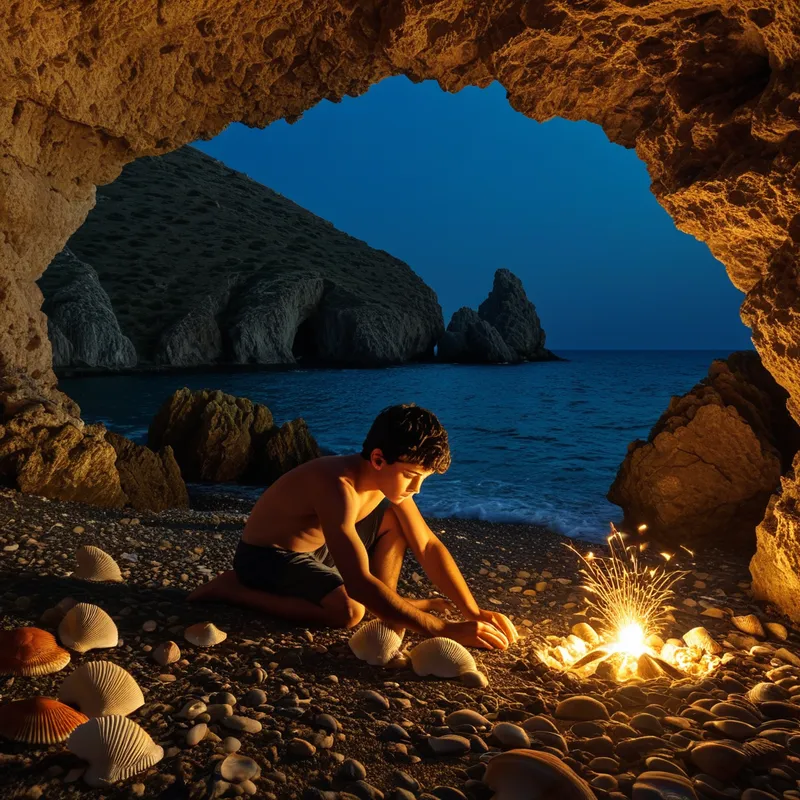
He fell. Not a meteor, but a seed of divine potential, tumbling through the vast, uncaring vault of [the sky](/myths/the-sky “Myth from Persian culture.”/) for a day and a night. The air grew thick, then salty. [The world](/myths/the-world “Myth from Tarot culture.”/) rushed up to meet him—not the marble of the gods, but the black sand and jagged cliffs of an island born of fire: Lemnos. [The sea](/myths/the-sea “Myth from Greek culture.”/) itself recoiled, then softened. The oceanid [nymphs](/myths/nymphs “Myth from Greek culture.”/) [Thetis](/myths/thetis “Myth from Greek culture.”/) and Eurynome caught his broken form in the foam and carried him to a secret grotto beneath the waves. For nine years, the waves were his cradle, the coral his first workshop. There, in the submarine dark, his fingers first learned their cunning, fashioning jewels from shell and [pearl](/myths/pearl “Myth from Chinese culture.”/) to thank his saviors.
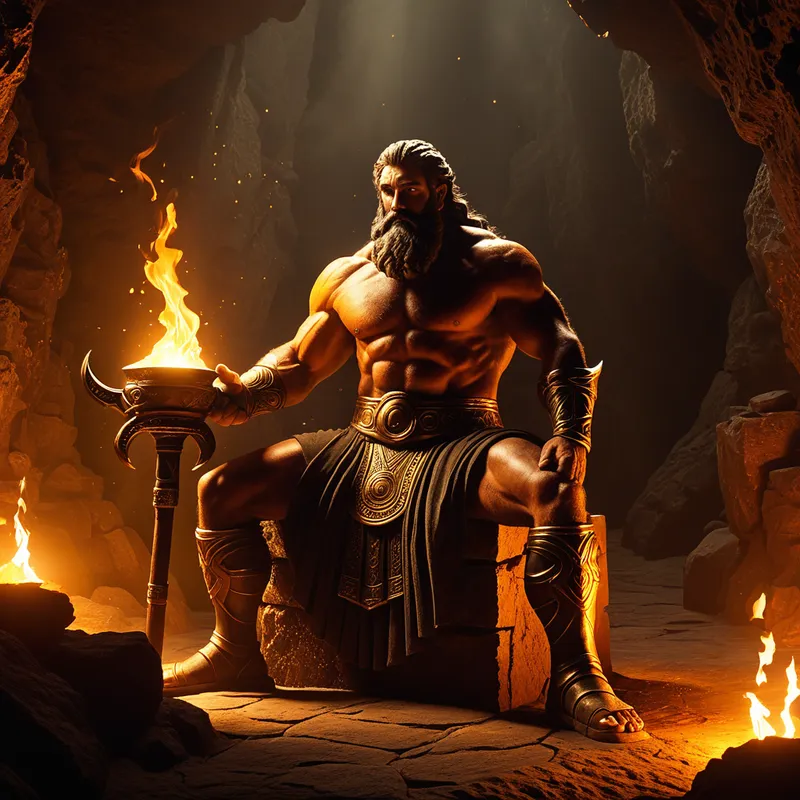
But the fire in the island’s heart called to the fire in his own. He emerged, not as a castaway, but as a claimant. He climbed not to a palace, but descended into the mountain’s throat. Here, in [the womb](/myths/the-womb “Myth from Various culture.”/) of the world, he built his true home. The Lemnian Forge was not a room but a realm: caverns where rivers of molten stone flowed like honey, where the air shimmered with heat and the constant song of hammer on metal was the only liturgy. His lameness was no impediment here; it was the root of his stability. He forged his own support—a leg brace of gold, more articulate and strong than any mortal limb. And from that anvil, born of his exile and pain, wonders flowed: Hera’s enchanted throne, Achilles’ armor, the very scepter of Zeus.
The gods who had discarded him now came as supplicants, descending to his fiery domain. They needed his art. In that moment of their need, the exiled one became the indispensable one. His return to Olympus was not a pardon, but a negotiation. He returned not as a scorned son, but as the divine artificer, [Hephaestus](/myths/hephaestus “Myth from Global/Universal culture.”/), limping on his golden brace, the sound of his step a permanent reminder that the foundation of their perfect world was forged in the imperfect, creative fire of the depths.
Cultural Origins & Context
The myth of Hephaestus’ exile and his forge on Lemnos is woven from several ancient threads, primarily found in [Homer](/myths/homer “Myth from Greek culture.”/)’s Iliad and later elaborated by poets like Apollodorus. Lemnos was a real and significant island in the Aegean, historically associated with Hephaestian worship and, tellingly, with a volcanic, chthonic character. The myth served multiple societal functions. For the Greeks, it explained the presence of divine craftsmanship and technology (techne) in the human world—it originated not in celestial perfection, but in a gritty, earthly struggle.
It also provided a complex theodicy, a way to reconcile the existence of imperfection (both physical and moral) within a divine family. Hephaestus’ story was likely told by bards and artisans alike. For the smiths, potters, and builders of the ancient world, Hephaestus was a patron who sanctified their labor. His myth validated the dignity of physical work, the intelligence of the hands, and the transformative power of the forge—a microcosm of cosmic creation. It taught that value and power are not solely the province of the beautiful and swift, but can be born from the very point of rejection.
Symbolic Architecture
At its core, this is a myth of the [Shadow](/symbols/shadow “Symbol: The ‘shadow’ embodies the unconscious, repressed aspects of the self and often represents fears or hidden emotions.”/) made sacred. Hephaestus represents the part of the [psyche](/myths/psyche “Myth from Greek culture.”/)—and by extension, of society—that is initially rejected for its perceived weakness, strangeness, or raw, unpolished [nature](/symbols/nature “Symbol: Nature symbolizes growth, connectivity, and the primal forces of existence.”/). His lameness is the “sacred wound,” the locus of both pain and unique power. His fall from [Olympus](/symbols/olympus “Symbol: In Greek mythology, Mount Olympus is the divine home of the gods, representing ultimate power, perfection, and spiritual transcendence.”/) is not merely a [punishment](/symbols/punishment “Symbol: A dream symbol representing consequences for actions, often tied to guilt, societal rules, or internal moral conflicts.”/), but a necessary descent into the raw materials of [the self](/myths/the-self “Myth from Jungian culture.”/) and the world.
The forge is not a place of escape, but of encounter. It is where the rejected element of the self is subjected to the heat of attention and the hammer-blows of discipline, to be reshaped into a source of strength and creation.
The [island](/symbols/island “Symbol: An island represents isolation, self-reflection, and the need for separation from the external world.”/) of Lemnos symbolizes the chthonic feminine and the unconscious. It is the antithesis of bright, rational Olympus. His [rescue](/symbols/rescue “Symbol: The symbol of rescue embodies themes of salvation, support, and liberation from distressing circumstances.”/) by the sea-nymphs represents the nurturing, hidden resources of the unconscious that catch us when conscious [identity](/symbols/identity “Symbol: Identity represents the sense of self, encompassing personal beliefs, cultural background, and social roles.”/) shatters. The golden [brace](/symbols/brace “Symbol: A structural support in architecture, symbolizing reinforcement, stability, and the prevention of collapse under pressure.”/) is the ultimate [symbol](/symbols/symbol “Symbol: A symbol can represent an idea, concept, or belief, serving as a powerful tool for communication and understanding.”/) of this [alchemy](/symbols/alchemy “Symbol: A transformative process of purification and creation, often symbolizing personal or spiritual evolution through difficult stages.”/): the wound itself, through conscious work, becomes the [instrument](/symbols/instrument “Symbol: An instrument symbolizes creativity, communication, and the means by which one expresses oneself or influences the world.”/) of support and the hallmark of [identity](/symbols/identity “Symbol: Identity represents the sense of self, encompassing personal beliefs, cultural background, and social roles.”/). He does not “heal” to become like the other gods; he integrates his [difference](/symbols/difference “Symbol: Difference symbolizes diversity, change, and the contrast between ideas or people.”/) into a new, self-fashioned wholeness.

The Dreamer’s Resonance
When this myth stirs in the modern psyche, it often manifests in dreams of profound isolation coupled with intense, focused creativity. One might dream of being in a basement, a garage, a hidden workshop—any secluded, earthy place where a complex, private project is underway. There is a somatic sense of pressure, heat, and rhythmic pounding. The dreamer may feel a literal or metaphorical lameness, a weight or obstruction that seems to anchor them to the spot, forcing ingenuity.
This dream pattern signals a critical phase of individuation where the psyche is working on its “Lemnian Forge.” It indicates that a part of the self, perhaps one associated with shame, injury, or social rejection, is being consciously engaged rather than repressed. The emotional tone is rarely happy; it is solemn, determined, and deeply absorbed. The dream is the psyche’s workshop, where the raw ore of traumatic experience or innate difference is being smelted into a unique form of personal authority. It is the process of building one’s own “golden brace”—a self-created structure of meaning and capability from the very site of brokenness.

Alchemical Translation
The journey of Hephaestus is a precise map for the alchemical process of psychic transmutation, the opus of turning leaden suffering into golden art. [The first stage](/myths/the-first-stage “Myth from Alchemical culture.”/), [nigredo](/myths/nigredo “Myth from Alchemical culture.”/), is [the fall](/myths/the-fall “Myth from Biblical culture.”/) itself—the crushing rejection, the experience of being cast out of one’s own perceived “Olympus” (family, community, self-image). This is the necessary dissolution, the descent into [the prima materia](/myths/the-prima-materia “Myth from Alchemical culture.”/) of pain.
Lemnos and the nymphs’ grotto represent the albedo, the washing and purification in the salty waters of the unconscious, where the identity is softened and receptive. But the true work begins in the forge, the stage of citrinitas and [rubedo](/myths/rubedo “Myth from Alchemical culture.”/)—the application of fiery, focused consciousness (the will to create) to the raw material. Here, [the ego](/myths/the-ego “Myth from Jungian culture.”/) must become the smith to its own shadow.
Individuation is not about returning to a previous state of innocence, but about forging a new, more complex integrity in the subterranean workshop of the soul. The goal is not to walk like the others, but to craft a gait that is wholly, powerfully your own.
The final stage is not merely a return, but a revelation. The transformed self, bearing the artifacts of its labor (the brace, the creations), re-enters the world of relationships and responsibility not as the supplicant, but as the one who brings an indispensable gift. The Hephaestus within does not seek approval from the inner Hera or Zeus; he establishes a new covenant based on the undeniable power and necessity of his hard-won craft. The myth teaches that our deepest value is often forged in the very place we were told had none.
Associated Symbols
Explore related symbols from the CaleaDream lexicon: