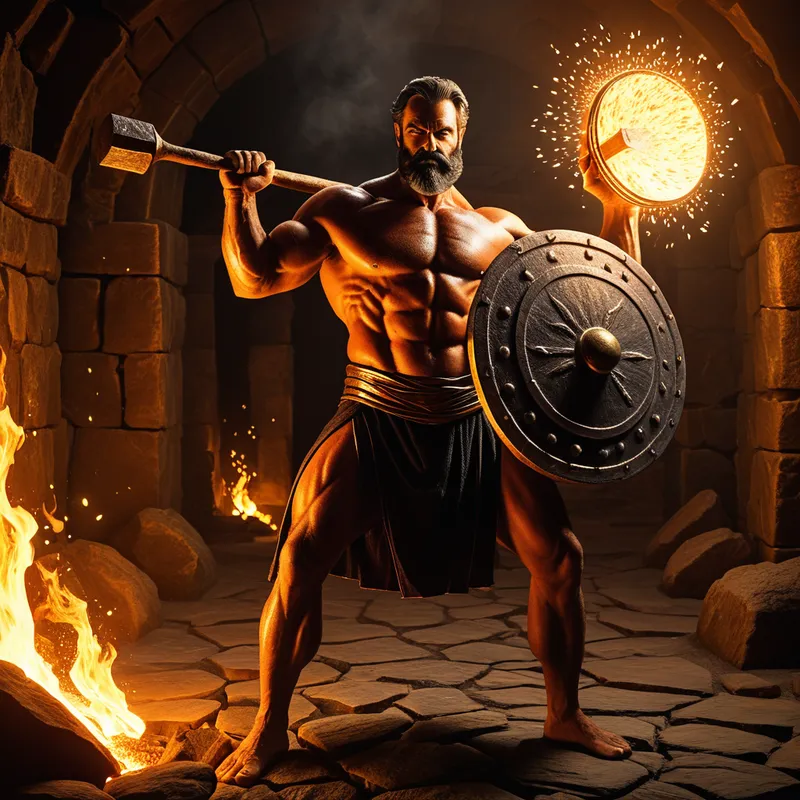
Hephaestus' Hammer Myth Meaning & Symbolism
The myth of the divine smith, cast from Olympus, who transforms his pain into creation, forging gods and heroes with his sacred hammer.
The Tale of Hephaestus' Hammer
Hear now the tale of fire born from pain, of the maker who was first unmade.
It began not with a bang of the hammer, but with a cry and a fall. On the sun-drenched peaks of Olympus, where the air tastes of nectar and the light has no shadow, a queen wept. Hera, wife of Zeus, looked upon her newborn son and saw not perfection, but a flaw. His limbs were twisted; his gait would never be the graceful stride of a god. In a moment of divine shame and rage that would echo for eons, she snatched the babe from his cradle and cast him from the high walls of heaven.
He fell for a day and a night, a tiny, burning star of potential snuffed by rejection. The sea, Thalassa, herself received him with a cold embrace, and he sank into the silent, crushing dark. But fate, or perhaps a deeper will within the world, would not let him end. Sea-nymphs, the Nereids, found him. With whispers of pity, they carried his broken form to the secret shore of Lemnos. There, in a cave that breathed the hot, sulfurous breath of the earth itself, they left him.
He grew in the dark, this god named Hephaestus. His companions were not the laughing Muses but the groaning of the mountain’s roots and the hiss of steam. His body, deemed ugly by the perfect ones above, became powerful in its own way—arms thick from dragging himself, hands broad and sensitive as they learned the contours of stone and ore. He listened to the mountain’s heart, a drumbeat of molten rock. And in that listening, he heard his own.
With nothing but raw will, he built his first tools from the bones of the earth. Then, he built his first forge. The first time he struck a spark from flint and nurtured it into a blaze, the cave did not just light up—it awoke. This was no ordinary fire. It was the fire of intelligence, of transformation. He found metal sleeping in the rock and, with heat and relentless, rhythmic blows, sang it awake. He fashioned a hammer. Not a weapon of war, but an instrument of conversation—a means to speak to the soul of metal, to ask it to become.
Years flowed like lava. His fame spread, not as the lame outcast, but as the Master Craftsman. His creations returned to Olympus: thrones of unbreakable gold, automatons that lived, jewelry that held the light of stars. He was summoned back, a god indispensable. Yet, he chose to keep his forge on Lemnos, in the womb of the earth that had nurtured him.
His greatest test came not from a monster, but from a request. Zeus, his very father who had allowed his fall, demanded a new being. From the brow of the king of gods, Hephaestus, with a blow of his wedge and hammer, released Athena, fully formed and armored. He forged the shackles that bound the Titan Prometheus, and the very chains, subtle as gossamer, that ensnared his unfaithful wife, Aphrodite, with her lover Ares. He made Achilles’ armor, a masterpiece of grief and protection. Each strike of his hammer was a word in a silent language, translating divine will, mortal need, and his own profound, unspoken history into tangible, enduring form.

Cultural Origins & Context
The myths of Hephaestus are woven into the earliest strands of Greek storytelling, appearing in the epic verses of Homer’s Iliad and Odyssey and elaborated upon in later works like Hesiod’s Theogony. He is a paradox within the pantheon: a deity of supreme technological and artistic skill who embodies physical imperfection. This was not a casual detail for the Greeks, a culture that idealized physical beauty and athletic prowess.
His myths were likely told and retold by bards at communal gatherings and in the workshops of actual smiths. For the ancient Greeks, the blacksmith’s forge was a place of awe and mystery—a spot where humans wielded a primal, dangerous element to create civilization itself (tools, weapons, art). Hephaestus mythologized this process, giving it a divine patron. His story served multiple societal functions: it explained the origin of technology and craft, provided a divine model for artisans (elevating their often-sooty work), and, crucially, offered a narrative container for the experience of marginalization. In a society obsessed with wholeness, Hephaestus represented the profound truth that wholeness can be forged, not inherited.
Symbolic Architecture
Hephaestus’ hammer is not merely a tool; it is the central symbol of his being and his philosophy. It represents the transformative application of force—not destructive, but formative. The hammer mediates between the idea and the reality, the fire and the form.
The hammer does not ask the metal if it is worthy. It meets it as it is, and through repeated, conscious blows, reveals the potential sleeping within.
His lameness is equally symbolic. It is the wound that precedes the calling. Cast from the realm of perfect forms (Olympus), he falls into the realm of matter, the underworld of the physical and the flawed. This "fall" is not a punishment but a necessary descent into the raw materials of existence—both the ore in the mountain and the pain in his own soul. His forge, located within a volcanic island, is a symbol of the vas or sacred workshop, the contained space where the heat of suffering can be safely applied to the raw matter of experience to create something new.
Hephaestus represents the archetype of the wounded creator. His power does not come from innate, untroubled perfection like Apollo’s, but from the alchemical process of integrating his fracture. He is the god of the complex, not the simple; of the made, not the born.
The Dreamer's Resonance
When the motif of Hephaestus’ hammer arises in a modern dream, it signals a profound somatic and psychological process underway. It is the psyche’s announcement of a "forging."
To dream of wielding a heavy, glowing hammer often coincides with a period of intense pressure, "heat," or feeling "under the hammer" in waking life—a career crisis, a creative block, a relational breakdown. The hammer in the dream is the tool to meet that pressure. The act of striking is not violence, but the necessary, rhythmic effort of shaping this difficult experience into something coherent.
Dreaming of a forge, especially one in a cave or basement, points to work being done in the depths of the unconscious, in the somatic and instinctual layers of the self. There is heat here—anger, passion, frustration—but it is being contained and utilized. To dream of being lame or immobilized, yet simultaneously holding great power in your hands, is a direct resonance with Hephaestus’ core paradox. It speaks to a felt sense of inadequacy or brokenness that is, in truth, the very seat of one’s unique creative strength. The psyche is reconciling the wound with the gift.
Alchemical Translation
The myth of Hephaestus is a master blueprint for the alchemical process of individuation—the journey toward psychic wholeness. It models the stages with stark clarity.
- The Fall (Nigredo): The initial rejection and casting out represents the confrontation with the shadow, with the parts of ourselves deemed unacceptable, ugly, or broken. This is the prima materia, the leaden state of depression, alienation, or crisis.
- The Descent & Containment: The fall into the sea and rescue to the cave is the necessary descent into the unconscious. The cave/forge is the vas, the ego’s capacity to create a container for this painful material, to hold it without being destroyed by it.
- The Application of Fire (Albedo): Lighting the forge is the awakening of conscious attention and emotional energy (libido) to work on the raw material. This is the beginning of purification, where one "heats" their history and pain with reflection and feeling.
- The Hammer Blows (Citrinitas): This is the stage of work, of opus. Each conscious effort to understand, to create meaning, to build a new habit or perspective, is a hammer blow. It is repetitive, often tedious, and requires immense perseverance. It is the slow shaping of the soul.
- The Return (Rubedo): The forged object—be it a piece of art, a healed relationship, a new skill, or simply a hardened, resilient self—is returned to the world. This is not a return to a naive Olympus, but the offering of one’s hard-won, unique creation. The creator is no longer defined by the wound, but by what was forged in its fire.
Individuation is not about becoming perfect. It is about becoming operational. It is the hammer forging a functional, unique, and resilient self from the ore of inherited trauma and personal suffering.
Hephaestus does not heal his lameness; he builds his power around it. He does not seek revenge on Olympus; he makes himself indispensable to it through the quality of his craft. In the end, his hammer is the symbol of the ultimate creative act: the forging of a soul. It tells us that we are not given our form. We are called to strike the blows, feel the heat, and, in the sacred workshop of our own experience, hammer ourselves into being.
Associated Symbols
Explore related symbols from the CaleaDream lexicon: