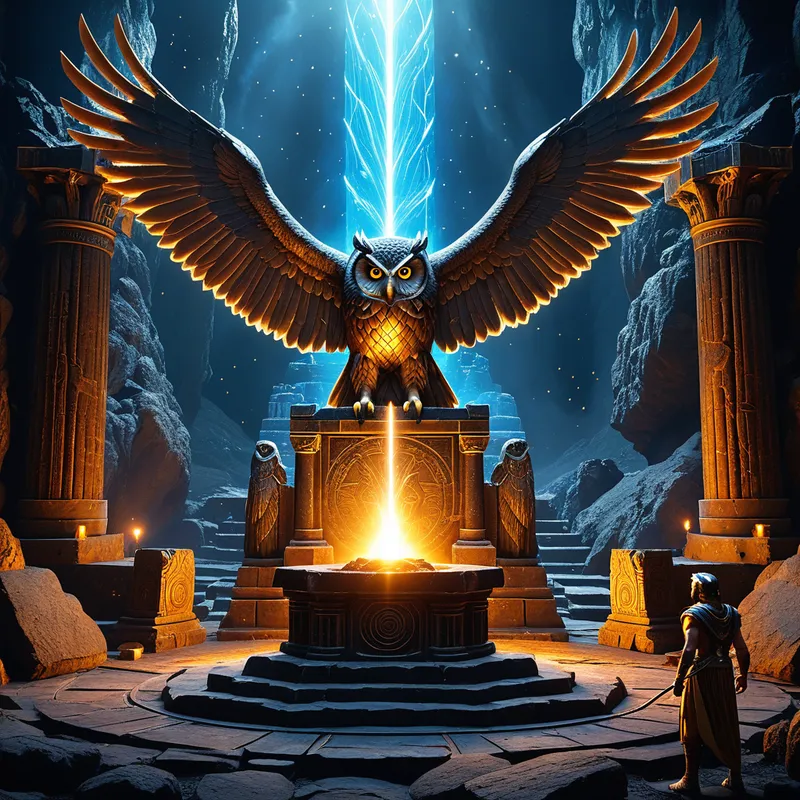
Hephaestus' forge or Athena's Myth Meaning & Symbolism
A myth of divine fire, where the wounded god of the forge and the goddess of strategic wisdom unite to create artifacts of profound power and meaning.
The Tale of Hephaestus’ Forge or Athena’s
Listen, and hear the song of the mountain’s heart. Not the cold peaks that scrape the sky, but the deep, secret ones that breathe smoke and bleed fire. Here, in a cavern where the air shimmers with heat and rings with a sound older than language—the hammer’s chant—dwells the master.
He is Hephaestus, born of Hera alone in her spite, cast out from Olympus for his imperfection. His legs are twisted, his gait a lurching rhythm that echoes the pulse of his domain. But his arms—his arms are the pillars of the world, corded with strength that can coax form from chaos. His forge is not a place of mere labor; it is a womb of potential. Rivers of molten gold and silver flow through stone channels. Bellows, worked by automatons of his own design, sigh like sleeping giants. In the eternal twilight, lit only by the heart of the earth and the bloom of white-hot metal, he works.
He makes wonders: the unbreakable throne of Zeus, the Pandora of fatal curiosity, the armor of heroes destined to live in song. Yet, for all his making, a hollow echo resides in the clangor. His creations walk in the sun, while he remains in the underworld of creation, the soot-stained god of the beneath.
Then, a different light enters the smoky gloom. It is not the flash of molten ore, but the cool, grey gleam of a wise eye. Athena has descended. She who sprang, fully armed, from the brow of Zeus, embodies the clarity of strategy, the measured line, the plan born in the mind’s silent chamber. She wears no soot, but her hands are not idle; they are the hands of the weaver, the potter, the architect of civilization itself.
She does not come to command the fire, but to converse with it. She stands at the boundary of the heat, her form a bastion of composed intellect amidst the primal roar. She speaks of purpose, of form following function, of the idea that must precede the blow. Hephaestus, his hammer stilled, listens. In her words, he hears not pity for his lameness, but recognition of his power. In his fire, she sees not chaos, but the necessary crucible for manifesting thought.
Together, they turn to the raw materials. Not just bronze and iron, but the very concepts of justice, protection, and destiny. Under Athena’s guidance, the design becomes a prayer. Under Hephaestus’s hammer, the prayer becomes substance. Perhaps it is the Aegis, fearsome and beautiful, or the fateful weapons of Achilles. The process is a silent symphony—her finger tracing a line in the ash of the floor, his nod, the hiss of quenching oil that smells of ozone and resolve. Here, in the marriage of geothermal force and celestial wisdom, artifacts are not merely made; they are born, imbued with a soul-stuff that mere skill could never instill.

Cultural Origins & Context
This is not a single, codified myth from one scroll or epic, but a powerful pattern woven through the tapestry of Greek mythology, primarily found in the works of Homer and later poets like Hesiod. It is a story told not around a single hearth, but inferred from the artifacts that populate the larger narratives: who made them, and with what counsel?
In a society that venerated both the warrior-hero and the civilized polis, this mythic collaboration served a crucial function. It reconciled two foundational yet seemingly opposed human drives: the raw, physical, and often isolating power of technē (craft, skill) and the ordered, strategic, and communal power of metis (cunning wisdom). Hephaestus, often mocked yet indispensible, represented the marginalized artisan, the genius whose labor was essential but whose person was kept at a distance. Athena, patron of the city, represented the integrating principle that brings such raw genius into the service of the collective good and higher purpose. The myth thus acted as a cultural blueprint for ideal creation: true power arises not from force or intellect alone, but from their sacred conjunction.
Symbolic Architecture
Psychologically, Hephaestus and Athena represent two fundamental, and often split, aspects of the creative Self.
Hephaestus symbolizes the Wounded Creator. His lameness is the mark of rejection, the psychic or physical trauma that forces consciousness inward, into the volcanic depths of the unconscious. His forge is the inner sanctum of complex formation—the place of intense, often painful, emotional heat and pressure where raw experience is hammered into meaning. He is the embodiment of the somatic, hands-on, persevering struggle of bringing something into being. His fire is libido, the transformative life-energy that can consume or create.
The forge is not a place of escape, but of confrontation. The god labors in the dark so that the world may hold form in the light.
Athena symbolizes Strategic Consciousness. Born from the head of the ruling principle (Zeus), she represents intellect divorced from primal, biological origin (she has no mother). She is logos, pattern, the blueprint, and the foresight of consequence. She is the capacity to step back from the fiery process, to analyze, to give direction and purpose to the chaotic creative drive. She brings the “why” to Hephaestus’s “how.”
Their collaboration is the symbol of individuated creation. It is the marriage of the deep, instinctual, wounded-healer energy with the clear, disciplined, and socially-attuned mind. The myth tells us that profound creation—whether art, a relationship, or a self—requires this inner union. Without Hephaestus’s fire, Athena’s wisdom remains an abstract, unmaterialized idea. Without Athena’s guidance, Hephaestus’s fire risks creating beautiful but dangerous or meaningless objects (like Pandora, or the net that entraps).

The Dreamer’s Resonance
When this myth stirs in the modern dreamer, it signals a profound alchemy underway in the psyche. To dream of a workshop or forge, especially one that feels both ancient and personally resonant, points to a somatic process of transformation. The heat felt in the dream is the heat of repressed emotion, forgotten trauma, or passionate potential being brought to the surface for working.
Dreaming of laboring alone at an anvil, frustrated with a piece that won’t take shape, may reflect the “Hephaestus complex”: feeling creatively potent yet isolated, defined by one’s wounds, struggling to give form to inner turmoil without a guiding vision. Conversely, dreaming of brilliant plans or designs that float, insubstantial and impossible to build, speaks to an “Athena complex”: an over-reliance on intellect severed from the grounding, messy, emotional fuel needed for manifestation.
The healing dream is the collaborative one. It might feature a guiding, calm presence (not necessarily gendered) offering insight in the workshop, or the sudden, intuitive knowledge of how to combine materials. It is the psyche’s signal that the time has come to marry your deepest, perhaps most wounded, creative instincts with your conscious intelligence and purpose.

Alchemical Translation
The alchemical journey modeled here is the conjunctio oppositorum—the sacred marriage of opposites—within the realm of the creative life. The modern individual’s “forge” is their own core complex, their central wound or passion. The first step is the descent: acknowledging the Hephaestus within, the part that feels cast out, different, and whose power is buried in volcanic emotion or obsessive focus. One must willingly enter that heat.
The second step is the invocation of Sophia (wisdom). This is the conscious, disciplined application of the Athena principle. It asks: What is this fire for? How can this intense, personal material be worked into a form that serves something greater than my own isolation or pain? This requires study, strategy, and often, a connection to a “polis” or community that gives the work context.
The gold is not in the ore, nor in the formula, but in the moment the hammer, guided by an image of wholeness, strikes.
The final creation—the “artifact” of the individuated self—is something entirely new. It is not just a product of trauma (Hephaestus alone), nor a sterile intellectual concept (Athena alone). It is a embodied truth, a piece of work or a way of being that is both fiercely authentic and wisely integrated. It carries the strength of the underworld and the clarity of the heavens. To achieve this is to become, like their collaboration, a vessel for the divine act of creation itself, transforming base, personal suffering into a timeless and useful beauty.
Associated Symbols
Explore related symbols from the CaleaDream lexicon: