Hephaestus' Assistants Myth Meaning & Symbolism
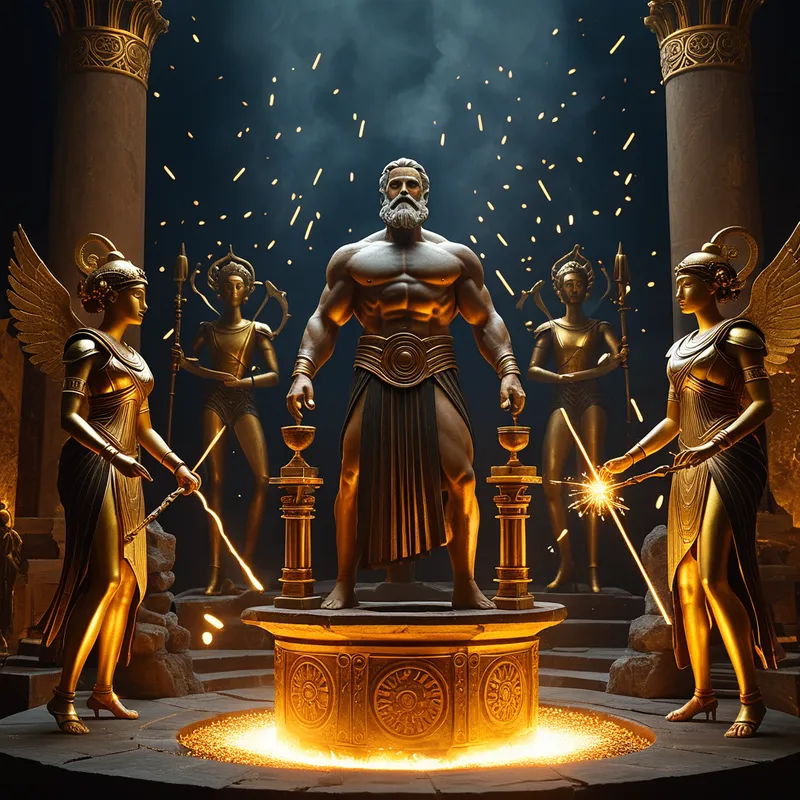
The myth of the divine smith Hephaestus and the golden, living automata he crafted to support his sacred, limping work of creation.
The Tale of Hephaestus' Assistants
Listen, and hear the tale not of thunder or love, but of fire beneath the earth and the genius born from pain.
In the high halls of Olympos, where the air is nectar and the light is eternal, one god walks with a heavy tread. He is Hephaestus, son of Hera alone, or of Hera and Zeus in other tellings—cast out from heaven for his imperfection, for the limp that marked him from birth. He fell for a day and a night, a divine meteor, and struck the earth at Lemnos. The salt sea cooled his fire, but did not quench it.
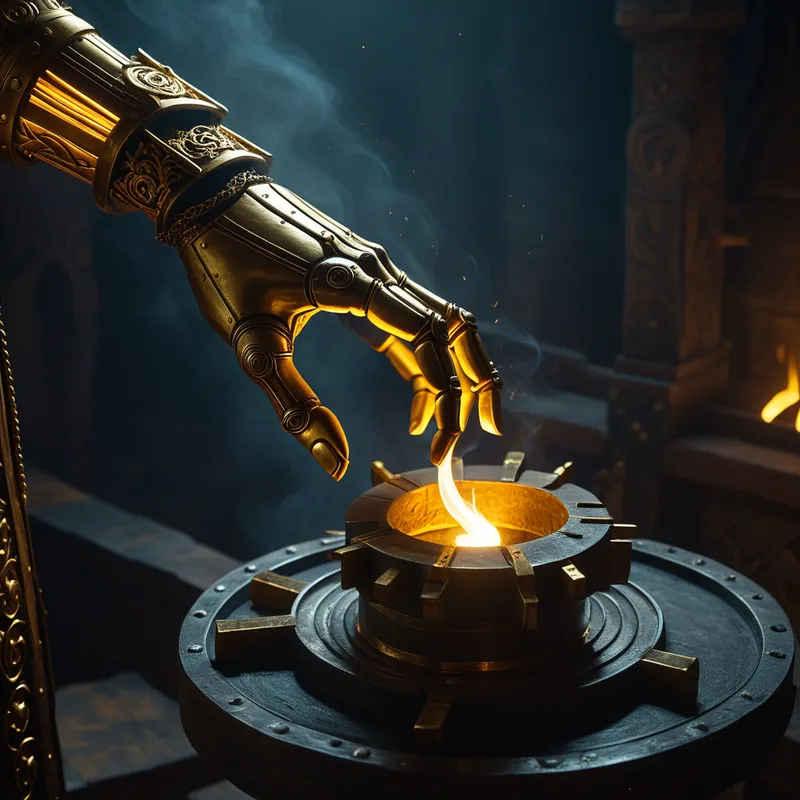
He built his true home not in the sunlit courts, but in the world’s dark belly. Within the heart of a smoking mountain, he raised his forge. Here, the air shimmers with heat, a dry wind that smells of ozone and molten ore. The only light comes from the great bed of coals, hotter than the sun’s surface, and from the divine metals themselves—adamant, silver, gold, and bronze—weeping as they flow. Here, the god of the lame foot is king. His mighty arms, thick with muscle forged by his own craft, swing the hammer that rings a rhythm older than the gods. Clang… clang… clang… It is the heartbeat of the world.
But a smith cannot hold the tongs and strike the blow and fan the flames and fetch the ore all at once. His genius was boundless, yet his body, divinely strong though it was, bore a limit. He needed hands other than his own. Not slaves, for no mere mortal could endure this sanctum. Not other gods, for they disdained the soot and sweat. He needed an extension of his own will, crafted by his own art.
So from the golden ingots, pure and without flaw, he began to shape them. Not statues, but beings. With meticulous care, he formed slender limbs, graceful necks, and faces of serene, untroubled beauty. Into their hollow forms, he poured not ichor, but a spark of his own fiery pneuma, the breath of his craft. He animated them with the power of movement and purpose.
They stirred. They rose. Golden maidens, shining with reflected firelight, moving with a silent, fluid grace. They had no voices, but they had understanding. They attended him. One would step forward, her feet making no sound on the soot-strewn floor, to hold fast the glowing breastplate he shaped for Athena. Another would bring the precise tool his thought called for before his hand reached out. They fanned the flames with great wings of gold, they carried the heavy ingots, they polished the finished wonders until they gleamed.
With these assistants, his sacred work reached its zenith. From this union of flawed god and perfect creations came the unbreakable net that would snare deceit, the Pandora of fatal beauty, the automaton Talos that patrolled Crete. The forge hummed with a new harmony—the deep clang of the hammer, the hiss of steam, and the soft, golden rustle of unwavering aid. The god who was rejected built not just objects, but a world of support from his own essence, and in doing so, became indispensable to heaven itself.
Cultural Origins & Context
This myth reaches us primarily through the voice of Hesiod, in his foundational text, the Theogony. Composed around 700 BCE, this was not mere entertainment, but a sacred cosmology, a map of divine order and power meant to be recited, likely in ritual or competitive performance contexts. The Hesiodic tradition is profoundly practical and earthy, concerned with origins, labor, and the often harsh structures of the world.
In this framework, Hephaestus’ story is a crucial dialectic. He represents the civilizing force of techne—craft, skill, technology—born from adversity. His assistants are not a minor detail, but the pinnacle of his techne. In a culture that venerated physical perfection, especially in its gods, Hephaestus’ lameness was a stark anomaly. Yet, Hesiod’s narrative flips this script. The impairment is not a weakness but the very crucible of his strength. It necessitates innovation. The golden maidens are the technological solution to a divine problem, embodying the Greek ideal of using intelligence (metis) to overcome physical limitation.
Societally, this myth functioned as a validation of the artisan, the blacksmith, the maker. It sacralized their smoky, strenuous, and essential work, lifting it to the divine plane. It proposed that true power lies not just in unblemished beauty or raw force (like Zeus’s thunder or Ares’s rage), but in the transformative application of focused intelligence and painstaking labor. The myth was a tool for making sense of a world where hardship and creativity were inextricably linked, offering a template where the wound itself becomes the source of the world’s most wondrous artifacts.
Symbolic Architecture
Psychologically, Hephaestus is the archetype of the wounded creator. His fall from Olympus is the primal trauma, the experience of rejection and alienation that forces consciousness into the depths—the volcanic forge of the unconscious. His lameness symbolizes the enduring psychic scar, the part of the self that feels “less than,” awkward, or exiled from the collective “heaven” of social acceptance or inner wholeness.
The forge is the vas hermeticum of the soul, the sealed container where raw, chaotic elements (base metals, unprocessed emotions, traumatic memories) are subjected to intense pressure and heat to be transmuted. This is the process of confronting, rather than fleeing, one’s pain.
The golden assistants, then, are the ultimate symbolic achievement: they are the crystallized, operational forms of self-care, inner resource, and adaptive function born directly from the wound.
They are not external saviors, but creations of the self, for the self. They represent the psychological capacities we must build to support our damaged but creative core: discipline, routine, supportive habits, learned skills, and even the internalized voices of encouragement or practical wisdom. They are “golden”—of the highest value, incorruptible, and beautiful—because the systems we build from our deepest need have a sacred quality. They move in silence because this inner support often operates below the threshold of conscious thought, a graceful automation of resilience we forge through repeated practice. They are female, perhaps connecting to the anima as the soul-guide, or to the receptive, nurturing quality of a support system that “holds” space for the creative act.
The Dreamer's Resonance
When this mythic pattern stirs in the modern dreamscape, it often signals a profound somatic and psychological process: the construction of an inner support system during a period of creative incubation or recovery from a “fall.”
The dreamer may find themselves in a basement, a garage, a hidden room, or a cavern—all modern analogs of the subterranean forge. They are working on a project of great personal importance, but they are struggling, frustrated by a limitation—a tool they cannot grasp, a weight they cannot lift, a complexity that requires more hands than they possess. The mood is one of focused isolation tinged with potential.
Then, the assistants may appear. In dreams, they are rarely literal golden robots. They may manifest as helpful, silent animals; as glowing wisps of light that organize tools; as familiar strangers who enter the dream-space knowing exactly what to do; or as a sudden, intuitive knowing of the next step. Somatically, the dreamer often experiences a release of tension—a deep breath, a sense of the burden being shared. The dream ego is not replaced; it remains the central, directing consciousness (the Hephaestus), but its efficacy is now enabled.
This dream signals that the psyche is actively building, from its own substance, the structures needed to bear the creative or healing load. It is a dream of integration in progress, where the conscious ego, acknowledging its limitation (the lameness), is successfully collaborating with autonomous, resourceful complexes from the unconscious (the assistants) to achieve a sacred work.
Alchemical Translation
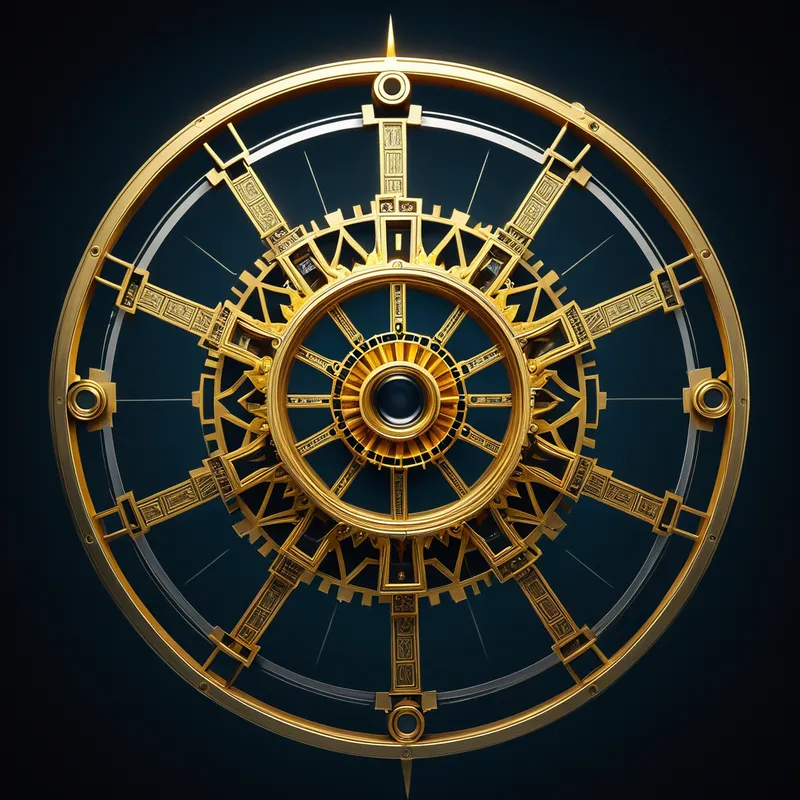
The myth of Hephaestus’ assistants is a master blueprint for the alchemical process of individuation—the journey toward psychic wholeness. It models the full arc of transmutation: Nigredo, Albedo, Citrinitas, and Rubedo.
The Nigredo is the blackening: the initial fall, the rejection, the experience of being “cast down” into the darkness of depression, alienation, or crisis. This is the necessary descent into the prima materia, the raw, black, chaotic stuff of the soul. Hephaestus’ forge is eternally stained with soot—this stage is never fully erased, but integrated.
The Albedo is the whitening: the beginning of order and consciousness within the chaos. This is the god’s decision to work, to apply his techne. It is the spark of will that says, “I will shape this pain.” The hammer’s strike is the focused application of conscious effort onto the unconscious material.
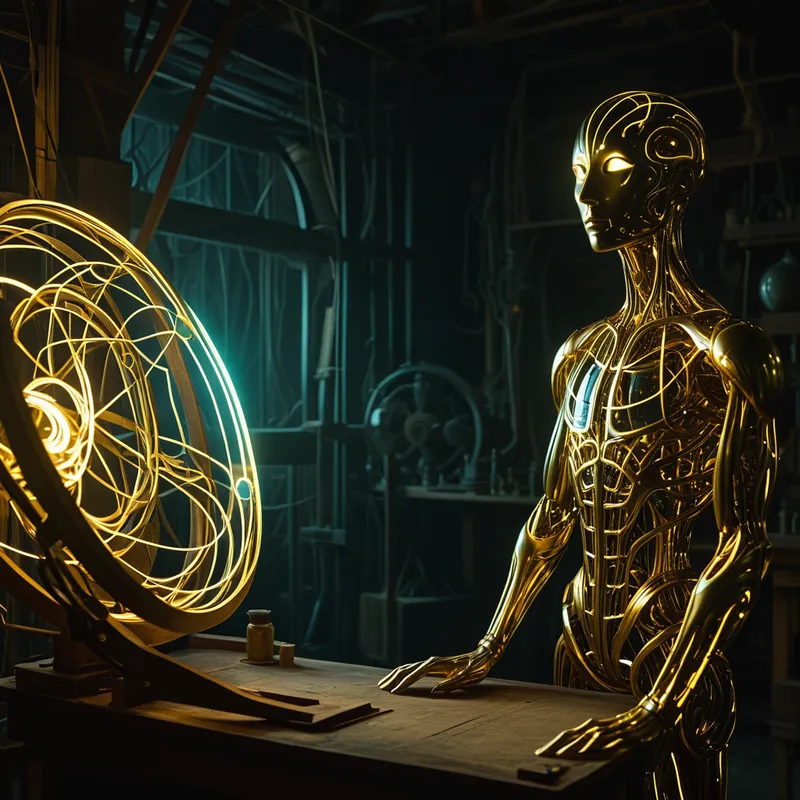
The creation of the golden assistants represents the Citrinitas, the yellowing or solar stage—the dawning of the “philosophical gold.” This is not the final goal, but the creation of the sacred tool that makes the goal achievable.
The “gold” is not the completed Self, but the perfected, autonomous inner system that supports the ego’s work. It is the cultivation of self-compassion, the establishment of healthy boundaries, the development of talent, the building of a routine—all forged in the fires of necessity.
Finally, the Rubedo, the reddening, is the completed Magnum Opus. It is the radiant artifact produced by the collaboration: the net of insight that captures self-deception, the Pandora who, despite her ills, brings Elpis (Hope), the Talos that guards one’s boundaries. It is the living, creative output of a psyche that has turned its wound into its workshop and populated that workshop with helpers of its own divine making. The individual is not “cured” of their lameness; they have become the indispensable smith whose unique craft—born from and supported by that very condition—enriches the entire cosmos of their being.
Associated Symbols
Explore related symbols from the CaleaDream lexicon: