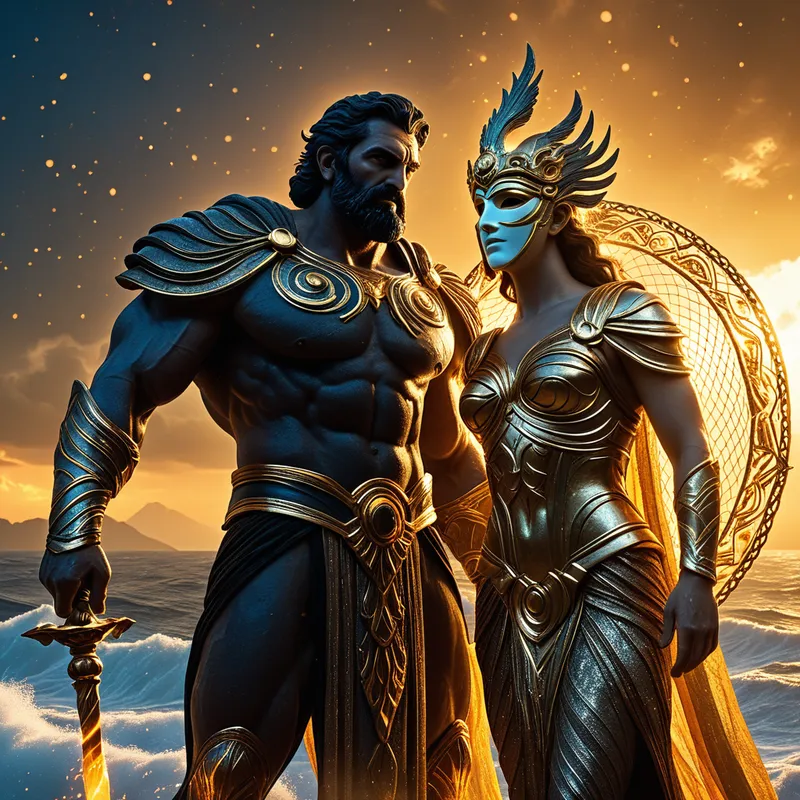
Hephaestus and Aphrodite's com Myth Meaning & Symbolism
The divine smith, betrayed by his radiant wife, forges an unbreakable net to expose her infidelity—a myth of wounded creation and the fire of truth.
The Tale of Hephaestus and Aphrodite’s com
Hear now the tale of fire and foam, of the forge and the bed, a story sung in whispers on the soot-stained winds of Lemnos and in the salt-spray of Cythera. It begins not with a bang, but with a loneliness as deep as the earth’s core.
He was Hephaestus, son of the queen of heaven, cast out for his imperfection. His gait was a lurch, his form marked by divine labor, but his hands… his hands could coax song from stone and destiny from ore. In the heart of the mountain, his forge was a second sun, where he hammered out the very sinews of the cosmos—thrones that bolstered pride, scepters that commanded fate, jewelry that captured starlight. For his service, he was given a bride: Aphrodite, she who rose from the severed genitals of the sky, a creature of perfect, effortless allure. To the gods, it seemed a fair trade: the maker’s genius for the goddess’s grace. A union of craft and beauty.
But foam cannot be bound by metal. While Hephaestus sweated at the anvil, the air around his wife grew thick with the scent of war and myrtle. Ares</ab title>, the brutal and beautiful, whose domain was the frenzy of the body, found his way to her. In the very marriage bed forged by the smith’s hope, they met, believing the clang of hammer and bellows covered their sighs. The laughter of the gods, Hephaestus sensed it—a subtle, cruel current in the halls of Olympus. He, the architect of their power, became the butt of their joke.
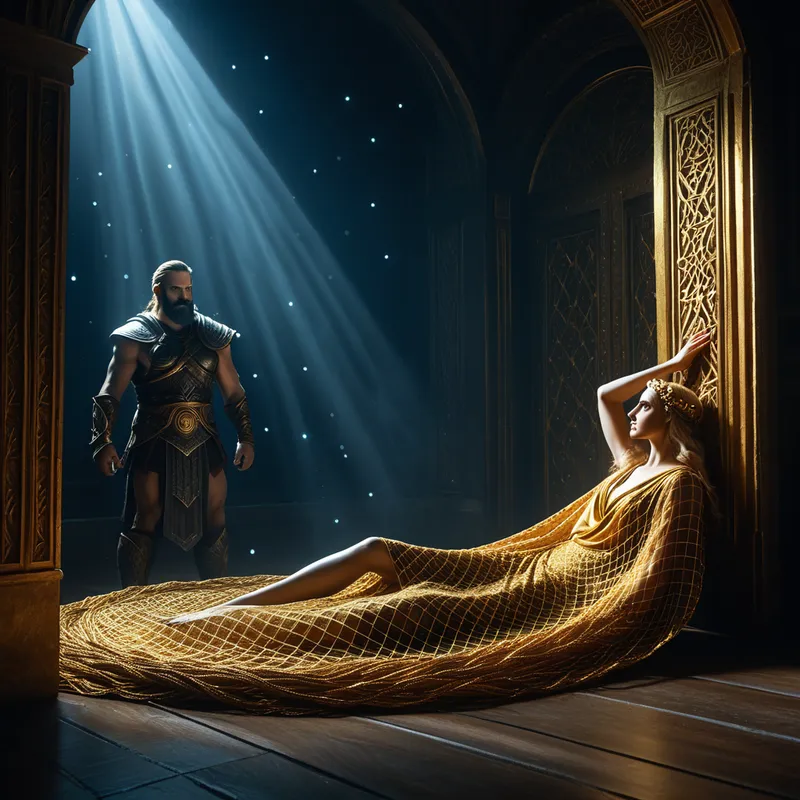
Then, the fire in his heart changed its nature. It was no longer the fire of creation, but a colder, more precise flame. He did not rage; he calculated. He returned to his forge, but this time he did not shape a gift or a weapon for another. In the dead of the celestial night, he drew out wires finer than spider-silk, stronger than destiny itself. He wove a net of gold, links so delicate they were invisible, yet so cunningly fashioned that no strength, divine or mortal, could break them. This was his masterpiece: not a thing of beauty, but a mechanism of truth.
With the care of a lover, he draped the unseen net over the bedposts and canopy. Then, he let word slip that he was departing for his beloved Lemnos. The trap was set. No sooner had the echo of his limping gait faded than Ares returned to Aphrodite’s arms. As they lay entwined, in the moment of their most intimate betrayal, Hephaestus, who had turned back, invoked his craft. The net fell, a sudden, glimmering prison. It bound them fast, skin to skin, in a grotesque parody of embrace. They were caught, utterly immobilized, their divine power useless against the artificer’s silent revenge.
Then Hephaestus did not hide his shame. He threw wide the doors of his hall and called all Olympus to witness. The gods came—Zeus, Hera, Hermes, Poseidon—and they looked upon the captured lovers. Laughter erupted, but it was not at Hephaestus now. It was the cruel, relieved laughter of those who see a secret exposed, shifting the burden of mockery. Hermes even quipped he would gladly trade places with Ares, such was the glory of the chains. Only Poseidon, uneasy at the spectacle, negotiated their release, promising compensation. The net was withdrawn. Ares fled in humiliation to Thrace; Aphrodite retreated to her sanctuary in Paphos to be restored. And Hephaestus? He stood amidst the fading laughter, the vindicated cuckold, holding his empty, perfect net.
Cultural Origins & Context
This myth is preserved primarily in the eighth book of Homer’s Odyssey, where the blind bard Demodocus sings it as entertainment in the Phaeacian court. Its transmission is oral-poetic, a story within a story, designed to delight a divine and aristocratic audience. In the context of archaic Greek society, it functioned on multiple levels. For the aristocratic warrior class, it was a cautionary comedy about hubris and the public shaming that awaits those who transgress social bonds, even gods. It reinforced the sanctity of the guest-host relationship and the marriage contract, however arranged.
The myth also reflects the complex Greek attitude towards its deities. The gods were not moral paragons but personifications of cosmic and human forces. Hephaestus represents the indispensable, undervalued artisan class—the backbone of civilization who is often scorned by the warrior aristocracy (Ares) and the privileged elite (the other Olympians). Aphrodite and Ares embody the raw, destabilizing, yet vital forces of desire and strife. The story allows society to laugh at these potent, dangerous forces while acknowledging their power. It is a societal pressure valve, using divine misbehavior to explore human social anxieties about fidelity, honor, and the conflict between inherent worth and superficial value.
Symbolic Architecture
At its core, this is a myth of the creative principle wounded by the erotic principle. It maps the psyche’s internal civil war.
Hephaestus is the archetypal demiurgos—the builder of the inner world. His lameness symbolizes the creative drive’s perceived inadequacy in the realm of instinctual, social grace. He is consciousness that feels ugly, laborious, and rejected. Aphrodite is not merely “beauty” but the anima, the soul-image, the magnetic pull towards relatedness, pleasure, and life. Her union with Ares reveals that untamed eros is often partnered with aggression, chaos, and the thrill of conflict—a union that feels vital but destructive to the structured self.
The net is the supreme symbol. It is not a weapon of destruction, but of revelation. It represents the transformative power of focused consciousness to craft a structure—a thought, an insight, a work of art—so precise that it can capture and make visible the hidden, chaotic dynamics of the unconscious.
Hephaestus’s triumph is not in keeping his wife, but in forcing the hidden truth into the light of collective awareness (the other gods). The laughter of the gods is the psyche’s acknowledgment of a truth too long denied. It is a painful but necessary integration. The compensation negotiated by Poseidon suggests that this revelation, though costly, leads to a rebalancing, a payment from the depths of the psyche for the injury suffered.

The Dreamer’s Resonance
When this myth stirs in modern dreams, it signals a profound process of psychic exposure. To dream of being the forger of a net or cage is to experience the ego’s attempt to consciously confront a pattern of betrayal or self-betrayal. The dreamer may be laboring to understand a relationship dynamic where they feel used, undervalued, or creatively stifled.
To dream of being caught in such a net speaks to a moment of painful, inescapable self-awareness. The dreamer is trapped in the visible consequences of their own actions or desires, often with a sense of shame or exposure. The somatic feeling is one of constriction coupled with illumination—a frozen, pinned sensation, as if under a spotlight. This is the psyche’s own “Hephaestian net” activating, forcing a hidden complex (the illicit union of a personal desire with a destructive impulse) into conscious view. The dream is an initiatory bind, preventing further unconscious enactment until the truth is acknowledged.

Alchemical Translation
The alchemical journey modeled here is the transmutation of woundedness into conscious artistry. The prima materia is the raw pain of rejection and betrayal. The initial fire is the heat of humiliation and rage.
The alchemical vessel is the forge of the soul, where the base experience of being a victim is subjected to the heat of conscious attention. The crucial operation is not retaliation, but precision crafting.
Hephaestus does not attack with a club like Ares; he engineers a net. This is the individuation move: to take the suffering and, through the focused application of one’s unique skill (whether that is analysis, writing, dialogue, or reflection), fashion it into a tool for revelation. The net is the lapis philosophorum of this myth—the philosopher’s stone that turns leaden pain into golden insight.
The final stage is the conjunctio, not a romantic union, but the integration of opposites. The conscious, crafting self (Hephaestus) successfully confronts and exposes the chaotic, unconscious shadow-union (Ares and Aphrodite). This brings the conflict to an end, not through victory of one side, but through the revelation that forces a new arrangement. The psyche learns that its creative power (techne) is ultimately more potent than its instinctual compulsions (eros and polemos). The creator, though still wounded, is no longer a fool. He becomes the sovereign of his own workshop, having used his deepest hurt to forge his most illuminating tool. The marriage may remain broken, but the artificer is made whole, his fire now serving a truth beyond his personal anguish.
Associated Symbols
Explore related symbols from the CaleaDream lexicon: