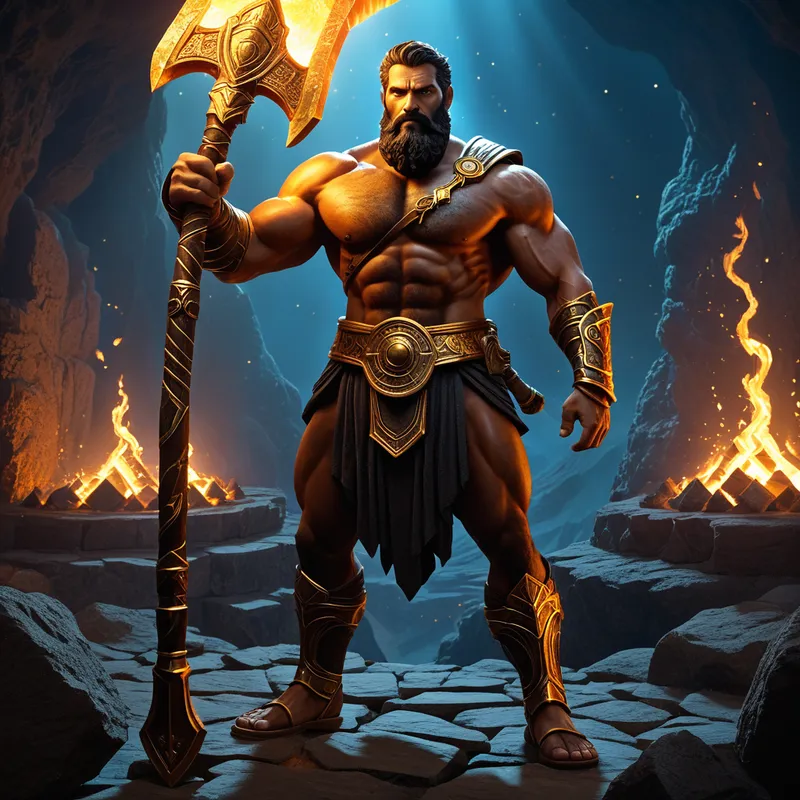
Hephaestus Myth Meaning & Symbolism
The myth of the divine smith, cast out for his imperfection, who forges beauty from pain and masters the transformative fire of creation.
The Tale of Hephaestus
Listen, and hear the tale of the fire in the deep, the maker in the dark. On Olympus, where the air is nectar and the light has no shadow, a child was born to the queen of heaven, Hera. But this was no child of perfect grace. He was born lame, his foot twisted. A gasp, then a silence colder than the void between stars fell upon the divine court. In that silence, shame curdled into a terrible decision. The queen, in a fury of perfection, took her own son, still mewling and new, and cast him from the gleaming parapets of heaven.
He fell for a day and a night, a tiny, tumbling star of flesh and potential. The salt wind screamed in his ears before the embrace of the wine-dark sea swallowed him whole. But the deep is not an end; it is a womb. The sea-nymphs Thetis and Eurynome found him, sinking into their grotto. In their sun-dappled cave, far from the blinding light of the gods, they nurtured him. And there, in the dark, wet earth beside the sea, he found his first friend: fire.
He coaxed embers from driftwood. He learned the language of heat, the song of the hammer on metal. His hands, which the gods deemed unfit, began to shape wonders—brooches that captured the shimmer of the sea, locks that whispered secrets to the wind. For nine years he worked, his body bent, his spirit a contained forge. Word of these marvels, born from the castaway, eventually drifted up to Olympus. A bargain was struck. The lame god would return, not as a son, but as an asset. In exchange for his freedom from the sea, he would build the gods their palaces.
And so Hephaestus ascended, not on graceful feet, but on the strength of his craft. He built the immortal halls, he fashioned the very thrones of power. But the old wound festered. He remembered the fall. In the heart of his new, smoky forge, built deep within the volcanic bowels of the mountain, he conceived a masterpiece of revenge. He forged a throne of adamantine, beautiful and cunning. He presented it to his mother, Hera. With a smile of reconciliation, she sat. And instantly, invisible fetters snapped shut, holding the queen of heaven fast. No god could free her. Laughter died on Olympus.
Only one being had the key: the maker himself. Zeus promised him anything. Hephaestus demanded not gold, but the goddess of love and beauty, Aphrodite, as his bride. The pantheon was scandalized, but a deal is a deal. The most beautiful was wed to the lame, sooty smith. Yet this was no happy ending. Aphrodite, bound by contract, not desire, took the god of war, Ares, as her lover. And Hephaestus, the master of traps, crafted one final, exquisite net—a web of gold so fine it was invisible. He cast it over the lovers in his own marriage bed, then called all the gods to witness their shame. The laughter that echoed then was not at him, but at the perfect, ensnared forms of Desire and Strife.
There he stands, forever after, in the glow of his subterranean fire. He forges the keraunos that rules the sky, the armor of heroes, the automatons of gold that serve the gods. He is essential and apart, the wounded creator whose power is born in the dark, whose artistry is the alchemy of pain into enduring form.

Cultural Origins & Context
The myth of Hephaestus is a foundational narrative from the corpus of ancient Greek mythology, primarily codified in epic poetry like Homer’s Iliad and Odyssey and later in the works of Hesiod. It was not a static, canonical text but a living tradition performed by bards (rhapsodes) in aristocratic halls and public festivals. This oral transmission allowed for variations—in some versions, Zeus is the one who casts Hephaestus out for defending Hera—but the core constants remain: the divine rejection, the fall, the oceanic incubation, and the triumphant return through supreme skill.
Societally, the myth functioned on multiple levels. For an ancient Greek audience, it explained the presence of craftsmanship and technology (techne) in the divine order. It validated the social role of the artisan, a figure who, while perhaps physically imperfect or socially marginal (like the god himself), possessed indispensable, quasi-magical power. The forge was a microcosm of transformative creation, and Hephaestus was its patron, connecting the raw, chthonic powers of fire and earth (the volcano) with the civilized needs of the Olympian polity. His myth served as a sacred justification for human industry and as a cautionary tale about the perils of rejecting the seemingly imperfect.
Symbolic Architecture
At its heart, the myth of Hephaestus is a profound map of the creative psyche born from injury. His lameness is not merely a physical defect; it is the symbol of a primal psychic wound, the experience of being fundamentally unacceptable to one’s source, of being rejected for one’s innate nature.
The first forge is not built of brick and bellows; it is the searing, contained space of a wound that must transform itself or consume its bearer.
His fall from Olympus represents the necessary descensus, the plunge into the unconscious (the sea). This is not a defeat, but the beginning of initiation. The nurturing sea-goddesses represent the compensatory, healing forces of the deep psyche that activate when the conscious ego’s perfect self-image shatters. The nine-year incubation is the period of latent development, where in darkness and isolation, the unique daimon—here, the genius for shaping form from chaos—is cultivated away from the judging eyes of the collective.
His return and the ensnaring of Hera symbolize the inevitable return of the repressed. The wounded creator holds the key to the liberation (or paralysis) of the very power that rejected him. His marriage to Aphrodite is the ultimate symbolic union: the forced, often dysfunctional, but necessary coupling of raw, aesthetic beauty (Aphrodite) with conscious, formative craft (Hephaestus). It is the mythic recognition that unformed beauty is fleeting, and craft without soul is sterile. Their discord is the eternal creative tension.
The Dreamer's Resonance
When the pattern of Hephaestus stirs in modern dreams, it often manifests as a profound somatic and psychological process of integration. The dreamer may find themselves in a basement, a garage, a subterranean workshop—places “below” the main living space. They are often alone, tasked with fixing a complex, broken machine, or forging a crucial but mysterious object. A sense of intense, focused urgency pervades, coupled with a physical feeling of limitation or heaviness, perhaps in the legs or hands.
This is the psyche working on the opus, the great work of transforming a core wound into a functional asset. The dream-forge is the somatic crucible where shame, rejection, or a sense of innate inadequacy is being subjected to the heat of conscious attention. The act of crafting in the dream is not a hobby; it is a survival imperative. To dream of successfully creating a tool, a piece of jewelry, or a support (like a brace) signifies the nascent emergence of a unique skill or perspective born directly from one’s history of pain. It is the unconscious affirming that the very point of fracture can become the source of greatest strength.

Alchemical Translation
The Hephaestian journey is a masterclass in psychic alchemy, a roadmap for the individuation process of the modern individual. It begins with the mortificatio: the brutal “death” of the idealized self, represented by the casting out from the perfect collective (Olympus). This humiliation is the necessary first ingredient.
The fall and oceanic immersion are the solutio—a dissolving of the old, rigid identity in the waters of the unconscious. Here, in the nurturing dark, the primal matter of the soul is softened and made malleable. The long incubation is the coagulatio: the slow, patient re-forming of a new identity around a central, authentic core, which is the discovered creative fire.
Individuation is not about becoming perfect, but about becoming essential. It is the process of building a golden brace for your own lameness, and discovering that brace is what allows you to walk your unique path.
The return to Olympus is the sublimatio: the elevated application of this hard-won skill in the world. Yet, the alchemy is not complete without the coniunctio, the integration of opposites. The fraught marriage to Aphrodite represents the ongoing, often difficult, work of uniting one’s deep, instinctual longing (love, beauty, desire) with one’s capacity for form, discipline, and manifestation. The final stage is not a static peace, but a dynamic, empowered stance: the capacity to be the sovereign of your own forge. You become the unbreakable smith who can hold the tension of your own contradictions, who can craft nets of exquisite awareness to capture fleeting inspirations, and whose foundational wound has been transmuted into the unwavering anvil upon which a conscious life is hammered into being.
Associated Symbols
Explore related symbols from the CaleaDream lexicon:
- Desk
- Machine
- Metal
- Wheelchair
- Peavey
- Mixer
- Design
- Motor
- Iron
- Professional
- Awkward
- Workshop
- Craft
- Gear
- Employee
- Worked
- Chef
- Worker
- Product
- Function
- Toaster Oven
- Rolling Pin
- Robot Assistant
- 3D Printer
- Internet of Things
- Denim Overall
- Overalls
- Limp Leg
- Sketching Dreams
- Creepy Factory
- Resourceful Inventor
- Pele's Fire
- Abandoned Factory
- Fiery Orange
- Bismuth Crystal
- Brilliant Cadmium
- Astilbe Glow
- Ingenious Inventor
- Mechanic's Toolbox
- Plumber's Wrench
- Jeweler's Workbench
- Chef's Knife
- Director's Clapperboard
- Guitar Pick
- Synthesizer
- Holographic Synthesizer
- Futuristic Synthesizer
- Twisted Melodica
- Resonating Steel Pan
- Pilates Equipment
- Crafting Table
- Paint Palette
- Glass Blowing Tools
- Crafting Kit
- Whittling Knife
- Industrial Revolution Machine
- Baroque Chandelier
- Industrial Revolution Gear
- Hemingway's Typewriter
- Palette Knife
- Holographic Art
- Rustic Easel
- Author's Dream
- Cloistered Author
- Wordsmith's Workshop
- Vintage Wrench
- Leather Apron
- Funky Toolbelt
- Weathered Pliers
- Rustic Forge Hammer
- Wooden Mallet
- Aerodynamic Drill
- Brass Screwdriver
- Marble Mortar
- Vibrating Sander
- Statue of Tools
- Brass Spanner
- Sapphire Anvil
- Bellows
- Art Deco Sideboard
- Funky Apron
- Handcrafted Cutting Knife
- Jumbo Size Whisk
- Frying Pan
- Grater
- Food Processor
- Tongs
- Pasta Maker
- Garlic Press
- Silicone Baking Mat
- Pastry Brush
- Sous Vide
- Artisan Keyring
- Glass Art Pendant
- Wire-Wrapped Jewelry
- Steampunk Airship
- Inkjet Printer
- Soldering Iron
- Paperclip
- Stapler
- Tape Dispenser
- Printer
- Tonercartridge
- Tape Dispenser Whimsy
- Pencil Sharpener
- Glue Stick
- Whirling Binder Clip
- Scotch Tape
- Kids' Tool Set
- Die-Cast Vehicle
- Tinker Toy
- Steel Drum
- Mechanical Musician
- Pedal Board
- Surreal Art Studio
- Imaginary Realm
- Industrial District
- Erupting Volcano
- Alchemy Table
- Victorian Ironwork
- Stone Axe
- Primitive Net
- Roasting Coals
- Stone Carving Tools
- Chipped Flint Ax
- Antler Tongs
- Lava Rock Tool
- Quartz Grinder
- Sandstone Grinding Stone
- Hand Ax
- Stone Hammer
- Meat Cleaver
- Heart of the Volcano
- Magma Flow
- Fire-Worked Artefact
- Heat of the Forge
- Beaten Copper Plate
- Stone Anvil
- Worked Stone Axe
- Clay Kiln
- Kiln Hearth
- Moonlit Forge
- Sizzling Heat
- Tech Support
- Sublimation
- Compounding
- Productive
- Hud
- Output
- Crafting
- Enzyme
- Seam
- Producer
- Enthalpy
- Piston
- Efficiency
- Prosthesis
- Chromosphere
- Stumble
- Molten
- Boiling
- Slag
- Fumarole
- Lavaflow