Hel's Realm Myth Meaning & Symbolism
The story of Baldr's death and Hermóðr's desperate ride to the frozen, silent hall of Hel, goddess of the dead, to bargain for a lost light.
The Tale of Hel's Realm
Listen, and hear of the day the sun grew cold. It began not with a scream, but with a sigh—the sigh of the fairest of the Æsir, Baldr the Shining, as he fell, pierced by a shaft of mistletoe. The laughter in the courts of Asgard turned to a silence so profound it was a sound unto itself. His body, a vessel of pure light, lay extinguished upon the deck of his ship, Hringhorni. The gods, mighty and wise, wept tears that turned to hoarfrost upon their cheeks.
But one did not weep. Loki, whose whispered deceit had guided the blind god Höðr’s hand, watched from the shadows, a smile like a crack in the world. The great funeral pyre was lit, sending Baldr’s ship into the sea on a river of flame. And as the smoke stained the sky, a question hung heavier than any mountain: could the light be reclaimed?
The task fell to Hermóðr the Bold, brother to the slain. With a heart of iron and a soul of desperate hope, he mounted Sleipnir, the steed that treads all paths. Down from the high branches of the Yggdrasil they rode, leaving the light of the worlds behind. They descended through roots that gripped the bones of giants, past whispering springs of memory, down into Helheim. The air grew thick and still, the light a perpetual, gloomy twilight. They crossed the echoing bridge over the river Gjöll, its waters speaking of finality, and were challenged by the maiden Móðguðr, her voice the sound of a tomb sealing.
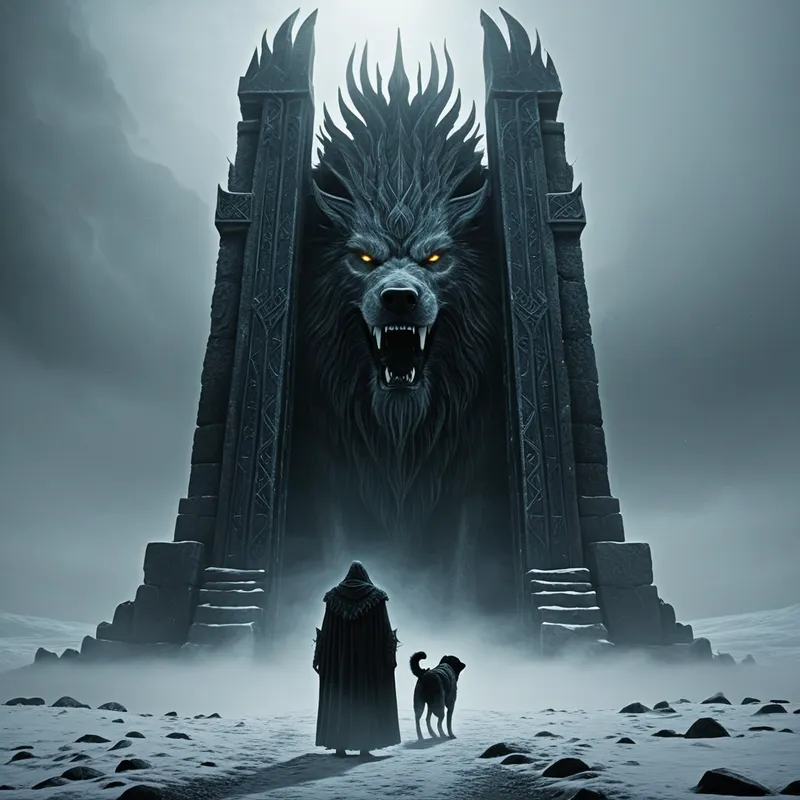
For nine nights, through valleys of mist where the breath of the dead hung like fog, Hermóðr rode. He came at last to the high walls surrounding Hel’s hall, Éljúðnir. The gates were barred, but Sleipnir, child of magic, leaped them in a single, impossible bound. Within the courtyard, the great hound Garmr stirred, but was silent.
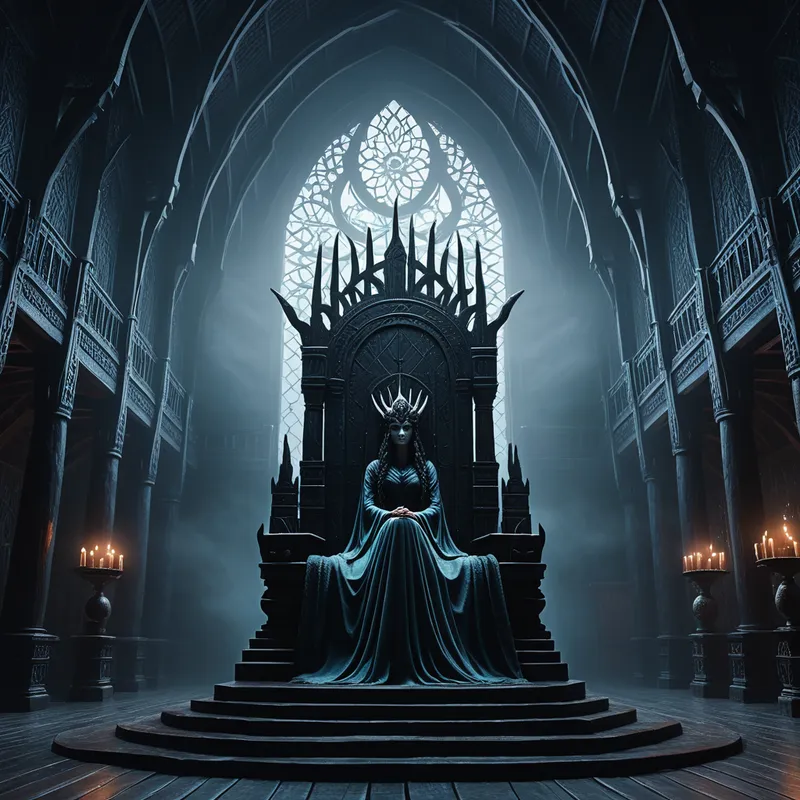
In the hall, on a throne of sorrow, sat Hel herself. One side of her face was as a beautiful, sorrowful maiden; the other was that of a corpse, blackened and necrotic. Around her moved a throng of those who died of sickness and age—a silent, endless procession. Hermóðr stood before her, the living breath in his lungs a foreign sound in that place of eternal quiet. He pleaded his case, his words echoing in the vast, cold space. He spoke of Baldr’s goodness, of the weeping of all creation, of a light the worlds could not bear to be without.
Hel, the goddess whose name means “Hidden,” listened. Her voice, when it came, was the rustle of dead leaves and the crack of winter ice. “If Baldr is so beloved,” she said, “then let every thing in the Nine Worlds, living and dead, weep for him. If all weep without deception, then he shall return to Asgard. But if one thing refuses, or speaks a dry word, then here he shall remain.”
Hope, fragile as an icicle, blossomed in Hermóðr’s chest. He took his leave, bearing Baldr’s ring Draupnir as a token, and rode back toward the living. Messengers flew to every corner of existence. Stones wept. Metals wept. The very earth shed tears. But in a dark cave, a giantess named Þökk sat, her eyes dry. “Let Hel hold what she has,” she spat. And with those words, the hope shattered. The sigh that began the tale became the law of the world: what goes to Hel remains. The light was lost, and the shadow of that loss stretched toward the coming of Ragnarök.
Cultural Origins & Context
The myth of Hel’s Realm reaches us primarily through the Prose Edda of Snorri Sturluson, written in the 13th century, and the older, poetic fragments of the Poetic Edda. These texts are Christian-era recordings of a far older, pre-Christian oral tradition. The stories were not scripture, but living narrative tissue, told by skalds (poets) and around hearth-fires. They functioned as a cosmological map and a moral-philosophical framework for a culture intimately acquainted with harsh winters, sudden death, and the capriciousness of fate.
Hel was not a place of punishment for sin, like later Christian hells, but a neutral destination for those who did not die in battle. It was the realm of the “straw-dead,” a necessary part of the cosmic order presided over by its equally necessary ruler. The journey to Hel, particularly Hermóðr’s ride, served as a narrative template for the ultimate confrontation with loss and the limits of divine power. It reinforced a worldview where even the gods are subject to ørlög (fate), and where the most heroic act is sometimes not victory, but the bearing of witness to an irrevocable truth.
Symbolic Architecture
Hel’s Realm is the archetypal landscape of the unconscious shadow—not evil, but all that is excluded from the conscious self: decay, passivity, sickness, and the forgotten. Baldr represents the conscious ego in its idealized, luminous state—beloved, innocent, but ultimately naive to the totality of existence. His death by mistletoe, a seemingly harmless plant, symbolizes how the integrated self can be shattered by what it has overlooked, dismissed, or deemed insignificant.
The journey to the underworld is never for the one who dwells there; it is always for the one who makes the journey. The treasure is the transformation of the traveler.
Hel herself is the ultimate image of the integrated shadow. Her half-living, half-dead visage is not monstrous but factual—a representation of the fundamental unity of life and death, beauty and decay. She is the ruler of what is, not what we wish to be. Her condition for Baldr’s return—that all things weep—is the demand for total, unconditional acknowledgment. The refusal of the giantess Þökk (often interpreted as Loki in disguise) represents the irreducible core of dissent within the psyche, the part that will not be sentimentalized or coerced into agreement, the hard truth that some losses are absolute.
The Dreamer's Resonance
When this myth stirs in modern dreams, it often manifests not as a literal Norse landscape, but as a somatic and emotional atmosphere. The dreamer may find themselves in a vast, institutional building that is empty and silent (Éljúðnir), crossing a threshold over a dark body of water (the river Gjöll), or desperately seeking someone or something that is just out of reach, obscured by mist. The core feeling is one of profound, chilly isolation and a search for a lost “light”—which could be a lost sense of self, a forgotten passion, a buried trauma, or a relationship that has ended.
Psychologically, this is the process of confronting a psychic “cold spot,” an area of numbness or frozen grief. The dream ego (Hermóðr) is tasked with entering this frozen state to retrieve a vital but lost part of the self (Baldr). The journey is the beginning of shadow-work, where the conscious mind ventures into its own underworld to parley with its neglected, “dead” aspects. The inevitable failure to retrieve the prize intact is not a dream of defeat, but one of initiation—it marks the point where the dreamer truly internalizes the reality of a profound change or loss, moving from denial to the beginning of acceptance.

Alchemical Translation
The alchemy modeled here is the transmutation of hope into meaning. The initial state is the golden, solar consciousness of Baldr—pure but brittle. The nigredo, or blackening, is his death and descent into the cold, dark realm. Hermóðr’s ride is the conscious ego’s arduous, willing descent into this blackness (descensus ad inferos), a necessary step in the process of individuation.
The alchemical vessel is not the crucible of fire, but the hall of silent frost. Here, the heat of desire is stilled so that the true shape of what is can be revealed.
The parley with Hel represents the confrontation with the Self in its most complete and terrifying form—the Self that includes death. The condition she sets is the alchemical formula: total, universal acknowledgment. The dream of saving the old, perfect light must die. The weeping of all things is the dissolution (solutio) of the old form in the waters of collective grief and recognition.
The failure of the condition—Þökk’s dry eyes—is the crucial moment of separatio. It is the realization that some elements cannot be redeemed or reintegrated in their former state; they must be left behind, acknowledged as irrevocably other. The return journey is not with the lost light, but with a token (Draupnir). This symbolizes the new insight gained: the ring that drips new rings is a symbol of cyclic generation from loss. The individual does not reclaim their old innocence (Baldr), but returns bearing the generative principle of acceptance. They have internalized the ruler of the underworld, making the cold, factual truth of limitation and mortality a part of their sovereignty. The light is not restored, but its essence is transmuted into a quieter, more enduring wisdom that can endure the long frost until its own season of renewal.
Associated Symbols
Explore related symbols from the CaleaDream lexicon: