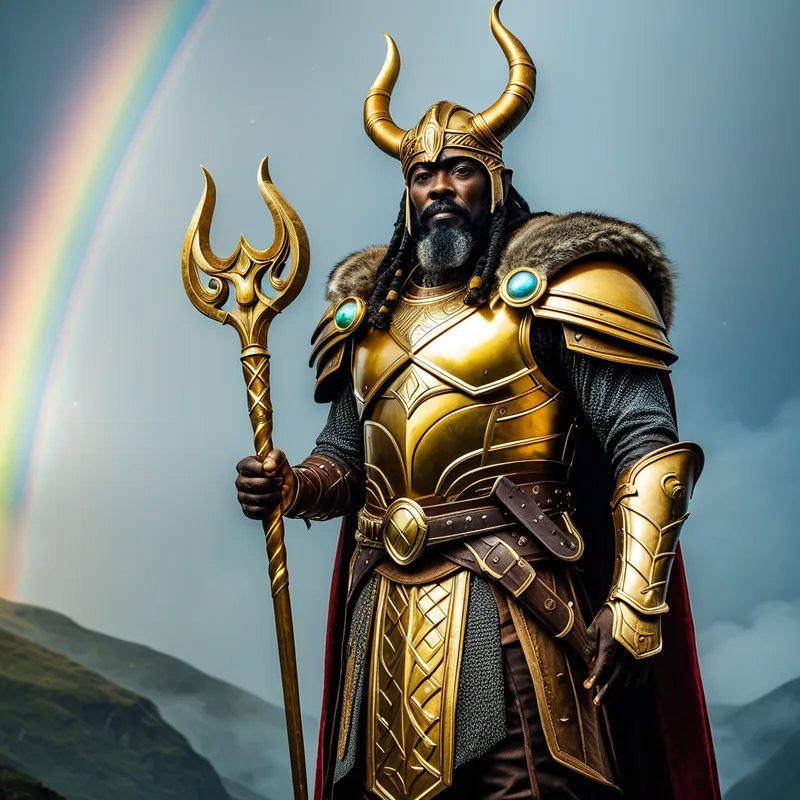
Heimdall Myth Meaning & Symbolism
The myth of the ever-watchful god who guards the rainbow bridge, hears the grass grow, and sounds the horn that heralds the world's end and renewal.
The Tale of Heimdall
Listen. At the edge of all things, where the shimmering road of the gods meets the root of the world, there stands a figure. He is not like the others. While Odin wanders for knowledge and Thor rides to battle, this one stays. His name is Heimdall, the White God, son of nine mothers, and his home is Bifröst.
His watch is eternal. He needs less sleep than a bird. His eyes, forged in the dawn of time, see for a hundred leagues by night or day, piercing through rock and mist alike. His ears are tuned to the hum of the cosmos; he hears the wool grow on the sheep and the grass sigh from the earth. At his hip hangs Gjallarhorn, a curve of bone and destiny, waiting for its one, terrible note.
He guards the threshold. From his post at Himinbjörg, he turns away those who have no right to cross—the frost-giants in their envy, the tricksters in their guile. He is the gate that must be passed, the question that must be answered. The gods sleep soundly in Asgard because Heimdall does not.
But a shadow gathers. It is a shadow born of broken oaths and seething grudges, a wolf bound by a thread, a serpent stirring in the deep. Heimdall sees its approach long before the others feel its chill. He hears the grinding of the ship of nails being built, the slow, inevitable drip of venom. He watches, unblinking, as the threads of fate woven by the Norns grow taut and fray.
And he knows. He knows the moment will come when the horn must be lifted. He will fill his lungs with the breath of nine worlds and sound a blast that will shatter the silence of eternity. That note will be the end of watching. It will be the call to arms, the death knell for an age, and the first cry of a world yet unborn. He waits, the sentinel at the end of time, holding the line between what is and what must be.

Cultural Origins & Context
The figure of Heimdall is preserved primarily in the Poetic Edda and the Prose Edda. Unlike the more narratively fleshed-out exploits of Thor or Odin, Heimdall’s stories are fragments—powerful, evocative glimpses. He is the god who “foresees like the other Vanir,” hinting at a possible connection to this other tribe of deities associated with fertility and wisdom. His mysterious birth from nine mothers, often interpreted as nine wave-maidens, roots him in the primordial, chthonic forces of the sea.
His myth was not one of adventure, but of function. In the Norse worldview, a cosmos perpetually under threat from chaos (Jötnar) required eternal vigilance. Heimdall embodied this societal and cosmological imperative. He was the divine watchman, a role that would have resonated deeply in a culture of coastal watchers, sentinels, and the ever-present need to guard against threats from the wilderness and the sea. His ultimate fate—to slay and be slain by the chaos-god Loki at Ragnarök—cements his role as the guardian of cosmic order against its ultimate adversary.
Symbolic Architecture
Heimdall is not merely a guard. He is the personification of the faculty of consciousness itself—the part of the psyche that watches, discerns, and maintains boundaries.
He is the ever-present witness, the "I" that observes the procession of thoughts, feelings, and impulses without being wholly consumed by them.
His phenomenal senses symbolize hyper-awareness. To hear the grass grow is to be attuned to the subtle, unconscious processes of life and growth beneath the surface of daily reality. To see for a hundred leagues is to possess foresight and the ability to perceive the distant consequences of present actions. He stands on Bifröst, the rainbow bridge—a symbol of the connection between the divine/conscious realm (Asgard) and the human/mundane world (Midgard). He is the guardian of that connection, ensuring that traffic between these levels of reality is conscious and intentional, not an invasive flood of unconscious content.
His weapon, the horn Gjallarhorn, is the symbol of the catalytic call. It does not create the crisis (Ragnarök), but it announces its arrival to the sleeping psyche. It is the alarm bell of necessity, the inner voice that can no longer ignore a gathering conflict, a repressed truth, or a call to radical change.
The Dreamer's Resonance
When the archetype of Heimdall stirs in the modern dreamscape, it often manifests as dreams of heightened vigilance or profound thresholds. You may dream of being a lookout on a high tower, watching an approaching but indistinct storm. You might dream of standing guard at a door, bridge, or gate, feeling an immense responsibility to protect what lies behind you, mixed with dread for what approaches.
Somatically, this can correlate with states of hyper-vigilance, anxiety, or insomnia—the body’s own “Heimdall” is on overdrive, unable to rest, listening for threats real or imagined. Psychologically, it signals a phase where the conscious ego is tasked with maintaining a difficult boundary. This could be during a time of personal crisis, a need to protect a vulnerable new insight or creative project, or when old, chaotic patterns (the Jötnar of the psyche) threaten to overwhelm one’s sense of order. The dream is highlighting the exhausting but essential work of the sentinel self.

Alchemical Translation
The individuation process—the journey toward psychic wholeness—requires a Heimdall. Initially, his vigilance might manifest as a rigid, neurotic ego-defense, over-controlling and fearful. The alchemical work is to transform this raw vigilance into conscious discernment.
The goal is not to silence the horn, but to understand what its sounding truly heralds within.
The first step is the cultivation of the “Heimdall faculty”: the practice of mindful observation. This is learning to “hear the grass grow” within—to attend to the subtle somatic signals, the quiet intuitions, the slow growth of a new attitude beneath the surface of busyness. It is developing the foresight to see where one’s current path leads.
The critical alchemical moment comes when the horn must be sounded. In a life, this is the point of no return—the decision to leave a stagnant job, to confront a deep-seated fear, to acknowledge an addiction, or to let an old identity die. The ego, as sentinel, must consciously choose to blow the horn, to initiate the inner Ragnarök. This is terrifying, for it means welcoming the necessary destruction of outworn structures. Yet, as in the myth, this destruction is the prerequisite for renewal.
Finally, Heimdall’s mutual slaying with Loki symbolizes the ultimate integration. The pure, rigid guardian of consciousness and the chaotic, shape-shifting trickster of the unconscious destroy each other, clearing the way for a new world. In the individuated psyche, discernment is no longer a tense, external vigilance against chaos, but an integrated awareness that includes and relates to the creative, disruptive energies of the unconscious. The watchtower dissolves, and one learns to see and hear from everywhere at once.
Associated Symbols
Explore related symbols from the CaleaDream lexicon: