Heidrun Myth Meaning & Symbolism
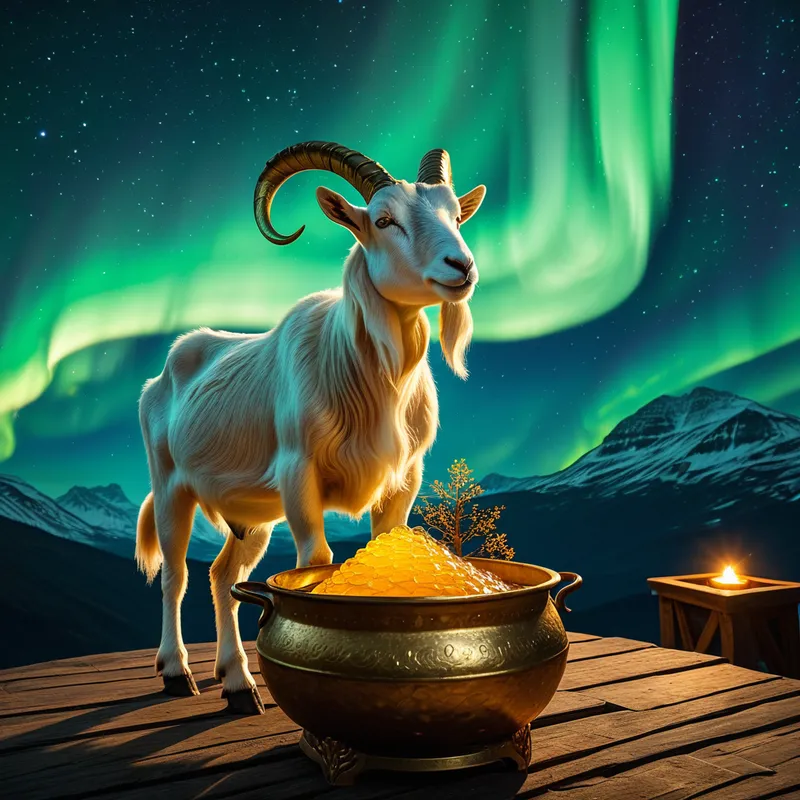
A magical goat atop Valhalla, feeding on the World Tree, provides an endless flow of mead for the gods and heroes of the slain.
The Tale of Heidrun
Listen, and let the winds of Ginnungagap carry you to a time when the worlds were young and the deeds of gods were sung by firelight. High above the clamor of Midgard, beyond the Bifrost bridge, lies the shining hall of Valhalla. Its roof is thatched with golden shields, and its rafters are spears. Here, the Einherjar feast and fight, awaiting the final battle.
But their eternal vigor is not born of battle alone. It flows from a source of quiet, constant grace. Upon the very peak of Valhalla’s roof stands Heidrun. She is no ordinary beast. Her coat is the color of a winter sky at dusk, and her horns curve like the crescent moon, tipped with a light that is not of sun or star. She stands serene, a silent sovereign of the roof-tree.
Her sustenance is the very axis of the worlds. She browses upon the leaves of Yggdrasil, the great Ash whose branches hold the nine realms. She does not devour, but partakes, nibbling the tender, dew-laden leaves that whisper with the secrets of the Norns. This is her sole fare, this cosmic foliage.
And from her, a miracle flows. Each day, from her udder, comes not milk, but the finest, clearest mead. It is the color of summer honey and light, and its scent is of wildflowers and oak. This endless stream pours forth, day after day, without cease or diminishment. It cascades down into the great cauldron called Heidrún, a vessel so vast it could drown a giant. From this cauldron, the Valkyries themselves draw the divine drink, filling the horns of Odin, of Thor, and of every hero who has earned his place in the hall.
While the wolves howl at the gates and the eagle shrieks from the highest branch of Yggdrasil, Heidrun stands in peaceful contrast. Her conflict is not one of blade and fury, but of eternal giving. Her rising action is the silent, ceaseless conversion of world-tree into life-drink. Her resolution is the filled horn, the strengthened arm, the laughter in the face of doom. She is the quiet heart at the center of the storm of glory, the unending wellspring in a realm preparing for an end.
Cultural Origins & Context
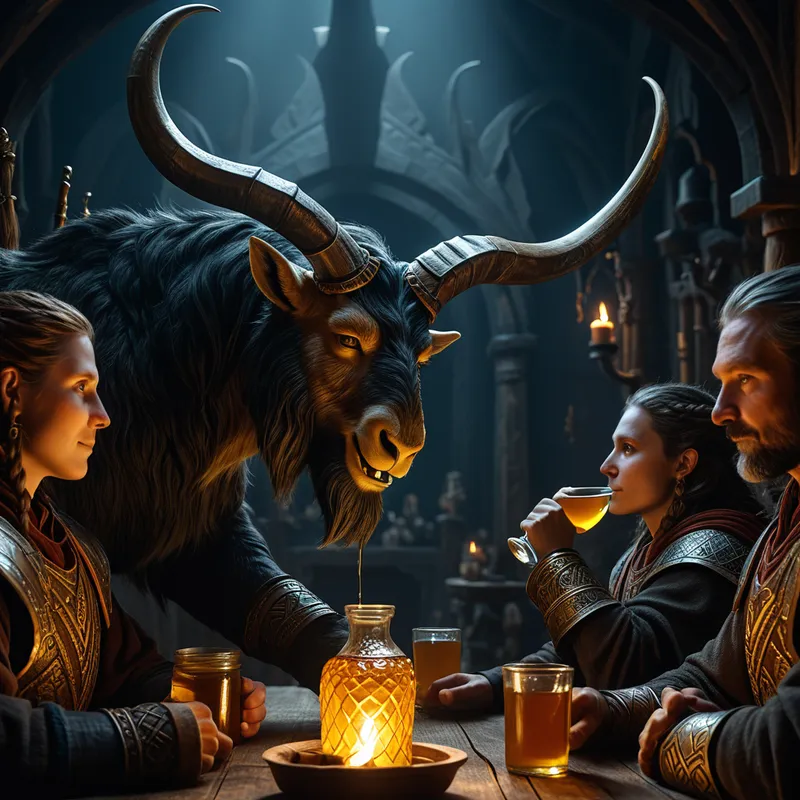
The myth of Heidrun is preserved primarily in two key sources from the 13th century: the Poetic Edda, a collection of older mythological poems, and the Prose Edda, a handbook for skalds (poets) written by Snorri Sturluson. It is in Snorri’s Gylfaginning that we receive the most detailed description of her. These texts were written down in Christian Iceland, but they are understood to be the last, fragmented echoes of a much older, oral tradition that thrived across the Germanic world.
The societal function of this myth was multifaceted. On one level, it was a vivid piece of cosmological world-building, explaining how the warriors in Odin’s hall could sustain their eternal feasting—a crucial detail for a culture that idealized the warrior’s afterlife. The mead itself, a potent and sacred drink in Norse society, symbolized poetry, inspiration, and divine favor. Heidrun’s mead was the ultimate source of this inspiration, directly linking the creative and intoxicating power of poetry to the nourishment of the gods.
Furthermore, the myth reinforced a profound connection between the animal world, the divine, and the cosmic structure. Heidrun is a domestic creature placed in the most exalted setting, performing the most vital function. This reflects a worldview where the boundaries between the mundane and the divine were permeable, and where sustenance—whether for the body or the spirit—was seen as a sacred cycle rooted in the fabric of reality itself.
Symbolic Architecture
Heidrun is not merely a fantastical creature; she is a living symbol of the principle of sustenance through sacrifice. She occupies a liminal space—atop the hall, between the world of the gods and the World Tree. She is the intermediary, the transformer.
The true nourishment of the soul is not taken, but transmuted. It requires one to stand at the axis of the world and consent to be a vessel of exchange.
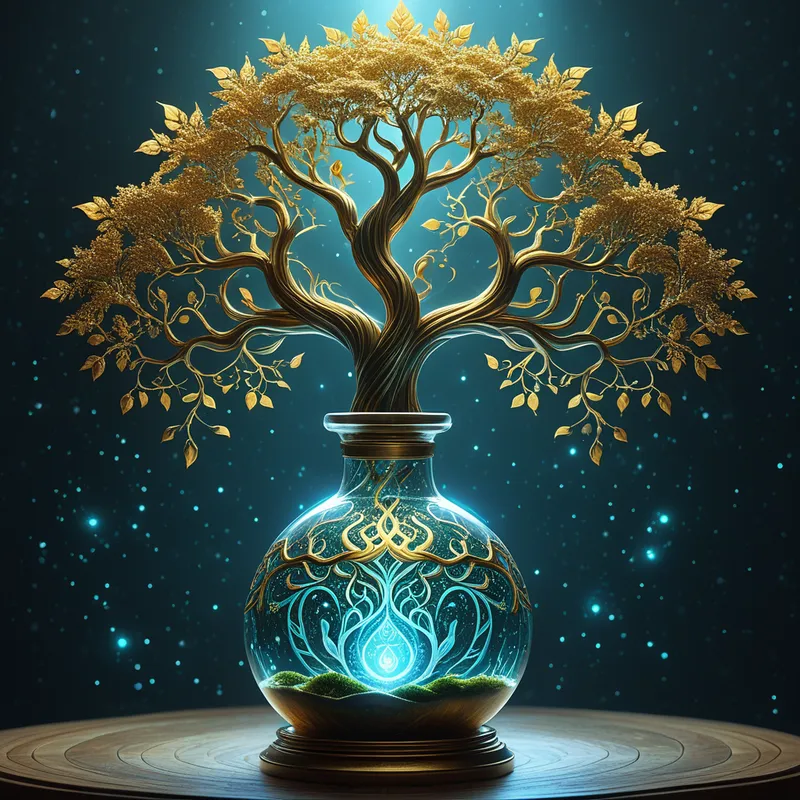
The Tree (Yggdrasil) represents the totality of existence, the interconnected web of life, time, and fate with all its suffering (as the tree is constantly gnawed and plagued). The Goat (Heidrun) represents the conscious, nurturing entity that engages with this raw, often painful, totality. The Mead is the distilled essence—the wisdom, the vitality, the inspiration—that results from this engagement. It is not brute consumption, but alchemical processing. Heidrun does not strip the tree bare; she grazes, participating in a cycle. Her act is one of gentle, continuous harvesting that does not destroy the source.
Psychologically, Heidrun represents the part of the psyche that can metabolize experience—especially difficult, "cosmic" experience—and transform it into inner nourishment. She symbolizes the capacity for resilience, for turning the bitter leaves of hardship into the sweet mead of wisdom and strength. The endless flow suggests that this is not a finite resource but a renewable one, contingent upon our connection to the greater "Tree" of life and our willingness to serve as a conduit.
The Dreamer's Resonance
When the image of Heidrun surfaces in modern dreams, it often signals a process of deep, somatic nourishment or a call to become a source of it. The dreamer may be in a period of exhaustion, feeling drained by the demands of life (the gnawing creatures on Yggdrasil). To dream of a goat, especially one in an elevated or majestic position, or of an endless, wholesome flow of liquid, points to the unconscious activating the archetype of the eternal provider.
Somatically, this can manifest as a felt sense of fullness in the chest or a calming of chronic anxiety—a psychological "feeding." Conversely, if the dream shows the goat distressed or the flow blocked, it indicates that the dreamer's natural capacity for self-nourishment or for nurturing others is obstructed. Perhaps they have severed their connection to their personal Yggdrasil—their core values, their connection to nature, or their spiritual practice. The dream becomes a corrective image, presenting the ideal state of graceful, abundant giving that stems from a secure connection to a source greater than oneself.
Alchemical Translation
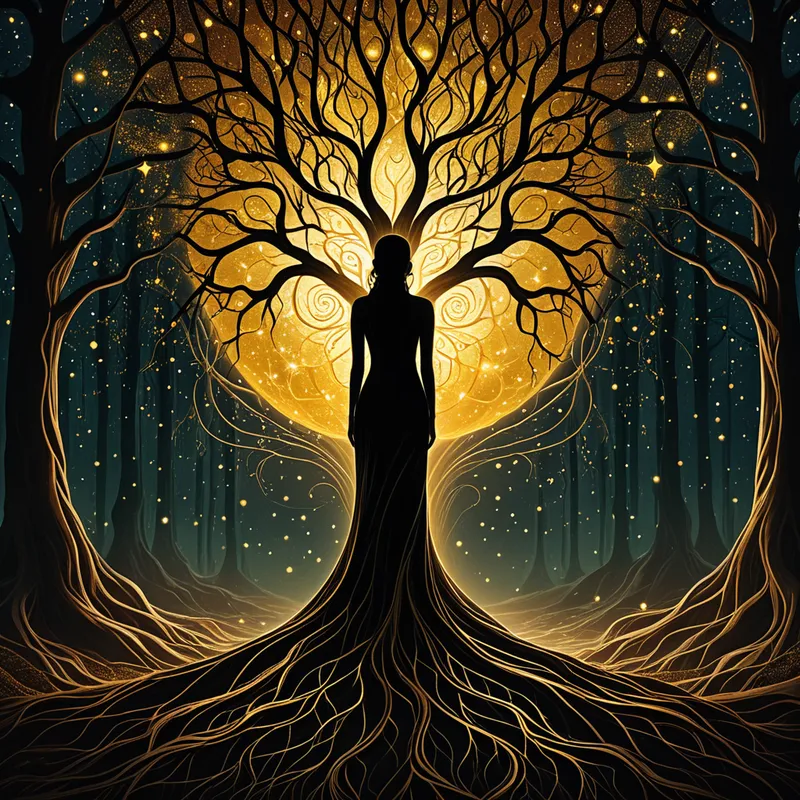
The alchemical process mirrored in Heidrun’s myth is that of the solve et coagula—dissolve and coagulate—applied to the psyche’s journey toward wholeness, or individuation. The raw, chaotic, and often painful material of life (the manifold leaves of the World Tree) must first be "grazed upon," or consciously integrated (the solve). This is the stage of confronting one’s shadow, acknowledging suffering, and digesting experience.
Individuation is the art of brewing one's own mead from the leaves of one's own world-tree. The goal is not to become the drinker alone, but to become the goat, the tree, and the cauldron—the entire sacred circuit.
Heidrun represents the vessel where this dissolution occurs. Her own being is the alembic. The transformation into mead is the coagula—the reconstitution of this digested experience into a new, vital substance: personal wisdom, emotional resilience, or creative inspiration. This "mead" then nourishes the inner pantheon—the various archetypal forces within us, such as our inner Warrior (Einherjar), our inner Ruler (Odin), and our inner Sage.
For the modern individual, the myth teaches that we are not passive consumers of fate. We are called to position ourselves consciously at the nexus of experience and meaning (atop our own Valhalla, our highest purpose). From there, we must learn to feed on the totality of our lives—the bitter and the sweet—and allow our deepest nature to transmute it into what sustains us and gives our life its intoxicating, inspiring flavor. The work is endless, like her flow, because life is endless in its offerings. The triumph is in becoming a perpetual source, grounded in the eternal, nourishing the eternal within.
Associated Symbols
Explore related symbols from the CaleaDream lexicon: