Hecate Myth Meaning & Symbolism
A goddess of thresholds, magic, and the underworld, Hecate illuminates the power of the crossroads and the wisdom found in the unseen realms.
The Tale of Hecate
Listen, and I will tell you of the one who walks where worlds meet. Before the reign of the Olympians, in the deep time of the Titans, she was born. Perses and Asteria brought forth a daughter unlike any other. They named her Hecate.
From the first, she was a child of the in-between. Not wholly of the sky, nor of the earth, but of the spaces where light bleeds into shadow. When the great war shook the cosmos, and the young gods of Olympus battled the old Titans for dominion, Hecate did not choose a side. She moved through the chaos, a silent witness at the edges of the fray. And when the thunder of Zeus finally fell silent, and the new order was established, she alone of the old powers was not cast into the abyss of Tartarus. Zeus, in his strange wisdom, beheld her and saw a power that belonged to no realm, and thus to all. He granted her a share of the earth, the sea, and the starry sky. Her dominion was not a place, but a condition: the threshold.
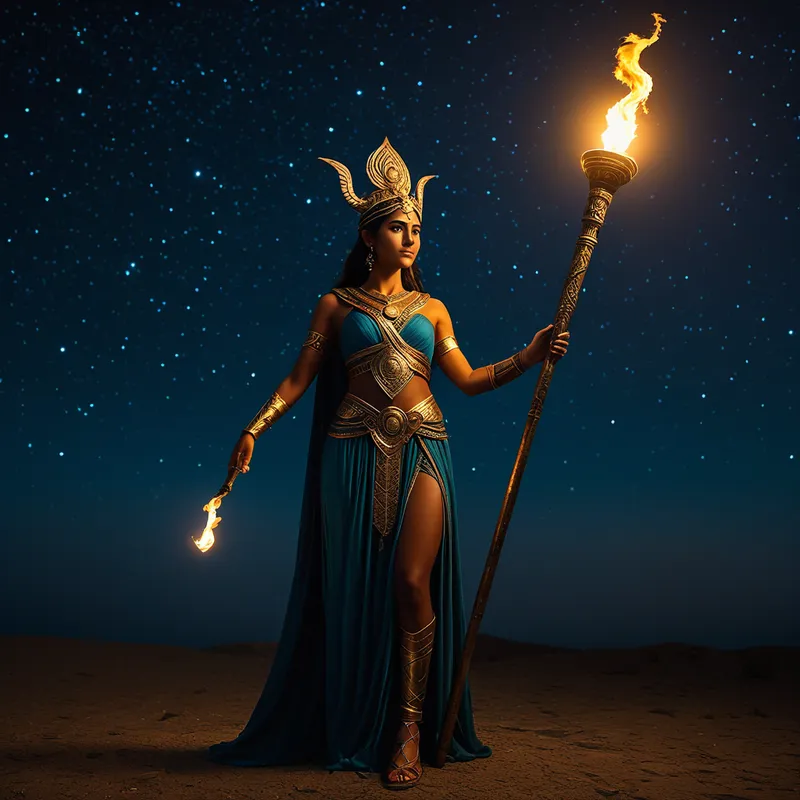
Her true home became the crossroads. Not the bustling market square, but the lonely place where three dirt paths converge under a waning moon. There, she would appear, but never as one. She was three women, or one woman with three bodies, facing down each road, seeing past, present, and future all at once. In one hand, she bore a torch that cast light without warmth, illuminating secrets. In another, a key that could unlock any gate—of a city, a heart, or the underworld. Sometimes, the whisper of serpents coiled at her feet.
The living made offerings to her there, at the crossroads, leaving honey cakes and eggs at the base of her Hekataion. They whispered prayers for protection on journeys, for guidance in impossible choices. But it was to the dead that she was most intimately bound. When Demeter, torch in hand, raged across the world searching for her stolen daughter Persephone, it was Hecate, hearing the echo of Persephone’s cry from a deep place, who came to her. Hecate did not offer comfort. She offered truth. With her own unearthly light, she led the grieving mother to the sun god Helios, who revealed the dark truth: Hades had taken the girl.
And when Persephone rose from the underworld each spring, and descended each autumn, it was Hecate who was her companion on that threshold walk, her guide and guardian through the veil. Thus, the goddess of the crossroads became the keeper of the ultimate transition, the one who holds the light in the deepest dark, knowing the way because she is the way between.
Cultural Origins & Context
Hecate’s roots are deep and likely pre-Greek, absorbed into the pantheon from Anatolian or Carian sources. Her earliest appearances in Greek literature, such as in Hesiod’s Theogony, present her as a greatly honored, pre-Olympian power. This antiquity is key; she is a relic of an older, more primal stratum of belief that the classical Greek mind could not fully assimilate, and so they placed her at the margins.
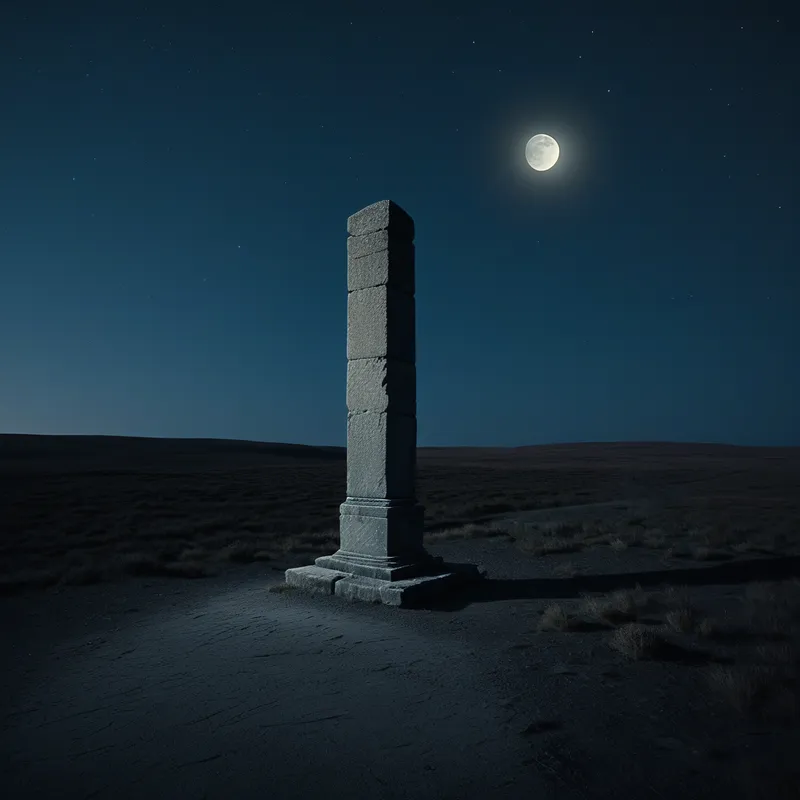
Her worship was not centered in grand state temples but in domestic rites and private, nocturnal rituals. Households would place offerings at her pillars (hekataia) at the entryways or at crossroads to ward off evil spirits and invite her protection. This practice highlights her role as a guardian of liminal spaces—the door, the gate, the crossroad—places of vulnerability and potential.
She was also the patron of magic, witchcraft, and necromancy. The famed Greek Magical Papyri are replete with invocations to her. This association stems from her knowledge of hidden things and her power over boundaries; the magician, like Hecate, operates in the spaces between the seen and unseen, seeking to influence one realm from another. Her festivals, like the Deipnon, were somber affairs involving the leaving of "suppers" at crossroads to appease restless spirits, a practice that purified the household and community.
Symbolic Architecture
Hecate is the archetypal embodiment of the liminal—the transitional, the neither-here-nor-there. She is not a goddess of a single domain but of the moment of passage itself. Her symbols form a coherent grammar of threshold consciousness.
Her triple form is her most profound cipher. It represents the three phases of time (past, present, future), the three realms (earth, sea, sky), and the three phases of the moon (waxing, full, waning). It is a symbol of complete, panoramic awareness. To stand at a crossroads is to be confronted with multiple possible futures; Hecate is the consciousness that can hold all possibilities without yet choosing one.
The true crossroads is not outside, but within. It is the psychic intersection where memory, present experience, and potentiality converge, demanding a choice that will redefine the self.
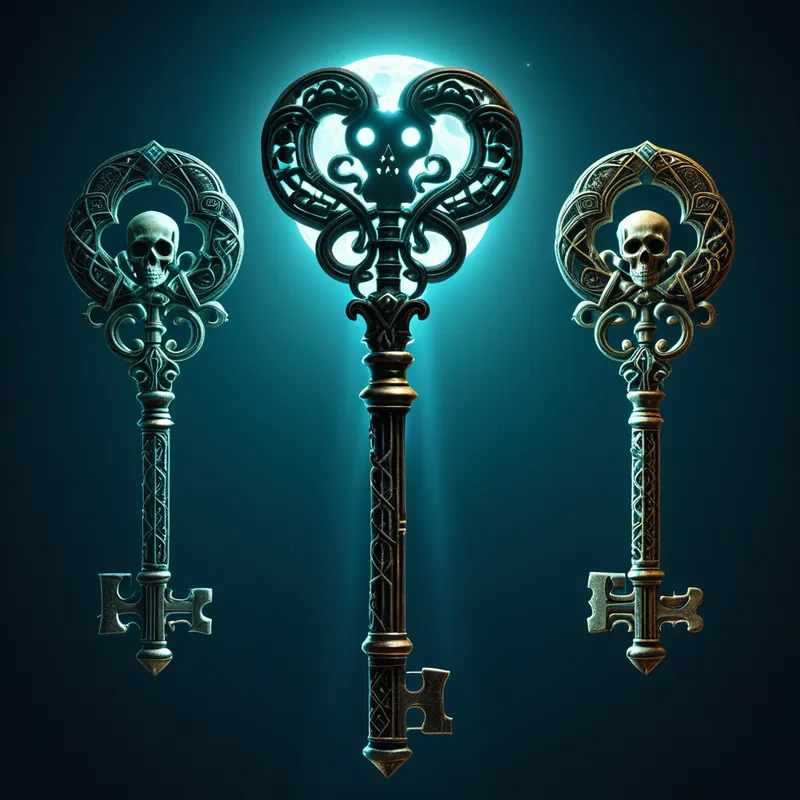
The torch illuminates what is hidden, but its cold light suggests this is not the comforting light of day, but the revelatory, often unsettling light of truth—the shadow brought to consciousness. The key signifies access to what is locked away, be it buried memory, forbidden knowledge, or the gates of the unconscious itself. The serpents, ancient symbols of chthonic wisdom and regeneration, coil at the base of her being, connecting her to the primal, instinctual earth.
Together, these symbols paint a portrait of a psychic function: the capacity to navigate profound uncertainty, to illuminate the contents of the personal and collective shadow, and to unlock the gates to deeper layers of the psyche.
The Dreamer's Resonance
When the pattern of Hecate emerges in modern dreams, it signals a profound encounter with a personal crossroads. This is not a simple choice between job A or job B, but a deeper, existential pivot point where the dreamer’s identity or life path feels fundamentally in question.
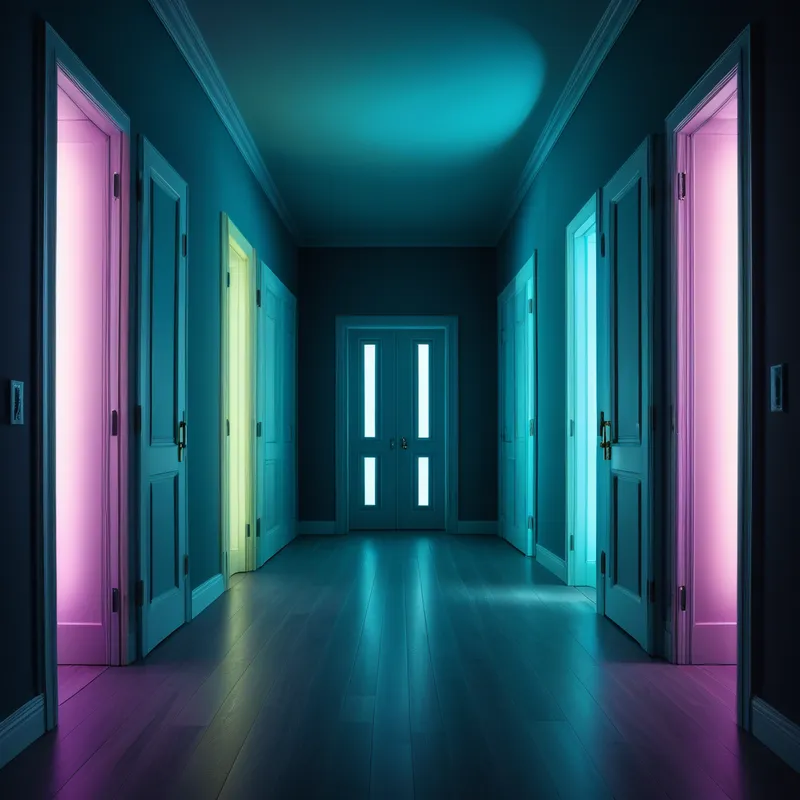
The dream imagery is characteristically liminal: a hallway with multiple doors, a fork in a road at dusk, a figure seen from behind who then turns to reveal three faces, or a potent, found object like a key or an unlit torch. There is often a quality of eerie stillness, moonlight, and a sense of being watched by a presence that is not hostile, but profoundly other.
Somatically, the dreamer may awaken with a feeling of tension or anticipation, a "prickling" of the skin, or a chill. Psychologically, this dream marks the activation of the individuation process at a critical juncture. The Hecate moment arrives when old structures of the personality (old "roads") have been traveled to their end, and new potentials are visible but not yet actualized. The psyche is summoning the archetypal energy required to stand in that terrifying, fertile space of not-knowing, to hold the tension of opposites, and to make a choice that comes from a place of deeper, often shadow-informed, wisdom.
Alchemical Translation
The alchemical journey is one of dissolution, purification, and recombination—solve et coagula. Hecate is the patron of the nigredo, the initial blackening, the descent into the prima materia of the soul. Her crossroads is the moment of dissolution, where the conscious ego's known paths dissolve into ambiguity.
For the modern individual, the "Hecate Work" is the conscious engagement with one’s own liminal states. It is the practice of voluntarily entering the uncertainty of a life transition—a loss, a creative block, a midlife reckoning—not with panic, but with the reverence of a sacred rite. It is to ask, at our personal crossroads: What in me must die? What hidden knowledge (the torch) do I need to face? What gate (the key) am I being called to unlock?
The magician archetype does not manipulate the world, but transforms the self. Hecate’s magic is the transmutation of confusion into insight, of paralysis into purposeful choice, achieved by enduring the threshold.
This process requires honoring the "three faces": honestly reviewing the past (what led me here?), fully inhabiting the discomfort of the present (the tension of the choice), and courageously envisioning potential futures without attachment. The triumph Hecate models is not a heroic conquest, but a successful navigation. The goal is not to escape the crossroads, but to become the crossroads—to develop an inner capacity to hold complexity and transition as a constant, creative state of being. In doing so, we integrate her power. We no longer just face the dark with a trembling light; we learn, in part, to be the light in the dark, the guide for our own soul’s passages between the worlds of who we were and who we are becoming.
Associated Symbols
Explore related symbols from the CaleaDream lexicon: