
Heather in folklore Myth Meaning & Symbolism
A myth of a goddess's love for a mortal, her transformation into the enduring heather plant, and the deep bond between land, spirit, and people.
The Tale of Heather in folklore
Listen, and I will tell you of a time when the veil between the worlds was thin as morning mist on the loch. In the high, lonely places, where the wind sings a ceaseless, keening song, there lived a spirit of the moors. She was not one of the great Tuatha Dé Danann, but a being of the land itself—a daughter of the granite and the rain, the peat and the cloud. Her name is lost to the ages, but the old ones knew her as the Lady of the Purple Mantle, for she walked the empty hills wrapped in the color of twilight and bruise.
Her realm was one of stark beauty and profound solitude. She knew the secret paths of the red deer and the nesting places of the golden eagle. Her companions were the whispering grasses and the sighing stones. Yet, for all her dominion, a loneliness grew in her, deep as the glacial corries. She watched the small, bright lives of mortals in the glens below—their fires, their songs, their fierce, brief loves—with a longing she could not name.
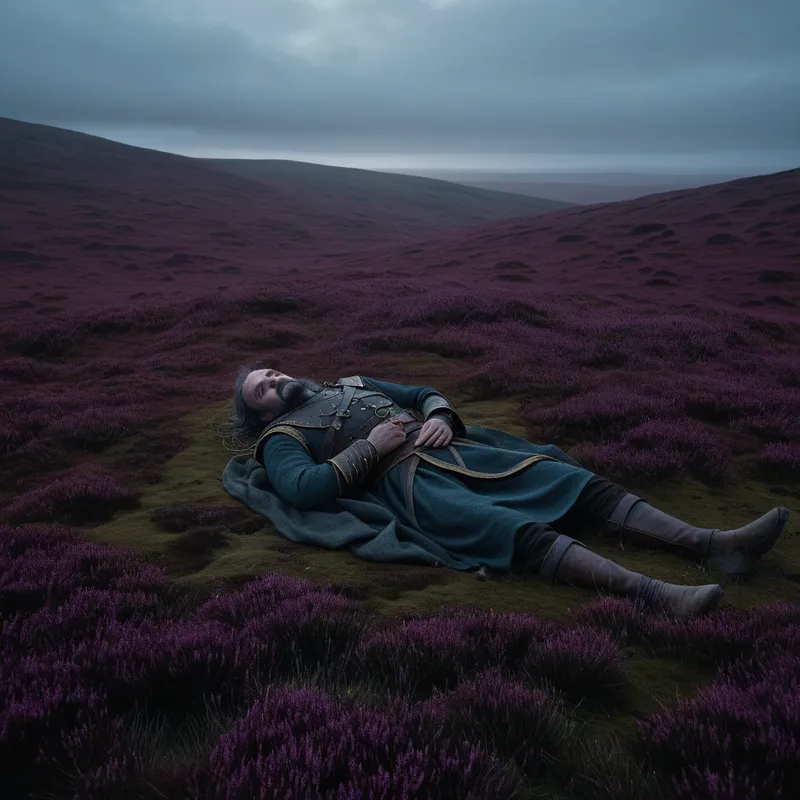
One autumn, when the muir was painted in rust and gold, a band of warriors passed through her high domain. Among them was a man named Donnchadh. He was not the tallest nor the loudest, but his eyes held the steady light of the northern star, and he moved through the wild land not as a conqueror, but as one who listens. Separated from his kin in a sudden, savage squall, he was wounded, a deep gash from a tusk or a blade staining his plaid.
It was thus the Lady found him: a spark of mortal warmth fading on her cold breast. A feeling unknown to her—a sharp, piercing urgency—pierced her immortal heart. She gathered him up, and where her tears fell upon his wound, the bleeding slowed. She sang to him a song that had no words, only the sound of water over stone and wind through pine. For days and nights that blurred into one, she tended him, using herbs known only to her and the cool touch of her spirit-hands.
In his fever, he spoke of his home, of the smell of baking bannock and the laughter of his sister’s child. He spoke of a love for the land so profound it ached. The Lady, who had loved the land as a concept, felt it now as a pulse, through him. She fell in love—not just with the man, but with the fragile, burning world he carried within him.
When his strength returned, he had to leave. His people needed him. As he prepared to descend from the high moor, he turned to her, his eyes full of a sorrow that mirrored her own. “I carry your song in my heart,” he said. “But my feet must walk a mortal path.”
The Lady stood at the edge of her world, watching him disappear into the mist of the glen. The loneliness that returned was no longer a quiet companion, but a devouring void. The wind’s song was a dirge. The beauty of her moors turned to ash in her sight. She could not follow him into his brief, bustling life, nor could she bear the eternity of her solitude without the echo of his mortal heart.
So, she made a choice. At the very spot where his blood had watered the earth and her tears had fallen, she lay down upon the cold ground. She called upon the oldest magic, the deep magic of the earth that predates gods and men. She whispered her essence into the soil, her love into the roots, her memory into the stems. Her spirit dissolved, not into death, but into a new, enduring form.
Where she lay, the hard, barren earth softened. Tiny green shoots, tough and resilient, pushed through the peat. They grew and spread, covering the mournful ground in a blanket of countless tiny bells—a purple so rich it seemed dyed with twilight and memory. The heather had come to the moor. It was not a death, but a transformation—a binding of her immortal love to the mortal earth, a gift of beauty and sustenance for the people he belonged to, forever.
Cultural Origins & Context
This tale, in its many local variations, is not found in a single, canonical text but lives in the oral tradition of the Scottish Highlands and Islands. It was a story told by the fireside, passed from seanchaidh (storyteller) to listener, often during the long, dark evenings of autumn when the heather was in bloom. Its function was multifaceted. On one level, it was an etiological myth, explaining the origin of a defining feature of the landscape. But more deeply, it served to sanctify the relationship between the people and their often-harsh environment.
The heather moorland is not passively beautiful; it is a vital resource providing bedding, thatch, dye, ale (heather ale being a legendary brew), and nectar for the bees that made mead. The myth transforms this practical relationship into a sacred covenant. The land is not inert; it is a beloved entity who has sacrificed her singular form for a communal, enduring presence. This story reinforced a worldview where the natural world is ensouled, a participant in the drama of life rather than a mere backdrop. It taught respect, gratitude, and the understanding that love and belonging can take forms beyond the human.
Symbolic Architecture
The myth of the Heather Lady is a profound map of a specific kind of psychological and spiritual transformation.
The most profound love is not possession, but a willing dissolution of the self into a form that nourishes the beloved’s world.
The Lady represents the archetypal spirit of place, the genius loci. She is the untamed, autonomous soul of the wild, complete in herself but isolated. Donnchadh represents the embodied human soul—wounded, temporal, connected to community and lineage. Their meeting symbolizes the moment the inner, wild Self encounters the conscious, vulnerable Ego. The wound is critical; it is the rupture that allows for a new connection, the crack where new growth can enter.
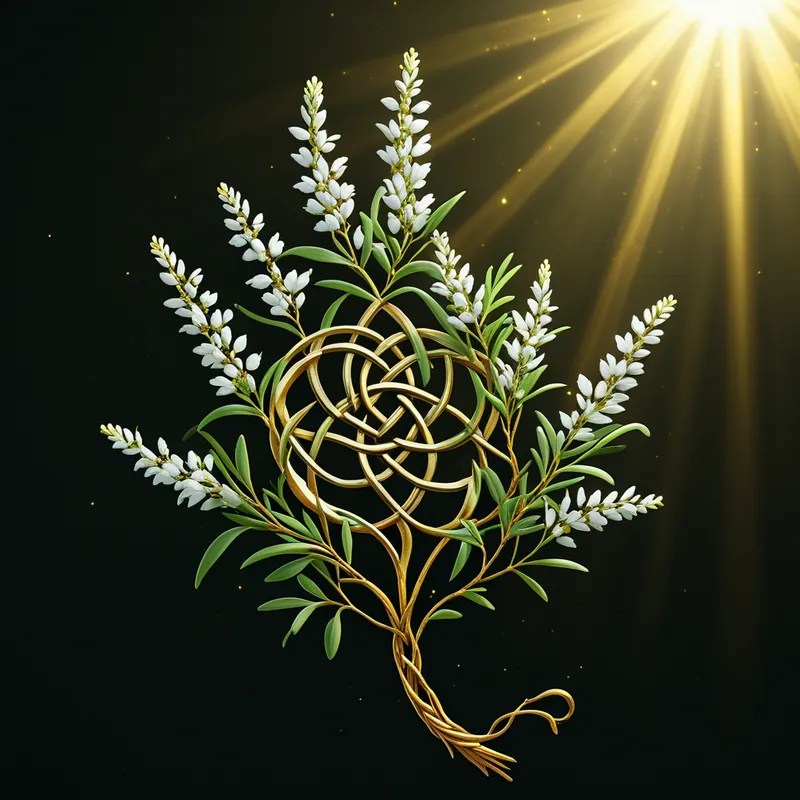
Her transformation into the heather is the core symbol. It is not a martyr’s death, but an alchemical change of state. She does not cease to be; she becomes pervasive, communal, and useful. The hardy, widespread, purple-flowering plant symbolizes resilience, humility, and a love that manifests as practical sustenance and enduring beauty. The white heather, said to spring where her tears fell purest, carries the symbol further into the realm of luck and protection—the blessing that remains from a sorrow transmuted.
The Dreamer's Resonance
To dream of this myth—of a luminous being on a moor, of a transformation into plants, or of a profound, wordless bond with a landscape—often signals a pivotal process in the dreamer’s psyche. Somatically, one might feel a deep ache of loneliness coupled with a yearning to belong in a more fundamental way. Psychologically, it speaks to the “high moor” of the soul: a place where one feels autonomous but isolated, self-sufficient but aching for connection.
The dream may emerge when the conscious personality (the warrior) is wounded—by life transition, loss, or a crisis of meaning. The healing offered by the inner, spiritual counterpart (the Lady) is not a rescue back to the old life, but a call to a radical transformation. The dream poses the ultimate question: Are you willing to let your current form of being—your isolation, your old identity—dissolve to become something new, something that serves a wider community (inner or outer) and roots you deeply into the fabric of life itself? It is the dream of the lover archetype confronting the necessity of sacrifice for the sake of a deeper union.
Alchemical Translation
The journey of the Heather Lady is a perfect model for the alchemical stage of solutio and coagulatio, central to Jung’s process of individuation.
First, there is the prima materia of her lonely, elemental existence. The encounter with the mortal is the coniunctio, the sacred marriage of spirit and matter, eternal and temporal. This union creates the unbearable tension—the nigredo of her despair—as she realizes her current form cannot contain this new love.
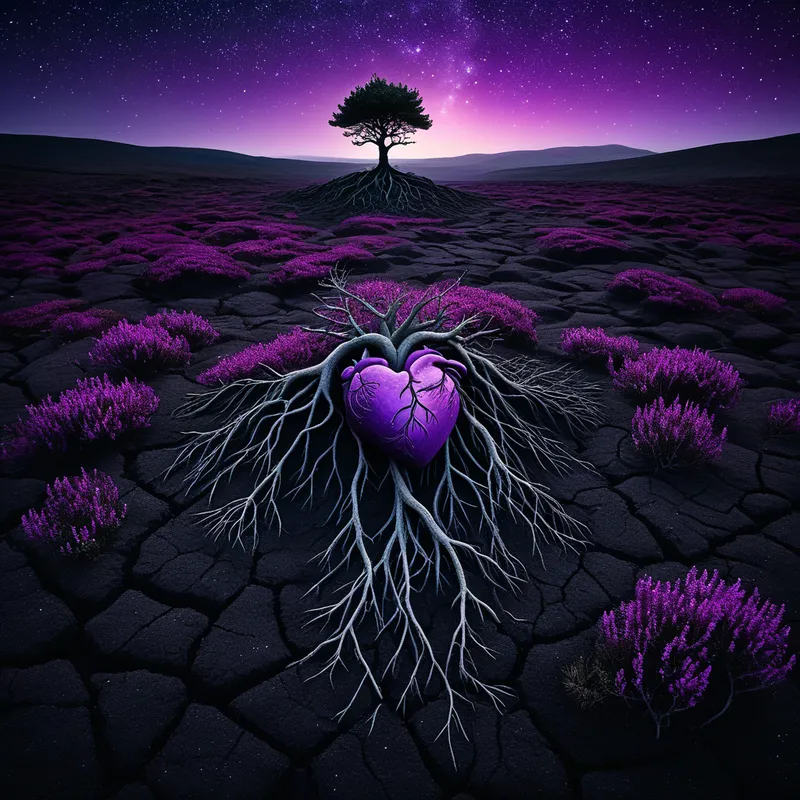
Her choice is the alchemical dissolution. She allows her defined, spiritual identity to “die” or dissolve into the substance of the earth. This is the terrifying, necessary step where the ego or a fixed self-concept must break down. But from this dissolution comes the albedo—the white heather of purity and blessing—and finally the rubedo, embodied in the pervasive purple bloom: the new, coagulated form.
The goal of the work is not to become spiritual, but to become fully, sacredly real. The spirit must incarnate, not the flesh evaporate.
For the modern individual, this myth does not counsel a literal demise, but a psychological one. It asks: What rigid form of yourself—your self-sufficiency, your protected identity, your isolated competence—must you let dissolve into the common ground of your relationships, your work, your community, or your own body? The triumph is not in staying the majestic, lonely spirit on the hill, but in becoming the heather: resilient, interconnected, humble, and nourishing. The myth teaches that true belonging and the highest expression of love often require the sacrifice of a cherished form of separateness, to bloom, at last, where you are most needed.
Associated Symbols
Explore related symbols from the CaleaDream lexicon: