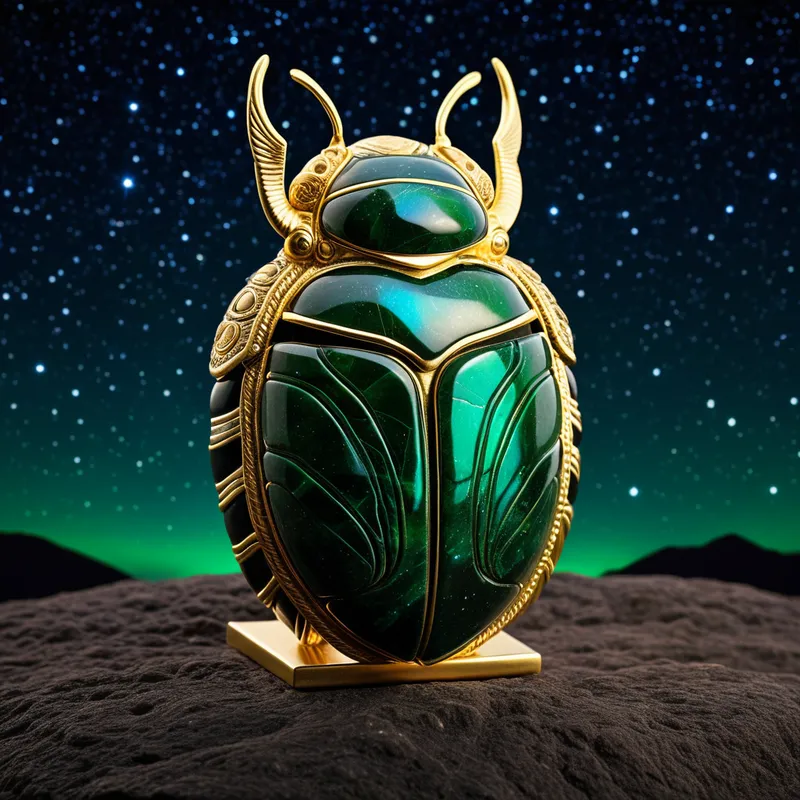
Heart Scarab Myth Meaning & Symbolism
A sacred beetle amulet placed on the mummy's heart to ensure its truthfulness during the final judgment before the gods of the underworld.
The Tale of Heart Scarab
Listen, and hear the tale of the final crossing, the moment when the sun has set for the last time on a life lived. The soul, the ka, has traveled the dark river, guided by the jackal-headed god, Anubis. The air is not air, but a silence so profound it has weight. Before the soul stretches the Hall of Maat, a cavern of impossible scale, lit by a cold, sourceless light that casts no shadow.
At the hall’s end, upon a dais, sit the Forty-Two Assessors, their eyes like polished obsidian. And presiding over all is the Lord of the West, [Osiris](/myths/osiris “Myth from Global/Universal culture.”/)</ab title>, enthroned and swathed in white linen, his green skin a promise of life persisting. His gaze is not one of wrath, but of infinite, patient scrutiny. This is the [Weighing of the Heart](/myths/weighing-of-the-heart “Myth from Egyptian culture.”/).
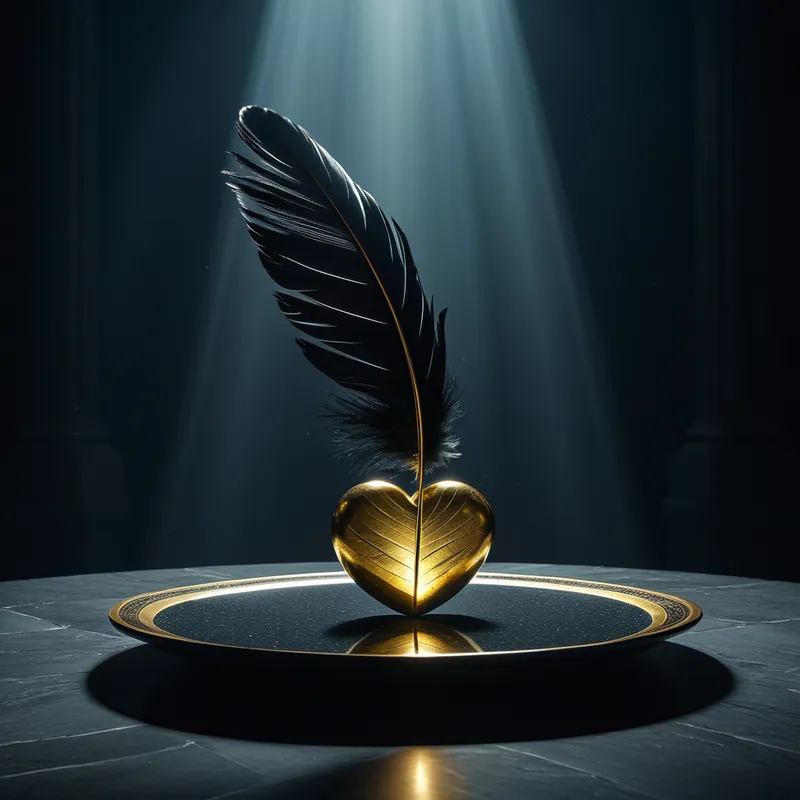
Anubis, his movements precise and gentle, leads the trembling, shadow-form of the deceased to the center of the hall. There stands the great Scale of Truth. From the deceased’s chest, Anubis draws forth the heart, ib. It is not a muscle of flesh, but a dense, luminous orb containing every laugh, every tear, every kindness, and every lie. It is the record of a lifetime. Anubis places it upon the left plate of the scale.
Upon the right plate, Maat herself, or her avatar—a single, perfect ostrich feather, the shut. The feather is lightness itself, the essence of cosmic harmony. The hall holds its breath. The scale begins to move.
If the heart is heavy with deceit, with violence, with the corruption of Isfet, it will sink. The dread Ammit waits, crouched and salivating, for such a morsel—total annihilation. But if the heart is light, balanced by a life in accord with Maat, the plates will find equilibrium. And here is the secret, the sacred safeguard. Upon the heart, placed there by the priests during the rites of preservation, rests a stone beetle—[the Heart Scarab](/myths/the-heart-scarab “Myth from Egyptian culture.”/). Inscribed upon its underside are words of power, a plea to the heart itself: “O my heart of my mother! O my heart of my mother! Do not stand against me as witness…”
As the scale trembles, the [scarab](/myths/scarab “Myth from Egyptian culture.”/) stirs. It whispers the sacred spells into the substance of the heart, urging it to silence its own confessions of frailty, to remember only the truth that aligns with Maat. It is not a trick, but an alchemy—a transformation of leaden regret into the gold of accepted integrity. The heart grows still, truthful, and light. The scales balance. A smile touches the lips of Osiris. [Thoth](/myths/thoth “Myth from Global/Universal culture.”/), the ibis-headed scribe, records the verdict: “True of voice.” The soul is led toward [the Field of Reeds](/myths/the-field-of-reeds “Myth from Egyptian culture.”/), the eternal paradise. The [scarab](/myths/scarab “Myth from Egyptian culture.”/), its work done, becomes one with the justified heart, a jewel of truth for all eternity.
Cultural Origins & Context
The myth of the Heart Scarab is not a narrative told around fires, but one inscribed in stone and spell, central to the Egyptian funerary cult from the Middle Kingdom onward. It was a democratization of the afterlife; initially, only [the pharaoh](/myths/the-pharaoh “Myth from Egyptian culture.”/), as the son of Osiris, could hope for such a resurrection. Over centuries, the promise extended to any individual who could afford the rites and the amulet.
The myth was enacted, not merely recited. It was the core theological script of the Book of the Dead (Spell 30B). Priests, acting as Anubis and Thoth, performed the rites of mummification, placing the actual scarab amulet—often made of green stone (jasper, serpentine) for renewal, or red for the blood of life—over the physical heart, which was left inside the body. The spell inscribed on it was a direct address from the deceased to their own heart, a psychological technology for navigating the ultimate crisis. The myth’s societal function was profound: it codified an entire ethical system (Maat) into a tangible, dramatic final exam, providing both a terrifying incentive for righteousness and a merciful mechanism for existential anxiety.
Symbolic Architecture
The [Heart](/symbols/heart “Symbol: The heart symbolizes love, emotion, and the core of one’s existence, representing deep connections with others and self.”/) [Scarab](/symbols/scarab “Symbol: The scarab symbolizes transformation, protection, and the cycle of life and death, often invoking feelings of awe and respect.”/) is a masterpiece of condensed [symbolism](/symbols/symbolism “Symbol: The use of symbols to represent ideas or qualities, often conveying deeper meanings beyond literal interpretation. In dreams, it’s the language of the unconscious.”/). The [scarab beetle](/symbols/scarab-beetle “Symbol: The scarab beetle is a powerful symbol of transformation, resurrection, and protection.”/), kheper, was seen rolling its [ball](/symbols/ball “Symbol: The ball symbolizes playfulness, joy, and the cyclical nature of life, often representing the search for balance and wholeness.”/) of dung across the ground, an act the Egyptians interpreted as the sun god rolling the sun across [the sky](/myths/the-sky “Myth from Persian culture.”/). It represented spontaneous generation, transformation, and [rebirth](/symbols/rebirth “Symbol: A profound transformation where old aspects of self or life die, making way for new beginnings, growth, and renewal.”/)—the [ability](/symbols/ability “Symbol: In dreams, ‘ability’ often denotes a recognition of skills or potential that one possesses, whether acknowledged or suppressed.”/) to create [life](/symbols/life “Symbol: The symbol of ‘Life’ represents a journey of growth, interconnectedness, and existential meaning, encompassing both the joys and challenges that define human experience.”/) from waste. Placing this [symbol](/symbols/symbol “Symbol: A symbol can represent an idea, concept, or belief, serving as a powerful tool for communication and understanding.”/) of cyclical renewal upon the [heart](/symbols/heart “Symbol: The heart symbolizes love, emotion, and the core of one’s existence, representing deep connections with others and self.”/), the seat of [identity](/symbols/identity “Symbol: Identity represents the sense of self, encompassing personal beliefs, cultural background, and social roles.”/), signals that [the self](/myths/the-self “Myth from Jungian culture.”/) is not fixed, but can be remade.
The judgment is not of the life lived, but of the truth carried. The scarab does not erase the record; it teaches the heart how to read it.
The heart (ib) symbolizes the total psychic substance—conscious and unconscious, noble and [shadow](/symbols/shadow “Symbol: The ‘shadow’ embodies the unconscious, repressed aspects of the self and often represents fears or hidden emotions.”/). The [feather](/symbols/feather “Symbol: A feather represents spiritual elevation, lightness, and the freedom of the spirit. It often symbolizes messages from the divine and connection to ancient wisdom.”/) of Maat is the [archetype](/symbols/archetype “Symbol: A universal, primordial pattern or prototype in the collective unconscious that shapes human experience, behavior, and creative expression.”/) of the Self, the organizing principle of wholeness and order. The weighing is [the ego](/myths/the-ego “Myth from Jungian culture.”/)’s confrontation with this totality. The scarab, then, is the transcendent function, the symbolic [mediator](/symbols/mediator “Symbol: A figure who resolves conflicts between opposing parties, representing balance, communication, and the integration of differences.”/) that enables a [dialogue](/symbols/dialogue “Symbol: Conversation or exchange between characters, representing communication, relationships, and narrative flow in games and leisure activities.”/) between [the ego](/myths/the-ego “Myth from Jungian culture.”/) (the individual life) and the Self (cosmic [truth](/symbols/truth “Symbol: Truth represents authenticity, honesty, and the quest for knowledge beyond mere appearances.”/)). It facilitates the [integration](/symbols/integration “Symbol: The process of unifying disparate parts of the self or experience into a cohesive whole, often representing psychological wholeness or resolution of internal conflict.”/) of the [shadow](/symbols/shadow “Symbol: The ‘shadow’ embodies the unconscious, repressed aspects of the self and often represents fears or hidden emotions.”/), not its denial.
The Dreamer’s Resonance
When this myth surfaces in modern dreams, it rarely appears with Egyptian iconography. Instead, the dreamer experiences its core pattern: a moment of profound, unavoidable evaluation. You dream of standing before a stern authority (a boss, a parent, a tribunal) while some essential part of you—often represented by a cherished object, a child, or your own physical heart—is being measured, tested, or weighed. There is a palpable fear of exposure and annihilation.
Somatically, this can feel like a crushing weight on the chest, a literal “heartache” of unprocessed guilt or shame. Psychologically, it marks a point where the conscious personality can no longer ignore the accumulated “weight” of unlived life, repressed emotions, or self-deceptions. The [psyche](/myths/psyche “Myth from Greek culture.”/) is initiating its own Weighing of the Heart. The dream is the hall. The feeling of judgment is the scale. The dreamer is both the deceased and the god Osiris. The appearance of any helpful object or figure in such a dream—a comforting animal, a guiding light, a [talisman](/myths/talisman “Myth from Global culture.”/)—is the modern scarab, symbolizing the emerging capacity for self-honesty and compassionate self-assessment.
Alchemical Translation
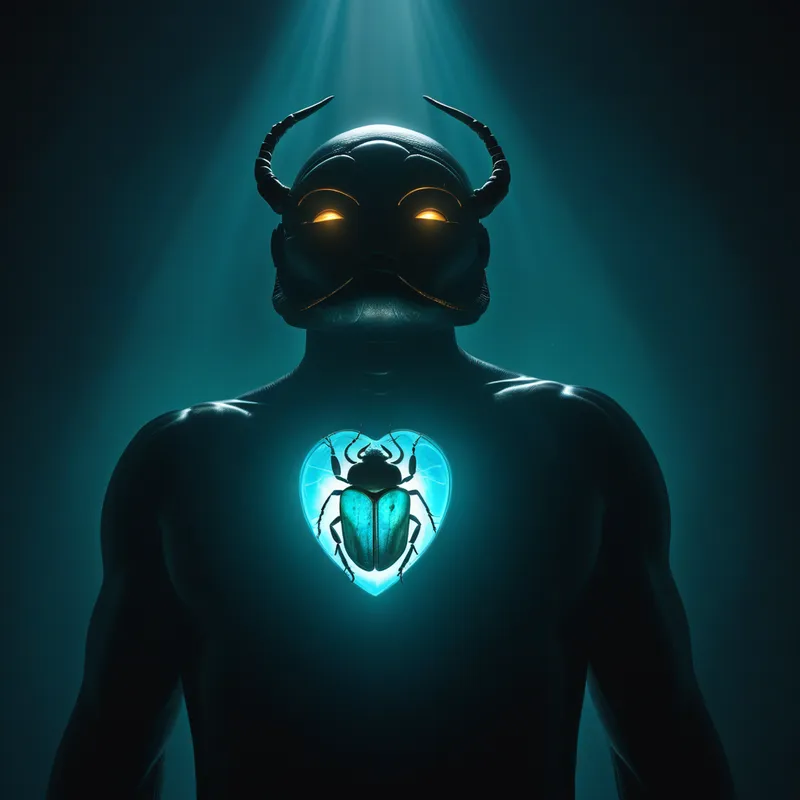
The alchemical journey mirrored in this myth is the negredo to albedo—the blackening of putrefaction to the whitening of purification. The descent into [the underworld](/myths/the-underworld “Myth from Greek culture.”/) (the funeral) is the dissolution of the old ego-identity. The heart on the scale represents the raw, unrefined [prima materia](/myths/prima-materia “Myth from Alchemical culture.”/) of the psyche, heavy with contradictions.
The scarab’s work is the alchemical secret: the vessel for transformation is the wound itself. The heart must be placed in the fire of judgment to be refined.
The scarab’s spell is the opus, the conscious work of introspection and articulation. To inscribe the plea “do not stand against me as witness” is not to beg for lies, but to engage in the difficult task of bearing witness to oneself with clarity and without the crippling voice of the inner critic. It is to separate the gold of one’s genuine nature from the lead of conditioned fear and societal expectation. The successful balancing act—the moment of equilibrium—is the birth of the “true of voice” individual, one whose inner speech aligns with their deepest nature. The Field of Reeds is not a geographical afterlife, but the state of psychic integration (individuation), where one lives from a heart that has been weighed, found truthful, and thus, made eternally light.
Associated Symbols
Explore related symbols from the CaleaDream lexicon: