
Hawthorn Myth Meaning & Symbolism
The Hawthorn guards the veil between worlds, a sacred tree of sovereignty whose blossoms promise life and whose thorns enforce the law of the threshold.
The Tale of Hawthorn
Listen. The wind does not blow through the branches of the Huath; it speaks through them. In the time when the world was younger and the veil was a mere gossamer curtain, there stood a tree that was not one tree, but a thousand. It was the Huath, the white-thorn, and it marked the places where the land held its breath.
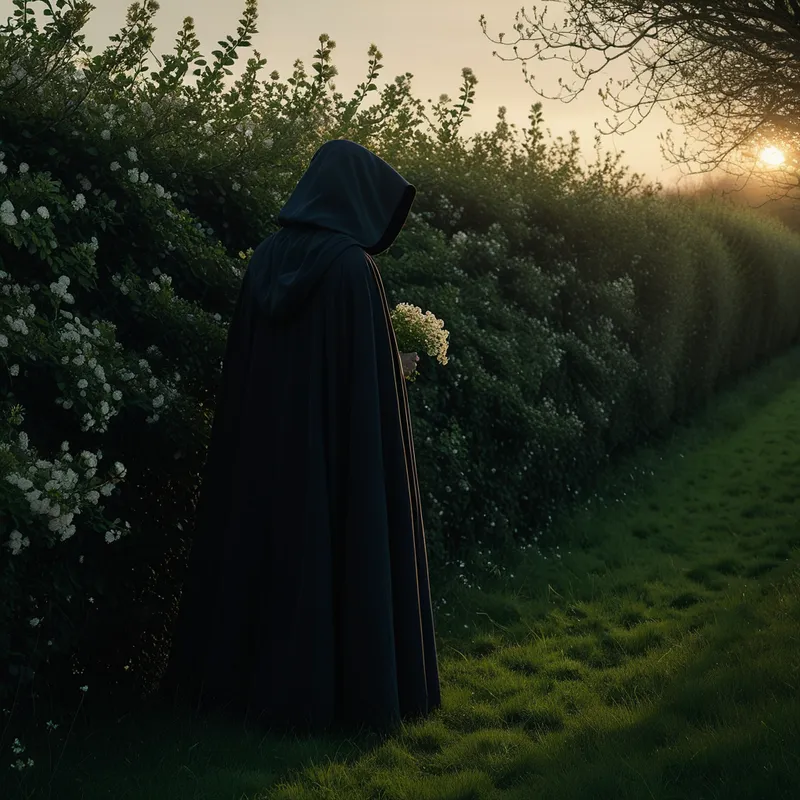
In the heart of the Fifth Province, where no mortal king ruled, there was a well. Not a well of water, but of vision. And around it grew a hedge of Huath, so dense and thorned that neither man nor beast could pass. Its blossoms in spring were a fall of snow that smelled of honey and memory, a scent so potent it could lure the soul from the body. This was Sídhe Crúachan, and it was guarded.
The guardian was not a giant with a sword, but the silence between the thorns. It was the law of the place itself: to pass the hedge unbidden was to pass out of time. Yet kings, in their hunger for the true Flaitheas, would come. They would circle the hedge for three days and three nights, fasting, listening to the whisper of the white flowers. Some heard only the wind. But one, a king whose heart was clear of false ambition, heard the land speak.
On the third night, as the first star pierced the twilight, a single branch of the Huath bent down. Not in submission, but in offering. From it hung a berry, red as a drop of heart's blood. The king knew the law. He did not grasp. He cupped his hands beneath it, and the berry fell. As it touched his palm, the hedge did not part, but it recognized. A path, narrow and twisted as an old root, appeared between the terrible thorns. He walked it, and the thorns caught at his cloak but not his skin, for he moved with the permission of the place. He reached the well, drank not of water but of understanding, and emerged not just a king of men, but a husband to the land itself.
But woe to the one who takes the blossom, breaks the branch, or forces the way. Their story is told in the rustle of the leaves—a tale of luck turned sour, of herds that sicken, of a sovereignty that slips through fingers like sand. The Huath gives its gifts freely, but its boundaries are absolute. It is the keeper of the threshold, and its price for disrespect is the very connection it protects.
Cultural Origins & Context
The hawthorn's myth is not a single story bound in a manuscript, but a living pattern woven into the landscape and psyche of the Celtic world. It belongs primarily to the Irish and Brythonic traditions, its lore preserved not by a centralized priesthood, but by the Filid and the memory of the land itself. This was an animistic worldview, where certain trees were understood as personifications of spirit, as markers of the Otherworld.
The hawthorn, often found solitary in the center of a field or guarding a holy well, was one of the most potent of these markers. It was considered a Sceach. Its narrative function was societal and psychological: it physically demarcated sacred space (a Fairy Fort or well) and psychologically enforced the cultural law of respect for boundaries—both territorial and spiritual. To cut down a lone hawthorn was not merely bad gardening; it was a cosmic offense, an invitation of misfortune from the displaced Aos Sí. Its myth was told to explain blight, personal ruin, or lost fortune, rooting abstract moral codes in the very real, prickly presence of the tree.
Symbolic Architecture
The hawthorn is the ultimate symbol of the liminal—the powerful, dangerous, and sacred space of the in-between. It is not a tree of the deep forest nor of the open plain; it is the tree of the hedge, the border, the gateway.
The true guardian does not forbid passage; it defines the sacred manner in which passage may be earned.
Its duality is its core: the devastating thorns that protect, and the beautiful, fragrant blossoms that invite. This represents the fundamental law of the psyche and the sacred: that which is most alluring and promising (blossoms of inspiration, love, sovereignty) is often guarded by that which is most painful and resistant (thorns of ordeal, sacrifice, discipline). The hawthorn myth teaches that sovereignty—Flaitheas, over a kingdom or one's own soul—is not seized, but received through respectful engagement with these boundaries.
Psychologically, the hawthorn represents the Self's protective mechanisms. The thorns are the necessary defenses, complexes, and neuroses that form around a tender, blossoming core of potential. To hack mindlessly at the thorns is to destroy the entire structure. The myth instructs us to approach, to fast (purify intention), to listen, and to wait for the gesture of recognition from the deep Self.

The Dreamer's Resonance
When the Huath appears in modern dreams, it signals a psyche at a threshold. The dreamer is confronting a boundary—internal or external—that feels both alluring and forbidding.
Dreaming of a lush, blossoming hawthorn in an unexpected place (a city street, one's living room) often points to an irruption of the sacred or the numinous into ordinary life. The unconscious is announcing a potential for new growth or a call from a deeper layer of the Self. Conversely, a dream of a bleeding, wounded, or cut hawthorn is a profound alarm. It suggests the dreamer is violating their own psychic boundaries, disrespecting their inner sanctum, or acting in a way that severs their connection to their own source of life and legitimacy. The somatic feeling is often one of unease, a prickling on the skin, or a sense of being watched or judged by an unseen law.
A common pattern is the dream of being lost in a hawthorn hedge—the path is obscured, the thorns catch at clothing, progress is painful and slow. This is the psyche modeling the process of navigating a complex transition where the old ways are gone and the new way is not yet clear. The dream asks for patience, respect for the process, and attention to small signs of permission.

Alchemical Translation
The hawthorn myth is a precise alchemical recipe for Individuation. It models the stage where the seeker must confront the guardian of the threshold—their own accumulated defenses, fears, and conditioned responses—to access the transformative waters of the unconscious (the well).
The ordeal at the threshold is not an obstacle to the goal; it is the fire that transmutes the seeker into a vessel capable of holding the goal.
The initial "fasting" is the nigredo, the darkening: the letting go of ego-driven desires and superficial ambitions. "Circling the hedge" is the conscious engagement with the complex, studying it from all angles without forcing entry. The "bending branch" is the coniunctio, the symbolic moment of grace where the unconscious (the tree/Self) responds to the purified ego. The offering of the berry is not the full transformation, but the token of permission to proceed.
The final journey through the thorny path is the albedo, the whitening. It is a purification under pressure, where one is scraped clean of all that is non-essential. Only what is aligned with the true Self passes unharmed. Drinking from the well is the rubedo, the reddening: the integration of the profound insight, the sacred marriage of the ego with the sovereignty of the Self. For the modern individual, this translates to any profound life transition—career change, spiritual awakening, deep therapy—where success depends not on bulldozing resistance, but on honoring the sacred, protective, and often painful architecture of one's own psyche to find the authentic path through.
Associated Symbols
Explore related symbols from the CaleaDream lexicon: