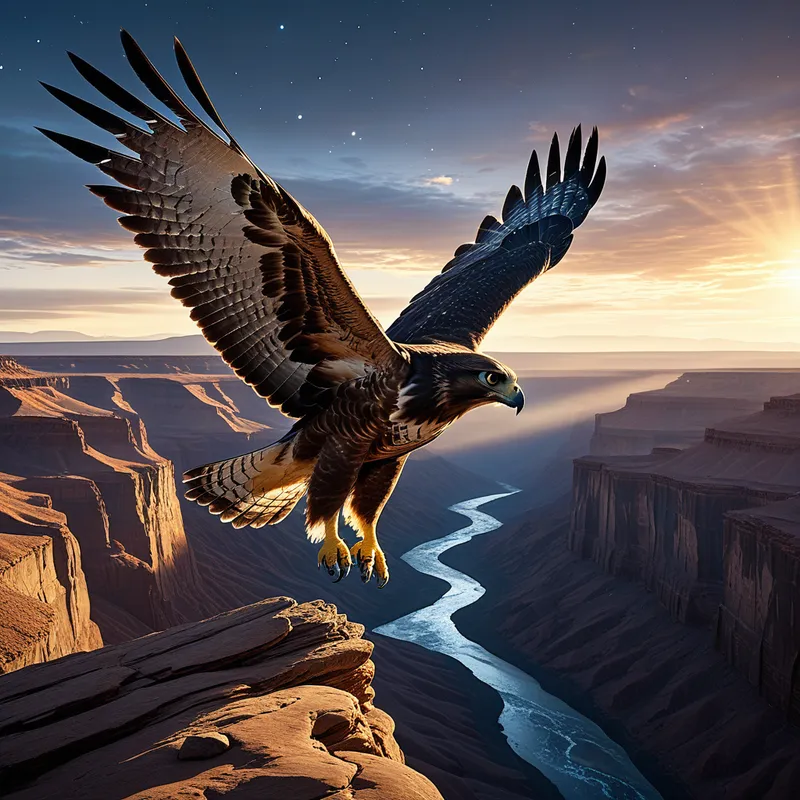
Hawk Spirit Myth Meaning & Symbolism
A messenger spirit ascends through suffering to gain a vision that bridges the worlds, teaching that true sight requires the courage to leave the ground.
The Tale of Hawk Spirit
Listen. In the time before time, when the world was soft and the voices of the ancestors still whispered in the wind, there was a being of the air. He was not yet the great messenger. He was simply Hawk, a creature of sharp eyes and swift wings, who lived on the cliffs and hunted in the valleys. His world was the stretch between the earth and the lowest clouds, a realm he knew with every beat of his heart.
But Hawk was restless. He watched the Sun, Gitche Manitou, travel a path he could not follow. He saw the storms brew in places beyond the farthest mountain, heard rumors of a great council where the animal spirits and the star people met. A veil lay over his sight, a horizon he could not pierce. This longing became a thorn in his spirit.
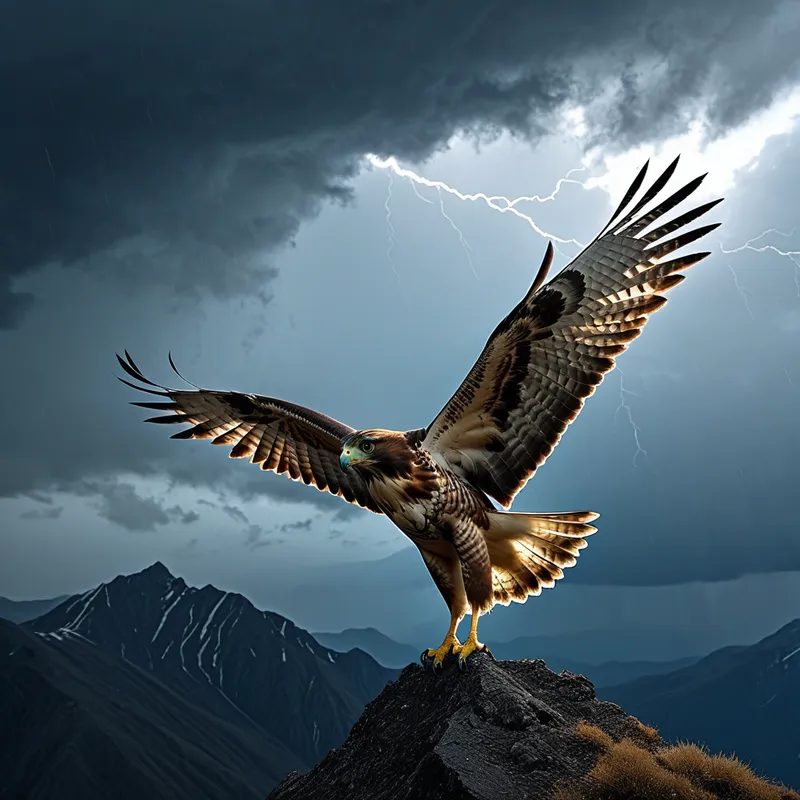
One day, driven by a fire he did not understand, Hawk flew higher than he ever had. The air grew thin and cold, biting at his feathers. The familiar shapes of the land blurred into a tapestry of green and brown. He pushed onward, toward the place where the blue of the sky deepens into the black of night. Then, a silence more profound than any he had known fell upon him. And from that silence, a force—a great wind from the heart of the sky—seized him. It was not a storm, but the breath of the void itself. His wings, so mighty in the world below, were as fragile as dried leaves. They shattered.
Hawk fell.
It was not the swift dive of a hunter, but a terrible, spiraling plummet. He crashed into the side of the sacred mountain, the World Navel, and lay broken among the rocks. His body was ruined, his wings twisted, his pride dust. For days and nights, he endured, a creature of the sky now bound to the cold stone. He was visited only by the biting wind and the indifferent stars.
In his deepest despair, as he stared at the unreachable heavens, a different kind of vision began to dawn. From his prison of stone, he saw everything. He saw the ant struggling on a pine needle far below. He saw the river’s secret path through the forest. He saw the hidden deer in the thicket, and the child laughing in a distant village. His physical eyes were dimmed, but a new sight was born in his spirit—a sight that needed no wings, for it was everywhere at once. He saw the connections: how the river fed the root, how the root fed the insect, how the insect fed the chick in his own abandoned nest. He saw the great circle.
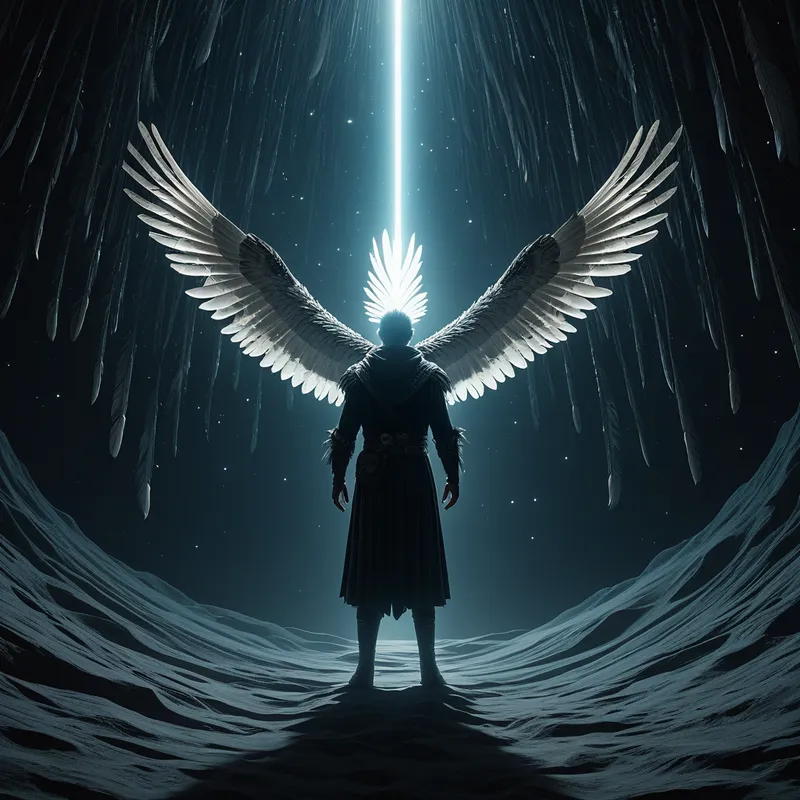
Moved by this pitiful yet illuminating sight, the spirit of the mountain took pity. The wind returned, but this time as a gentle breath. It lifted not his broken body, but his very essence. From the shattered form on the rocks, the spirit of Hawk ascended. He was remade, not of flesh and feather, but of light and intention. He became Hawk Spirit, the Far-Seeing One. His role was no longer to hunt, but to witness. To carry prayers from the people to the sky, and to bring back visions from the great mystery to the people. His brokenness had become his bridge.
Cultural Origins & Context
The figure of Hawk Spirit is not the property of a single nation, but a resonant pattern woven through many traditions across North America—from the Lakota and Cherokee to the tribes of the Pacific Northwest and Southwest. As a myth, it belongs to the oral tradition, told by elders and storytellers around winter fires and during rites of passage. Its function was multifaceted: it was a teaching story about the value of perspective, a cosmological map explaining the presence of a messenger between worlds, and a narrative framework for understanding visionary experiences.
The story was often invoked in the context of seeking guidance or preparing for a vision quest. The aspirant, like Hawk, had to willingly enter a state of vulnerability and "brokenness"—leaving the comfort of the village, fasting, and facing the elements—in hopes of receiving a clearer vision for their life path. Hawk Spirit modeled this process, showing that the most profound wisdom often comes not from strength, but from the surrender of a limited form of power. The myth served as a cultural container for the universal human experience of striving, failure, and transformative insight.
Symbolic Architecture
At its core, the myth of Hawk Spirit is an allegory for the birth of consciousness itself. Hawk begins as a creature of pure instinct and localized perception—a symbol of the ego, competent within its known domain but ultimately limited and restless.
The fall is not a punishment, but the necessary shattering of the container that is too small to hold the spirit.
The broken wings represent the collapse of our primary identity, the tools we rely on to navigate the world. This is the universal experience of crisis, failure, or profound loss that renders our old ways of being obsolete. The mountain, the World Navel, is the axis where heaven and earth meet—the place of the Self in Jungian terms, the central organizing principle of the psyche. It is only when Hawk is pinned to this sacred center, immobilized, that his true vision awakens.
The new sight—the simultaneous, panoramic understanding—symbolizes the achievement of a transcendent function. It is the ability to see the whole system, the interconnectedness of all life, the pattern behind the events. Hawk Spirit, in his final form, embodies this function: he is the psychopomp who can travel between the conscious world (the earth) and the unconscious, archetypal realm (the sky), integrating their messages.
The Dreamer's Resonance
When the pattern of the Hawk Spirit myth stirs in modern dreams, it often signals a critical juncture in the dreamer's psychological development. Dreaming of a hawk, especially one that is injured, trapped, or attempting a desperate flight, points to a striving aspect of the psyche—an ambition, a talent, or a spiritual longing—that has met with a severe limitation or failure.
The somatic experience accompanying such dreams can be one of constriction in the chest (the broken wings) or a dizzying, disorienting sensation (the fall). Psychologically, the dreamer is in the "mountain" phase: a painful but necessary period of immobilization where the old identity is being deconstructed. The dream may not offer the resolution of the myth; it may simply present the crisis. This is the unconscious presenting the first act of the drama, inviting the conscious ego to endure its own "brokenness" with the promise that this is not an end, but the precondition for a new mode of perception. Recurring dreams of flying after such a period can signal the beginning of the alchemical ascent, the emergence of the transcendent function.
Alchemical Translation
The journey of Hawk Spirit is a perfect map of the individuation process. It begins with the nigredo, the blackening: the restless ambition of the ego (Hawk's initial flight) leads to a catastrophic encounter with the unconscious (the void wind), resulting in the dark night of the soul (the fall and brokenness on the mountain). This is a voluntary suffering, the sacrificium intellectus, where the intellect and the will are humbled.
The immobilization on the mountain is the albedo, the whitening. It is a state of passive incubation, where in the stillness, a new kind of perception is born. The panoramic vision represents the synthesis of opposites—the detailed earthly view and the cosmic overview—giving birth to the lapis philosophorum, the philosopher's stone, which in psychological terms is the integrated Self.
The ultimate transmutation is not from lead to gold, but from a creature bound by horizon to a spirit defined by vision.
For the modern individual, this translates to the process where a life crisis—a career failure, the end of a relationship, an illness—shatters our ego-identity. The alchemical work is to not hastily repair the old "wings," but to remain in the difficult, liminal space. It is there we learn to see not with the eyes of ambition or fear, but with the eyes of the witness. We become a messenger to ourselves, carrying the raw data of our earthly experience up to be contextualized by the greater patterns of the psyche, and bringing back down the insights that grant meaning and direction. We become, in our own small way, the bridge between worlds.
Associated Symbols
Explore related symbols from the CaleaDream lexicon: