Hawaiki Myth Meaning & Symbolism
The mythic homeland from which all life and journeys begin, a paradise lost yet eternally remembered, guiding the soul's voyage across the ocean of being.
The Tale of Hawaiki
Listen. Before the world was as you know it, there was a place of first light. Not an island as you might walk upon, but the idea of an island, a perfect, pulsing heart of creation. This was Hawaiki. Here, the air was thick with the scent of flowering tiare and damp earth. Here, the first gods stirred in the primal darkness, Rangi and Papa, locked in a tight embrace, their children dreaming in the cramped space between them.
But the children—Tāne, Tangaroa, Tū, and others—longed for light, for space to become themselves. In the core of Hawaiki, a great tension grew, a yearning that vibrated in the roots of the great wauke trees. It was Tāne, the life-bringer, who placed his feet upon Papa and his back against Rangi, and with a groan that shook the foundations of existence, he pushed. Sky and earth were wrenched apart, and light flooded the world for the first time. This was the first great departure, the original separation that made life possible.
From this act, everything flowed. The first humans, Tiki, were shaped from the red earth of Hawaiki. The first kūmara was brought from its secret places. Life was abundant, a chorus of creation. But Hawaiki was also a place of conflict. Great battles were fought over land, over status, over love. A wrong was committed, a sacred tapu was broken. The sea grew restless, the winds whispered of distant, empty horizons.
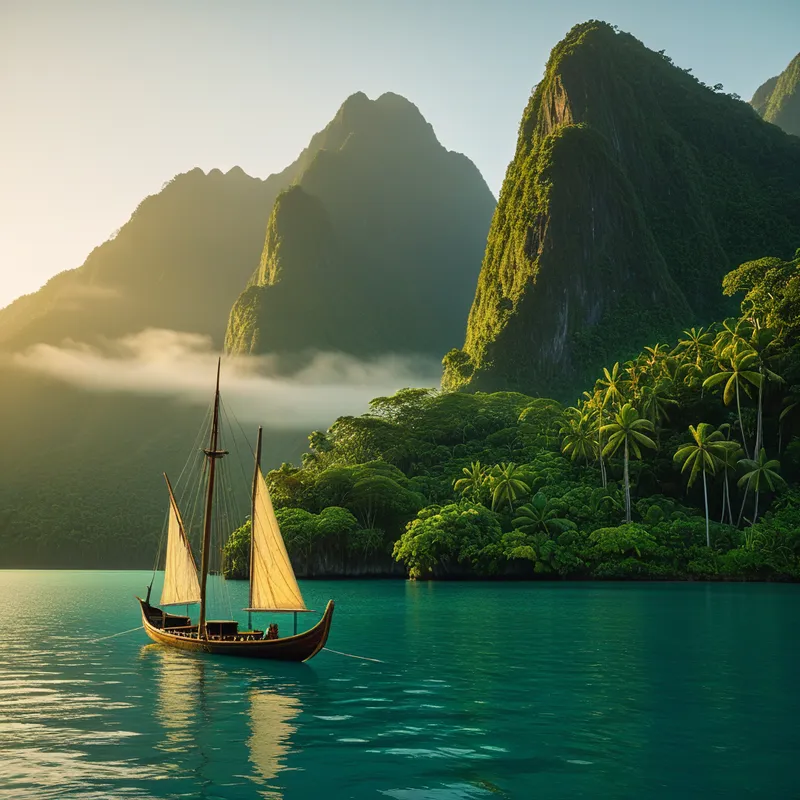
And so, the great canoes were built. The kahuna hoʻokele studied the stars—Hōkūleʻa, Crux—and read the paths of birds and waves. With hearts heavy with loss and bright with hope, they loaded the sacred plants, the animals, the ancestral bones, and the memories of Hawaiki into the bellies of their waka hourua. They cast off from the known shores, turning their backs on the homeland, guided only by the remembered song of the place they left behind. They sailed into the teeth of the wind, following the thread of memory across the trackless Moana, seeking the promise of land whispered in the swell. They did not find Hawaiki again. They found new islands, and in settling them, they carried Hawaiki in their chants, in their rituals, in the very shape of their new lives. The homeland was not a location, but the journey itself.
Cultural Origins & Context
Hawaiki is not a myth confined to a single text, but the foundational bedrock of the Polynesian worldview, echoed from Aotearoa (New Zealand) to Rapa Nui (Easter Island) to Hawaiʻi. It is the ultimate whakapapa, the point of origin in the great genealogical chants that link people directly to the gods and the land. This myth was not merely "told"; it was performed, chanted, danced, and carved into meeting house panels. It was the domain of priests (tohunga) and master navigators, who held the cartography of the past in their minds.
Its primary societal function was ontological—it answered the profound questions: Where do we come from? Why are we here? It provided a template for all human endeavor: life is a voyage (heke) from a source, through challenge, toward a destiny. It legitimized leadership and land rights through ancestral voyages, and most importantly, it encoded the incredible real-world feat of Polynesian celestial navigation and colonization of the Pacific Ocean into a sacred, guiding narrative. The myth was the spiritual compass that made the physical voyage possible.
Symbolic Architecture
Hawaiki represents the unconscious source of the Self. It is the primordial, undifferentiated state of being—the paradise of childhood, the womb, the collective unconscious where all potentials exist but no individual form has yet been taken.
The great separation of Rangi and Papa is the first act of consciousness, the necessary trauma of individuation that creates the space for a world to exist.
The homeland, therefore, is synonymous with a state of completeness that is also a state of stasis. To remain in Hawaiki is to remain potential, unborn. The conflict that forces the departure is the psyche's own growth, the internal pressure that can no longer be contained. The ocean voyage is the ego's journey through the vast, unknown realms of life and the unconscious. The canoe is the vessel of the conscious personality, fragile yet guided by the ancestral wisdom (the stars, the chants) carried within it. The new land found is not a replica of the old, but the new, conscious identity forged through the journey—the individual life built upon, but distinct from, its source.
The Dreamer's Resonance
When Hawaiki appears in modern dreams, it rarely manifests as a literal tropical island. It appears as the childhood home, bathed in an uncanny, golden light of nostalgia. It is the dream of a perfect relationship, a lost job of profound meaning, or a forgotten talent. The somatic feeling is one of deep, aching longing mixed with safety—a homesickness for a place you've never physically known.
Psychologically, this dream pattern surfaces during times of profound transition: leaving home, ending a major chapter, beginning a creative endeavor, or during midlife reflections. The dreamer is processing the necessary loss at the heart of all growth. The conflict in the dream—the reason they must "leave" this perfect place—is the conflict between the comfort of the known self and the call of the unlived life. To dream of building a canoe or packing for a voyage signifies the psyche preparing resources for this transition. To dream of being lost at sea reflects the terror of this individuation process, the fear of losing one's identity in the vastness of the unknown.
Alchemical Translation
The alchemy modeled by the Hawaiki myth is the transmutation of memory into destiny, of source material into sovereign self. The process begins in the nigredo, the blackness of the confined space between Rangi and Papa—a state of suffering in paradise, a feeling that the current self is too small, too constrained.
The voyage is the albedo, the whitening, the purification through ordeal. The salt of the sea tears away what is not essential; the vast, starry void reflects back the true navigational lights of the soul—one's core values and inherited strengths.
The breaking of tapu that triggers the exile is not a mere sin, but a sacred transgression—the necessary breaking of an old law to make way for a new consciousness. The modern individual engages in this when they break family patterns, cultural expectations, or self-imposed limitations.
The final landfall is the rubedo, the reddening, the achievement of the philosophical gold. It is not a return to the beginning, but the creation of a new internal "land." The individual plants the kūmara of their unique gifts in this new psychic soil. They realize that Hawaiki was never a place to return to, but the origin point that made the journey—and thus, the current, realized self—possible. The completed individual carries their own Hawaiki within, a living, breathing homeland of the soul from which they can draw strength and to which they can always orient, no matter how far their voyages may take them.
Associated Symbols
Explore related symbols from the CaleaDream lexicon: