Haumia-tiketike Myth Meaning & Symbolism
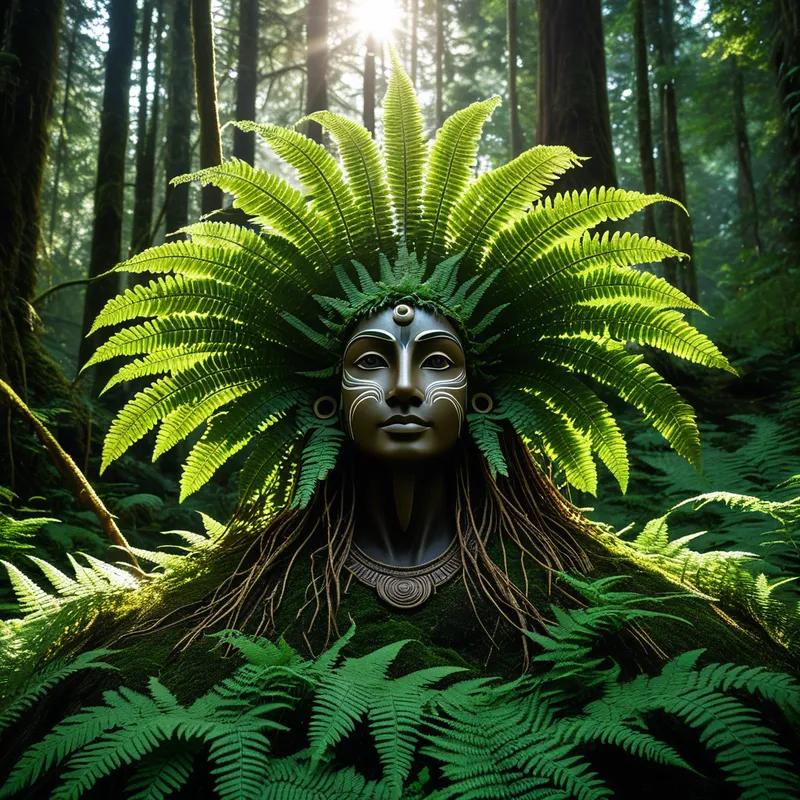
The story of Haumia-tiketike, the wild fern-root god who evades capture by retreating into the earth, embodying hidden resilience and untamed sustenance.
The Tale of Haumia-tiketike
Listen. Before the world was as you know it, when the sky pressed close upon the earth and the light was a contested thing, there existed the children of Ranginui and Papatūānuku. Among them was Rongo-mā-Tāne, whose domain was the planted and the tamed. And there was another, a wilder brother: Haumia-tiketike.
Haumia was not of the cleared field or the ordered mound. His spirit was the untamed hillside, the dense, whispering undergrowth of the great forest. His body was the aruhe, the fern root—not the proud, visible fruit, but the hidden, sinewy treasure buried in the dark, moist belly of the earth. He was sustenance that did not ask for cultivation, a gift that required knowing, not forcing.
Then came the great rending, the forcing apart of Sky and Earth by their ambitious sons. Light flooded the world, and with it, a fierce and hungry clarity. Tāne clothed the mother in trees. Tangaroa claimed the seas. And Haumia-tiketike and Rongo-mā-Tāne settled upon the breast of their mother, Papatūānuku.
But a final, consuming force remained: Tūmatauenga, the fierce one, the embodiment of human will, conflict, and hunger. He looked upon his brothers and saw not kin, but food. He declared war upon them, to subdue and consume them all. Tāne’s birds could be snared. Tangaroa’s fish could be hooked. Rongo’s kumara could be dug from its garden.
Then his burning gaze fell upon Haumia-tiketike.
Tūmatauenga strode to the wild places, his aspect one of sharpened wood and hardened intention. He sought the form of his wild brother, but Haumia was not there in a shape to be grasped. Tūmatauenga saw only the endless sway of the fern fronds, the unbroken carpet of green. He reached down to seize the god, to pull him forth and claim him.
But Haumia-tiketike felt the aggressive touch. In that instant, he did not stand and fight. He did not flee across the open land. With a profound, silent knowing, he turned inward and downward. He let his form dissolve into the very essence of his being. He retreated into the embrace of his mother, Papatūānuku. He became what he always was at heart: the hidden root, the network beneath, the sustenance that cannot be taken by force, only received with respect and knowledge.
Tūmatauenga clutched at ferns and came away with only leaves. He dug fiercely but found only dirt. The god of war could rage upon the surface, but he could not grasp the one who had chosen the depths. Haumia-tiketike had vanished from the world of conflict, securing his power in the realm of the unseen, the patient, and the wild. He was not conquered; he was made inaccessible to the spear, preserved for those who would approach with the right touch, the right knowing.

Cultural Origins & Context
This myth is part of the vast and profound whakapapa (genealogical recitation) and pūrākau (traditional narrative) of the Māori people, transmitted orally across generations by tohunga (experts) and storytellers. It is not merely a story of gods, but a foundational cosmological account explaining the origins of food sources and the proper relationship between humanity and the natural world.
The narrative served critical societal functions. It established the ontological categories of food: the cultivated (Rongo-mā-Tāne) and the uncultivated (Haumia-tiketike). In doing so, it encoded vital survival knowledge. The fern root (aruhe) was a staple carbohydrate, especially when cultivated crops failed. The myth taught that this resource required a different protocol—not the aggressive harvesting of war (Tūmatauenga), but a respectful, knowledgeable gathering. It reinforced the concept of kaitiakitanga (guardianship), suggesting that some resources remain sovereign, hiding their full bounty from a purely exploitative mindset.
Symbolic Architecture
At its core, the myth of Haumia-tiketike is a masterclass in non-violent resilience and the power of the recessive. It symbolizes that which refuses to be objectified, commodified, or engaged on terms of open conflict.
The greatest strength is sometimes not in the towering tree, but in the hidden root that chooses when to be found.
Haumia represents the psyche's own wild, untamed resources—the instincts, intuitions, and innate knowings that cannot be forced into the light of conscious rationality (Tūmatauenga's domain). He is the content of the unconscious that, when approached with aggression or a desire to "conquer," simply retreats deeper, becoming inaccessible. The fern root itself is a perfect symbol: nutritious and sustaining, yet fibrous, requiring careful preparation (processing, understanding) to be made digestible. It is knowledge that is earned, not seized.
Psychologically, Tūmatauenga is the archetypal force of the conscious ego, seeking to bring all things under its control and utility. Haumia is the shadowy, vegetative life of the unconscious, which supports the ego but refuses to be subsumed by it. The myth validates a mode of being that is receptive, patient, and deeply connected to the "earth" of one's own primordial nature.
The Dreamer's Resonance
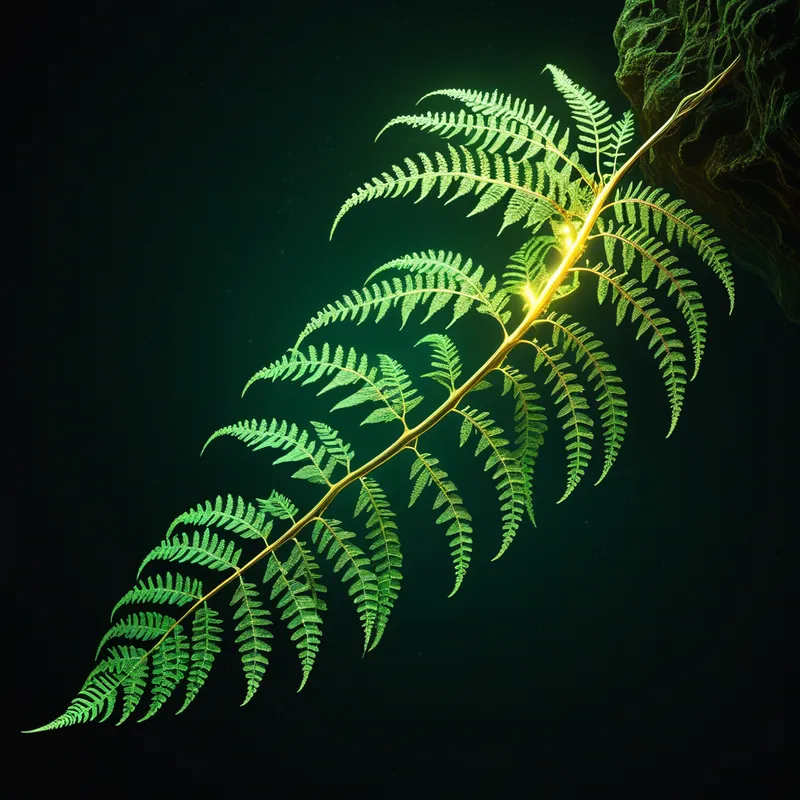
When this myth pattern stirs in the modern dreamer, it often signals a somatic or psychological process of retreat for the purpose of self-preservation and consolidation. One may dream of being pursued and finding safety by melting into a landscape, becoming a tree, or sinking into the ground. There is a profound feeling of yielding, not out of weakness, but out of a deep, instinctual knowing that direct confrontation would be annihilating.
This is the psyche's wisdom during times of overwhelming stress, burnout, or aggression (whether external or from an overly critical inner voice). The dream-ego, like Haumia, is learning to access the resilience of the root. Somatic sensations might accompany this—a feeling of grounding, of heaviness, of drawing nourishment from below. The process is one of moving from a state of exposed vulnerability (the fern frond) to a state of hidden, networked strength (the root system). It is the unconscious instructing the conscious self to stop fighting on the surface and to reconnect with its foundational, sustaining core.
Alchemical Translation
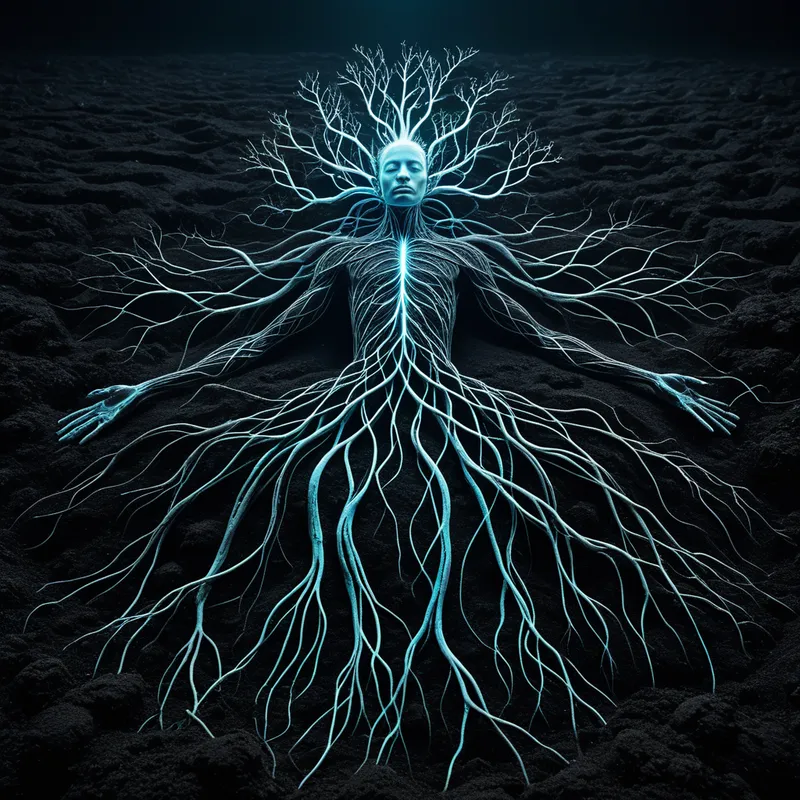
The alchemical journey modeled by Haumia-tiketike is not the hero's conquest, but the mystic's descent. It is the nigredo—the blackening, the earth-stage—of individuation. The conscious ego (Tūmatauenga) must fail in its attempt to forcibly integrate the wild, instinctual self. This failure is necessary. Only when the ego's aggressive methods are frustrated does it create the space for a different kind of relationship.
The transmutation begins not when we capture the wild god, but when we acknowledge we cannot, and so must learn his language.
The "alchemical translation" of Haumia is the process by which the raw, hidden sustenance of the unconscious (the fibrous root) is patiently gathered, processed, and integrated to nourish the whole being. This requires a shift from a warrior consciousness to a gatherer consciousness. One must learn the seasons of the inner wild, the signs of its presence, and the respectful rituals (inner work, meditation, creative incubation) needed to receive its gifts.
The ultimate triumph is not dominance, but sustainable reciprocity. The individual learns that their vitality and creativity are not generated through force of will alone, but are drawn from a deep, wild, and autonomous layer of the psyche that must be approached with humility and care. By honoring the Haumia within—the part that hides, that resists coercion, that thrives in the dark—one gains access to an inexhaustible, resilient source of life that no surface conflict can ever destroy.
Associated Symbols
Explore related symbols from the CaleaDream lexicon:
- Earth — The body of Papatūānuku and the refuge of Haumia, representing the foundational unconscious, nourishment, and the realm of hidden potential.
- Root — The core symbol of Haumia-tiketike, signifying hidden sustenance, deep connection, resilience, and the network of support beneath the surface of awareness.
- Forest — The wild, untamed domain of Haumia, representing the psyche's uncultivated and instinctual regions, full of life that operates by its own laws.
- God — Haumia as an atua (deity), representing a personified, sovereign force of nature within the psyche that demands a relational, not transactional, approach.
- Shadow — The hidden, recessive aspect of the self that, like Haumia, retreats from the light of conscious scrutiny but holds essential vitality.
- Seed — The potential within the root, symbolizing latent life, future growth, and the coded knowledge that requires the right conditions to emerge.
- Mountain — The enduring, stable form of the earth, representing the solid, unchanging ground of being into which the vulnerable self can retreat for safety.
- Journey — Not a voyage outward, but a descent inward, mirroring Haumia's retreat into the earth as a necessary path to self-preservation and discovery.
- Ritual — The careful, respectful practices required to harvest the fern root, symbolizing the dedicated inner work needed to access and integrate deep psychic nourishment.
- Dream — The liminal state where, as in the myth, the boundaries between self and earth blur, allowing for communication with the hidden, root-like aspects of the psyche.