Hatim al-Ta'i Generosity Myth Meaning & Symbolism
The legend of Hatim al-Ta'i, a pre-Islamic poet-chieftain whose boundless generosity became a mythic archetype of selfless virtue and soulful sacrifice.
The Tale of Hatim al-Ta'i
Let the sands whisper it. Let the wind carry it from the high dunes of Tayy to the ears of all who have ever known want. This is not merely a story of a man, but the song of a soul that burned not for gold, but for the light in another's eyes.
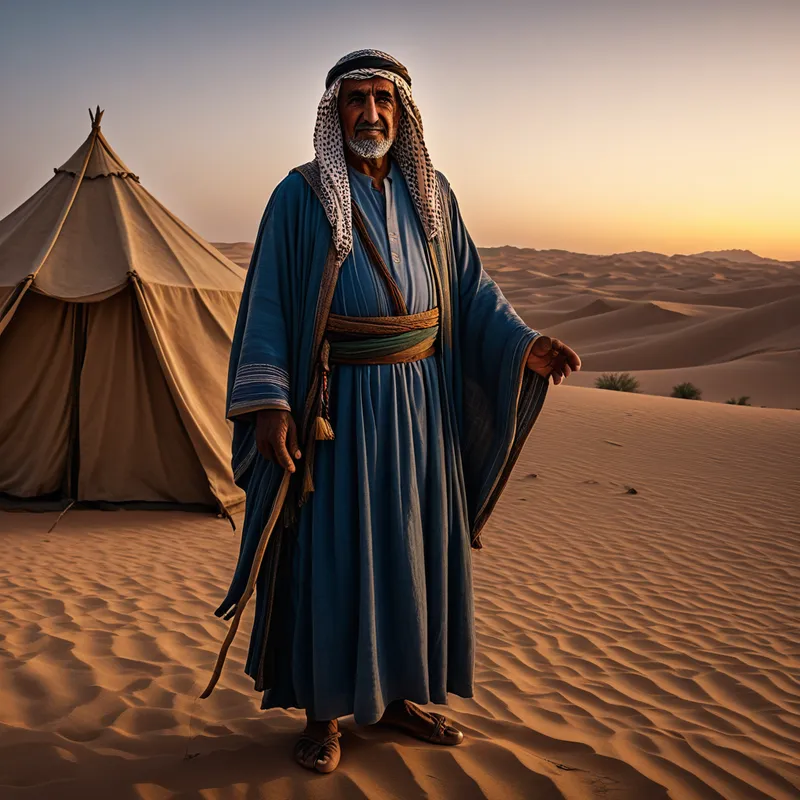
In the time before the Prophet, when honor was the only currency that never devalued, there lived Hatim of the Tayy. He was a chieftain, a poet, but above all, a wellspring in a land of thirst. His fame was not of the sword, but of the open hand. His fortress was his guest-house, his army the legion of those he had fed, and his treasure was the whispered blessing of the destitute.
One harsh winter, when the simoom blew cold and game was scarcer than hope, a party of travelers stumbled into Hatim's domain. They were ragged, their lips cracked with thirst, their eyes hollow with hunger. They had heard the legends—of the man who would give the shirt from his back, the last date from his plate—and desperation led them to his fire.
Hatim welcomed them as kings. But his stores were bare, emptied by a season of relentless giving. His people looked on, their own stomachs tight. Then the travelers spoke of their journey's true purpose: a challenge. A rival king, skeptical of the tales that painted Hatim as generosity incarnate, had sent them. "We are to test you," their leader said, shame and hunger warring in his voice. "We are to ask for the impossible, to see if the legend cracks."
Hatim listened, his face calm as a desert night. "Ask," he said.
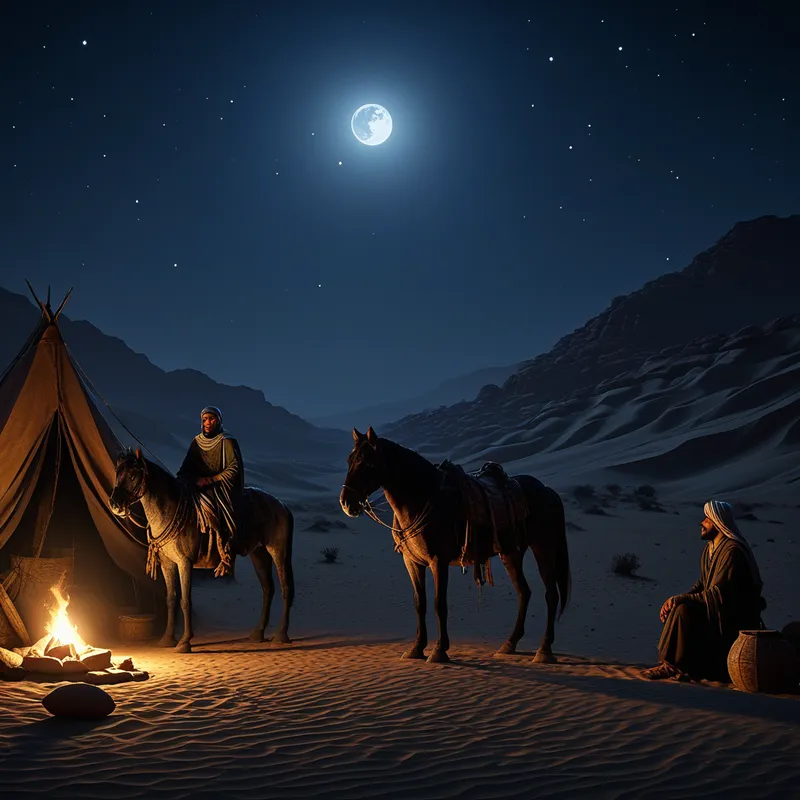
They asked for meat, in a season when no flock could be spared, when even the hunting dogs grew lean. A silence fell, broken only by the crackle of the fire. Then Hatim stood. He walked to the edge of the encampment, to where his most prized possession stood—a magnificent, purebred warhorse, the companion of his youth, the symbol of his strength and mobility in the vast, punishing landscape. Without a word of ceremony, without a moment's visible hesitation, he drew his blade and slew the animal.
That night, the travelers feasted on the flesh of a king's ransom. They ate with tears in their eyes, the meat tasting of awe and terrible grace. As they departed at dawn, laden with gifts they dared not refuse, one turned back. "Why?" he asked. "Why the horse? You could have turned us away."
Hatim, watching the sun rise over the sands he could now no longer patrol as widely, simply replied: "A guest's hunger at my hearth is a greater calamity than my own need. My honor is not in what I keep, but in what I give."
The tale of that night flew on the wind. It reached the skeptical king, who sent a messenger not with a challenge, but with an apology and a tribute of a hundred finer horses. But the legend was sealed not by the replacement, but by the original, irrevocable act. Hatim al-Ta'i had proven that the truest wealth is an empty hand that has filled another's.
Cultural Origins & Context
The story of Hatim al-Ta'i is rooted in the pre-Islamic Jahiliyyah period, a time when tribal identity, oral poetry, and a strict code of virtue (muruwwah) formed the bedrock of society. Hatim was a historical figure, a renowned poet and chieftain of the Tayy tribe who died around 578 CE. His historical generosity was amplified by the oral tradition into the mythic archetype we know today.
Passed down by storytellers (rawis) around campfires and later recorded in classical anthologies like the Kitab al-Aghani, his stories served a vital societal function. In a harsh, nomadic environment where survival was precarious, the virtue of diyafah (hospitality) was not mere etiquette but a sacred, life-preserving covenant. Hatim's myth was the ultimate exemplar, a narrative compass pointing to the extreme ideal of self-sacrifice for the sake of communal bond and personal honor. He became a benchmark against which all generosity was measured, a folk hero who embodied the most exalted aspect of the pre-Islamic ethical code.
Symbolic Architecture
The myth of Hatim operates on a profound symbolic level, transforming material sacrifice into spiritual currency. The act of slaughtering his warhorse is the central alchemical image.
The ultimate gift is always a sacrifice of the self—not of surplus, but of identity. To give what you are is to be reborn as what you mean.
The Horse is far more than livestock; it is a symbol of mobility, status, power, and survival in the desert. It represents the ego's assets—the strengths and resources we rely on to navigate the world. Hatim's sacrifice is not foolish profligacy; it is the conscious immolation of a personal power object for a transpersonal value: the sanctity of the guest (Diyaf), which here symbolizes the unexpected demand of the World, the Other, or the Soul itself. The Travelers represent fate, the unconscious, or the divine presenting a radical test of integrity. The ensuing feast is the communion that only such a total offering can create—a nourishment that is psychological and collective.
The Dreamer's Resonance
When this myth stirs in the modern Dream, it often manifests as dreams of radical, often unsettling, giving. You may dream of handing over your most prized possession—a house key, a family heirloom, a symbol of your career—to a stranger or an ambiguous figure. There is no logical reason, only a deep, somatic compulsion.
Psychologically, this signals a process where the psyche is negotiating a profound value shift. The conscious ego, identified with its "horses" (its competencies, resources, and self-image), is being compelled by the Self (the total, archetypal psyche) to relinquish control for a higher, integrative principle. The somatic feeling may be one of anxiety mixed with release—a "holy dread." This is the psyche's ritual enactment of moving from a psychology of accumulation and defense to one of circulation and trust. The dream is asking: What cherished aspect of your identity or security must be "slaughtered" to feed a deeper, hungrier part of your soul or to honor a sacred obligation you have neglected?

Alchemical Translation
The myth of Hatim al-Ta'i is a precise map for the alchemical stage of solutio and coagulatio in the individuation process. It models the transmutation of base egoism into the gold of a conscious, value-driven Self.
The process begins with the arrival of the "guests"—the unconscious contents or life circumstances that confront us with an impossible demand, challenging our deepest values. The ego's initial position is one of scarcity ("the stores are bare"). The alchemical operation is Hatim's decision: the conscious, willing sacrifice (Sacrifice) of a core complex (the Horse). This is the solutio—the dissolution of an old identity structure.
Individuation is not about becoming full, but about becoming empty enough to serve as a vessel for meaning. The slain horse is the ego's wealth transformed into the soul's worth.
The feast that follows is the coagulatio. The psychic energy locked in the complex (the horse as power symbol) is liberated and redistributed as nourishment for the entire psychic community—the previously neglected talents, relationships, or inner figures (the guests). The result is not impoverishment, but a paradoxical enrichment. The tribute of a hundred horses from the king symbolizes the return from the Self: when we sacrifice an ego attachment consciously, the psyche often rewards us with access to that very quality in a new, symbolic, and non-possessive form. We don't get the horse back; we gain the archetype of the horse within, the capacity for power in service of our true values. The individual becomes a legend to themselves—no longer merely a possessor of things, but the living embodiment of a principle.
Associated Symbols
Explore related symbols from the CaleaDream lexicon:
- Horse — The prized warhorse represents the ego's most valued assets—mobility, status, and power—which must be sacrificed to fulfill a higher, sacred obligation of the soul.
- Sacrifice — The central, transformative act of giving up something essential, not from surplus, but from identity, to achieve spiritual communion and integrity.
- Guest — Symbolizes the sacred, unexpected demand of the Other, of fate, or of the unconscious, which tests and ultimately refines the individual's core values.
- Feast — The communion and profound nourishment that arises only after a true sacrifice, representing the psychic integration and collective blessing that follows selfless giving.
- Fire — Represents the hearth of hospitality, the transformative heat of the sacrificial act, and the enduring light of legendary virtue that guides others.
- Desert — The harsh, arid landscape of scarcity and testing, which serves as the crucible where the pure metal of generosity is separated from the dross of self-interest.
- Honor — The internal, non-negotiable code that compels the act of extreme generosity, representing the soul's integrity taking precedence over material logic.
- Gift — Not a simple present, but a total offering that carries the giver's essence, transforming a material transaction into a mythological event.
- Heart — The organ of feeling and courage that motivates the sacrifice, representing the center from which true, non-calculating generosity flows.
- Mythic Hero — Hatim embodies this archetype not through physical combat, but through the epic battle against his own possessiveness, achieving legendary status through virtue.
- Cup — Symbolizes the vessel of hospitality that must be endlessly refilled and poured out, representing the soul's capacity to receive and give in a continuous cycle.
- Shadow — The potential for selfishness, hoarding, and refusal that is consciously overcome in the act of sacrifice, integrating the opposite impulse into a higher synthesis.