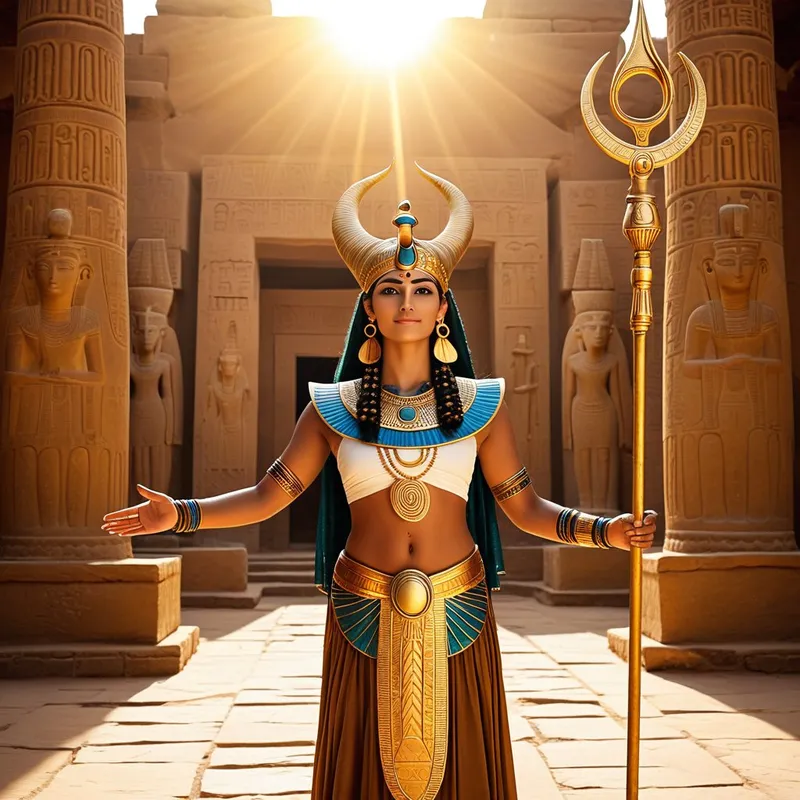
Hathor's Sistrum Myth Meaning & Symbolism
The myth of how the goddess Hathor's destructive fury was soothed and transmuted by the sacred, rhythmic sound of the sistrum, restoring cosmic balance.
The Tale of Hathor's Sistrum
Listen. The air over the Two Lands is not still. It is thick with the perfume of lotus and the distant murmur of the Nile, but beneath it lies a silence that is not peace, but a held breath. The sun, Ra, has grown old. His bones ache with the weight of the sky; his voice, once the command that birthed dawn, is now a whisper lost in the corridors of his celestial barque. And in the shadows where the old gods do not look, humanity has begun to murmur. They speak not of gratitude for the flood’s gift, but of rebellion. They plot in the alleys of Memphis, their hearts turned to flint against the one who gave them life.
Ra hears. From his high throne, a spark of divine fury, hotter than the core of the sun, ignites. He does not summon thunder or earthquake. He reaches into his own sovereign being, into the part of him that sees and judges all—his Eye. “Go,” he whispers, and the word is a crack in creation. “Show them the cost of their whispers.”
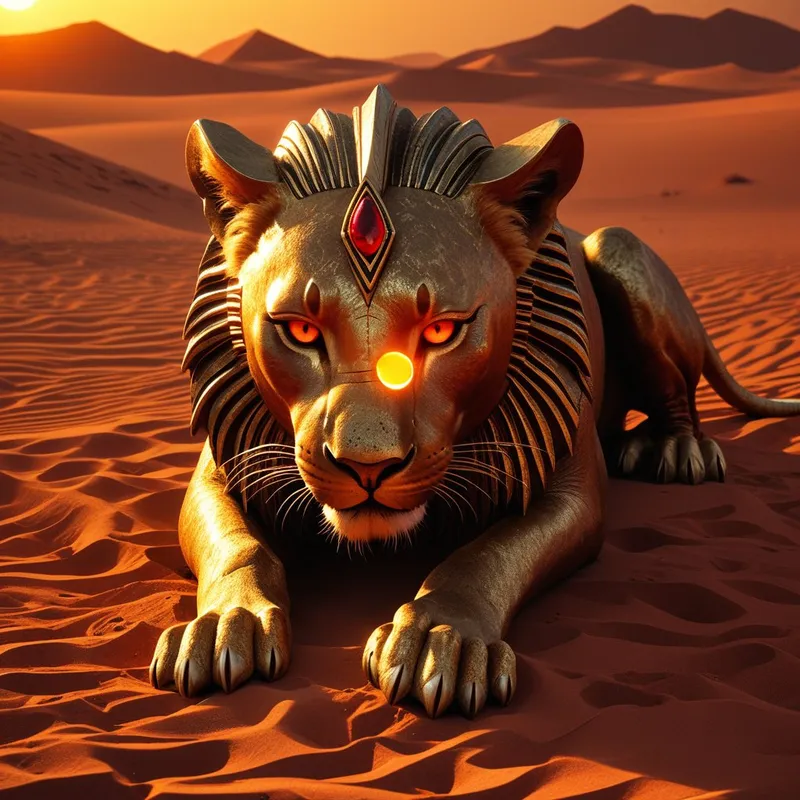
And so, the Eye of Ra leaps forth. But she does not go as a beam of light. She transforms, becoming Sekhmet, the Powerful One. Her form is molten bronze and burning desert rock. Her mane is a wildfire, her teeth are white-hot knives, her roar the sound of mountains splitting. She descends to the red earth, and her dance begins. It is not a dance of grace, but of annihilation. Where she pads, the fields blacken. Where she flicks her tail, villages become kindling. She does not merely kill; she revels. She drinks the life-essence of humanity, and the sand turns to mud with a river not of water, but of blood. The rebellion is drowned, but Sekhmet, drunk on her own power, cannot stop. The instrument of justice has become an engine of endless, ecstatic slaughter. The world tilts toward an eternal crimson twilight.
High above, Ra’s anger cools, replaced by a cold, paternal dread. He must stop what he has unleashed, but how does one cage a force of one’s own soul? The other gods huddle in terror, their magic useless against this primal fury. Then, the whisper of a plan, born from cunning and compassion. The god of wisdom and craft, Thoth, speaks. He does not speak of force, but of trickery of the heart.
He seeks out the swiftest messengers and gives them a secret task. To the far south, to the island of Elephantine, they race. There, they gather not weapons, but earth—a mountain of red ochre, the very color of blood and desert. Back at the epicenter of chaos, as Sekhmet pauses her rampage, Thoth and the gods work with frantic haste. They mix the ochre with barley and water, staining seven thousand great jars of beer the color of the Nile in flood, but with the opaque, terrifying hue of blood.
Under the cover of night, they pour this enchanted lake onto the fields of Dendera, where Sekhmet is prophesied to pass at dawn. The sun rises. Sekhmet, her jaws still dripping, sees the vast, red pool. A roar of triumph shakes the sky. She stoops, believing it to be the last of her enemy’s life-force, and drinks. She drinks deep and long, until the lake is gone and her great lioness belly is swollen. The beer, heavy and soporific, works its magic. Her fury ebbs. The fire in her eyes dims to a glow. She stumbles, lies down in the field, and sleeps.
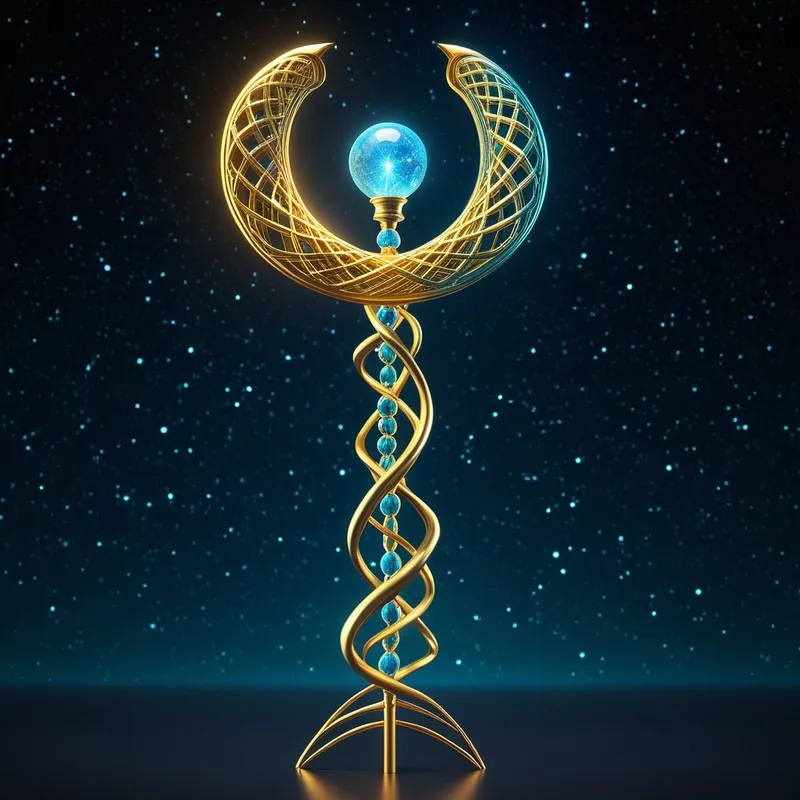
When she wakes, the lioness is gone. In her place stands Hathor. Her face is gentle, her horns cradle the sun disk, her expression is one of serene, if weary, benevolence. The rage is integrated, not destroyed. To commemorate this great turning, to ensure the wildness of the Eye would always be held in a vessel of harmony, a sacred instrument was fashioned: the sistrum. Its arched frame is the vault of the heavens. The rattling bars are the sound of life stirring. Its handle is the axis of the world. And henceforth, when Hathor’s priestesses shook the sistrum, its sesheshet sound was not mere music. It was the remembered echo of chaos being soothed, of fury being lulled back into the breast of the loving mother. It was the sound of the world being saved from itself.
Cultural Origins & Context
This myth, often called "The Destruction of Mankind," is preserved in the tombs of New Kingdom pharaohs like Seti I and Ramesses III in the Book of the Heavenly Cow. It was not a folktale for the populace, but a state myth, a divine charter for kingship. The Pharaoh was the "Son of Ra," the living embodiment of the god’s authority on earth. This story justified his absolute power—humanity’s rebellion necessitated a strong, divine ruler—while also illustrating the Pharaoh’s primary duty: to maintain Maat against the ever-present threat of chaos (Isfet).
The sistrum itself was a ubiquitous ritual object, primarily associated with the cult of Hathor. Her priestesses, often of high status, used it in temple ceremonies and processions. Its sound was believed to pacify the goddess, invoke her protective, joyful aspects, and repel chaotic forces. Thus, the myth provided the aetiology—the sacred origin story—for a core ritual practice. Every shake of the sistrum was a re-enactment of the world’s salvation, a sonic reinforcement of cosmic order.
Symbolic Architecture
At its heart, this is a myth of radical integration. It does not describe the destruction of a "bad" aspect, but its transformation and re-incorporation. Sekhmet is not an external monster; she is Ra’s own Eye, his capacity for fierce, unbounded judgment and power.
The most dangerous force is not the enemy without, but the sovereign power of the Self, unleashed without the balancing wisdom of the heart.
Sekhmet represents the raw, undifferentiated psychic energy of wrath—the righteous anger that, when disconnected from consciousness and compassion, becomes a self-perpetuating holocaust. Hathor represents the same energy, but channeled into life-affirming domains: love, music, fertility, and joyful intoxication. The myth maps the journey from one to the other.
The red beer is the masterstroke of alchemical symbolism. It is a trick that works because it speaks the language of the unconscious force. It meets Sekhmet on her own terms (as blood) but contains an entirely different essence (soporific beer). This is the principle of homeopathy in depth psychology: a minute dose of the symptom, skillfully administered, becomes the cure. The chaos is neutralized by a mirrored, yet transformed, image of itself.
The sistrum, born from this crisis, is the symbol of the regulated channel. Its sound is structure imposed on noise, rhythm imposed on frenzy. It is the tangible artifact of successful integration, a tool that forever after allows humanity to safely invoke and commune with the tremendous power of the divine feminine, in both its creative and destructive potentials.
The Dreamer's Resonance
When this myth stirs in the modern psyche, it often manifests in dreams of uncontrollable, red-hued rage or a terrifying, autonomous force breaking loose in one’s life. The dreamer may be pursued by a lion or panther, see landscapes of fire and blood, or feel a volcanic anger within that threatens to obliterate relationships and self-control. Somatic sensations accompany this: a pounding heart, clenched jaws, a feeling of being "drunk" on one’s own adrenaline and bitterness.
This is the Sekhmet-phase. The psyche is signaling that a powerful, instinctual force—perhaps long-suppressed righteous anger, a creative drive turned toxic, or a deep-seated passion—has been activated but is operating in a blind, destructive mode. It is "out for blood," seeking to destroy the perceived source of frustration, often at the cost of the dreamer’s own wholeness.
The turning point in such a dream cycle might be the appearance of a deceptive solution (the red pool), a sudden fatigue leading to sleep (the intoxication), or the presence of a rhythmic sound or a nurturing, maternal figure (Hathor). The dreamwork here involves not fighting the rage, but asking: What part of my sovereign self does this fury represent? What ancient rebellion or injustice is it trying to address? How can I meet its intensity with recognition, not rejection?

Alchemical Translation
For the individual on the path of individuation, the myth of Hathor’s Sistrum is a precise manual for psychic transmutation. The process begins with the Acknowledgment of the Sovereign Shadow. Ra, the ruling consciousness, must first own that the devastating force is his, a part of his own authority that he set loose. In personal terms, this means ceasing to project one’s destructive impulses onto others and recognizing the fury as an aspect of one’s own power.
Next comes the Cunning Intervention (Thoth). The rational, mediating mind (Thoth) must devise a strategy to engage the unconscious force. This is not brute-force repression, which would only create a more powerful complex, but a symbolic, empathetic intervention. One must "speak the language" of the symptom. If the rage is about feeling powerless, the intervention might involve channeling that energy into assertive, boundary-setting action (the "red beer" of empowered expression).
The alchemical vessel is not the mind that judges, but the heart that contains. Transmutation occurs when the raw element is held in a field of intentional awareness until its nature changes.
Then, the Transmutation through Containment. The red beer is the containing vessel. Psychologically, this is the act of holding the intense emotion in mindful awareness—journaling about it, discussing it in therapy, expressing it through art—without acting it out. This container "intoxicates" the raw fury, allowing its energy to dissipate and reform.
Finally, the Birth of the Integrating Symbol (The Sistrum). From this process, a new inner capacity is born. This is the "sistrum"—a personal ritual, a creative practice, a philosophical stance, or a somatic technique that can now regulate that once-destructive energy. It allows the individual to access their power (Hathor’s joyful vitality) and their fierceness (Sekhmet’s protective strength) in a harmonious, life-serving way. The once-devouring rage becomes the rhythm of a passionate, purposeful life. The individual learns to shake their own inner sistrum, not to banish their darkness, but to compose its chaos into a sacred song.
Associated Symbols
Explore related symbols from the CaleaDream lexicon: