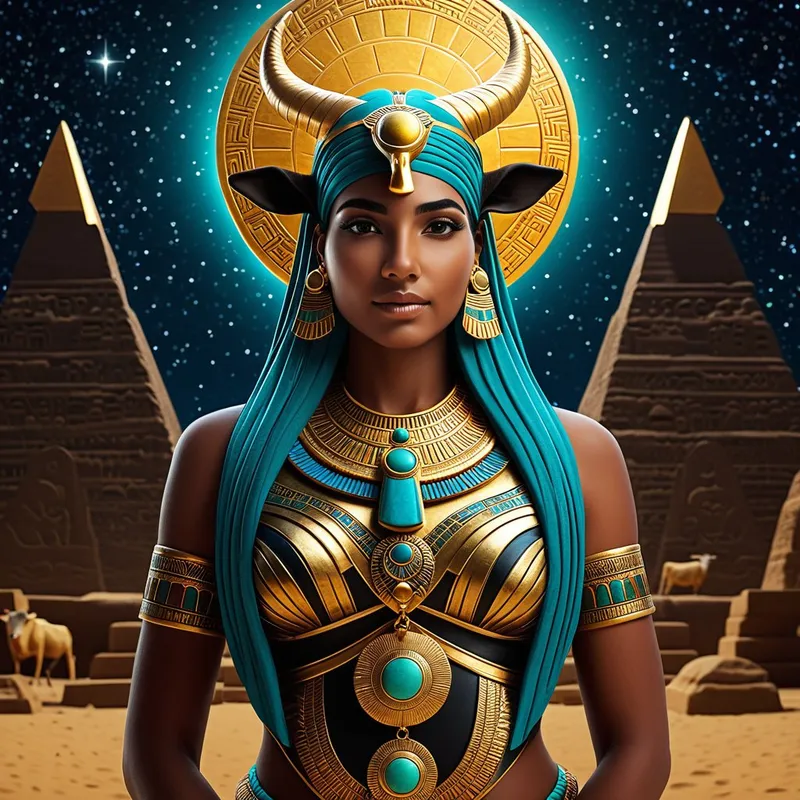
Hathor Myth Meaning & Symbolism
The story of the goddess Hathor, sent as the Eye of Ra to destroy humanity, who is tricked into drunkenness and transformed into a benevolent force of joy.
The Tale of Hathor
Listen. The air over the Two Lands grows heavy, thick with the silence of gods betrayed. The sun, Ra, now aged and weary upon his throne, feels a new ache in his bones. It is not the ache of years, but of ingratitude. From the mud of the Nile, he had fashioned humanity, and now their whispers coil up to the heavens—not prayers, but plots. They speak of rebellion against their maker.
A divine council is called, a gathering of shadows in the hall of stars. Ra summons the great ones: Thoth, Isfet-slayer Set, and the ancient one, Nun. Their faces are grim. “Mankind, whom I created from my tears,” Ra declares, his voice like stone grinding on stone, “now seeks my end. What is to be done?”
A terrible solution is born. Ra calls forth his own fury, his avenging power—his Eye. And from the searing heat of his brow, she steps forth. Not the gentle lady of the sycamore, but a transformation of terror. She is Hathor, but now she wears the face of a lioness, Sekhmet. Her beauty is a furnace; her song is a roar. “Go,” commands Ra, his heart a conflicted stone. “Teach them the price of their arrogance.”
She descends. The world turns red. Not the red of sunset, but the red of the desert sands drinking deep. Sekhmet-Hathor moves through the land, a storm of tooth and claw. Her delight is in the slaughter; the taste of rebellion is copper on her tongue. She hunts humanity into the mountains, into the reeds, and the river itself seems to run with a new, darker current. Ra watches from his barque, and a cold dread seeps into his divine ka. This is not correction. This is unmaking. The vengeance of the Eye knows no satiety; she will drink the world dry and come thirsting for the gods themselves.
A plan must be forged, a trick of sweetness to halt the dance of blood. The gods send swift messengers to the far south, to the island of Elephantine, where the red earth sleeps. There, they command the people to grind ochre and barley, to brew not beer, but a lake of soporific magic—seven thousand jars of a potion the color of blood and sunset.
Dawn breaks over the field of execution. Sekhmet-Hathor comes, her jaws stained, her fury undimmed. And there, spread across her path, she finds a vast, shimmering lake of this red brew. She pauses, her lioness nose twitching. “Blood,” she snarls, a laugh like cracking stone. “The last of them.” She bends her head and drinks. She drinks deep, lapping at the intoxicating flood. The fury in her limbs turns to lead, then to honey. The lioness’s snarl softens; the blazing eyes grow heavy. The wrath of Ra drains from her, and she stumbles, sated and stuporous, into a deep, dreamless sleep.
When she awakens, the world has changed. The taste of blood is gone, replaced by the memory of sweetness. The lioness face recedes; the gentle cow-eared visage of Hathor returns. The goddess of love and music has come back to herself, but she is transformed. She who was the instrument of apocalypse now becomes the promise of mercy. She returns to Ra not as his weapon, but as his reconciled daughter, a testament to the truth that even divine rage can be lulled, and that from the brink of annihilation, joy can be reborn.

Cultural Origins & Context
This myth, often called “The Destruction of Mankind,” is preserved in the tombs of New Kingdom pharaohs like Tutankhamun and Seti I, inscribed on the walls of their burial chambers to ensure its protective power accompanied them into the afterlife. It was not a folktale for the populace, but a state myth, a theological drama performed by priests and embodied by the pharaoh himself. The pharaoh was the living mediator between gods and humanity; this story articulated his sacred duty to prevent the world from sliding back into the chaos (Isfet) that Sekhmet’s rage represented.
The myth functioned as a foundational explanation for the necessity of ritual, festival, and order (Ma'at). The annual Festival of Hathor, often involving copious amounts of beer and music, was a direct re-enactment and prophylactic against this primal threat. By getting joyfully, ritually drunk, the community symbolically re-performed the pacification of the goddess, ensuring her benevolent aspect prevailed. It was a societal pressure valve and a profound reminder that civilization is a fragile pact, maintained through offerings, music, and mindful reverence to stave off the inherent wildness of the cosmos—and of the human heart.
Symbolic Architecture
At its core, this is a myth of radical integration. Hathor-Sekhmet is not two goddesses, but one divine entity with two inseparable faces. She embodies the full spectrum of the feminine divine, a totality that ancient Egyptian thought did not shy away from: the nourisher and the devourer, the muse of ecstasy and the bringer of plague.
The untamed force that can destroy a world is the same force that can bless it with love and music; the difference is not in the essence, but in its relationship to consciousness.
The Eye of Ra represents projected power—the sovereign’s (or the ego’s) unchecked, autonomous will to punish. Ra’s dread upon seeing its work is the shock of the conscious mind realizing the monstrous scale of its own unconscious shadow. The “blood” that is actually intoxicating beer is the supreme symbol of alchemical trickery. It represents the need to transform a literal, destructive impulse (murderous rage) into a symbolic, contained ritual (intoxication, ecstatic dance). The red ochre links the beer to the desert, to blood, and to life-giving ceremony, showing that the raw material of destruction is identical to the raw material of salvation.
The Dreamer's Resonance
When this myth stirs in the modern psyche, it often manifests in dreams of overwhelming, impersonal fury. The dreamer may be pursued by a great feline predator, or find themselves in a landscape burning with a strange, righteous anger. They may witness catastrophic violence or feel a terrifying power awakening within them that they cannot control.
Somatically, this can correlate with experiences of “seeing red,” of explosive tension in the jaw and shoulders (the lioness’s bite), or a hot, rushing feeling of uncontrollable emotion. Psychologically, this is the process of encountering one’s own shadow in its most potent form: not just petty resentments, but a primordial, archetypal rage. This rage often stems from a deep sense of betrayal (Ra’s by humanity) or from parts of the self that have been ignored, shamed, or exploited, now rising up with a demand for absolute, destructive justice. The dream is the psyche’s Sekhmet, running amok, showing the dreamer the cost of long-maintained psychic imbalances.

Alchemical Translation
The individuation process modeled here is the transmutation of autonomous complex into integrated function. We all have an “Eye of Ra” within—a capacity for ruthless, punitive judgment, often directed at ourselves or others when we feel betrayed or our authority (our inner “Ra”) is challenged. The first step is the descent: allowing this fury to be acknowledged, to see its devastating potential. To deny it is to let it operate autonomously in the shadows.
The critical alchemical work is the “trick” of the red beer. This is the act of sublimation—not repression, but creative redirection. The raw, bloody emotion must be “dyed” with the pigment of consciousness. For the modern individual, this is the practice of channeling fierce, destructive energy into a form that can contain and transform it: into passionate artistic creation, into the disciplined fury of athletic performance, into the deep, roaring truth-speaking of therapy, or into the ecstatic release of dance and music (Hathor’s primary domains).
The goal is not to eliminate the lioness, but to persuade her to lay down her bloody work and remember she is also the goddess who heals with song.
The resolution is Hathor’s return. This is the state where the powerful, instinctual force is no longer a feared enemy or a blind weapon, but a reconciled part of the whole personality. It brings not bland peace, but vibrant, creative joy grounded in the knowledge of its own terrible power. The individual who undergoes this translation carries a profound stability; they know their own capacity for wrath, and having ritualized it, they are less likely to project it unconsciously onto the world. They become a vessel for both profound compassion and fierce protection, a living embodiment of the pact that keeps chaos at bay—not through suppression, but through sacred, conscious integration.
Associated Symbols
Explore related symbols from the CaleaDream lexicon: