Hapi Myth Meaning & Symbolism
The myth of Hapi, the androgynous Nile god, embodies the sacred, life-giving chaos of the annual flood and the union of cosmic opposites.
The Tale of Hapi
Before the first stone of Memphis was laid, when the world was a strip of black earth between two endless deserts, the land dreamed of water. And the river answered.
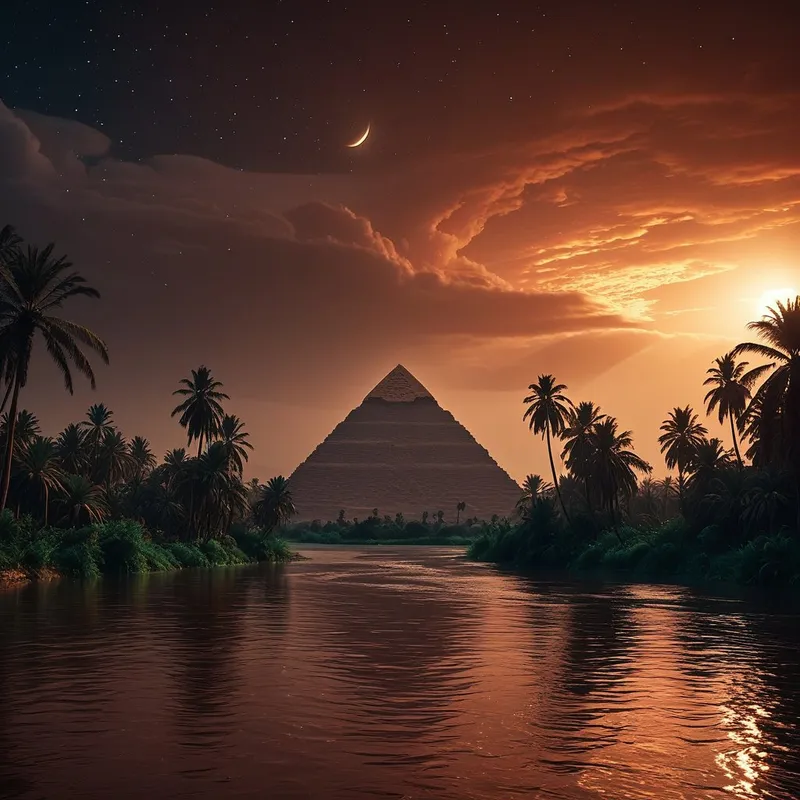
It did not come as a gentle stream, but as a roar from the far south, a groaning from the belly of the earth. The people would watch the horizon, their skin prickling with the scent of distant rain and upturned soil. Then, they would see it: a line of turbulence, a wall of churning, reddish-brown water, swallowing the river’s banks. This was not destruction, but arrival. This was Hapi walking.
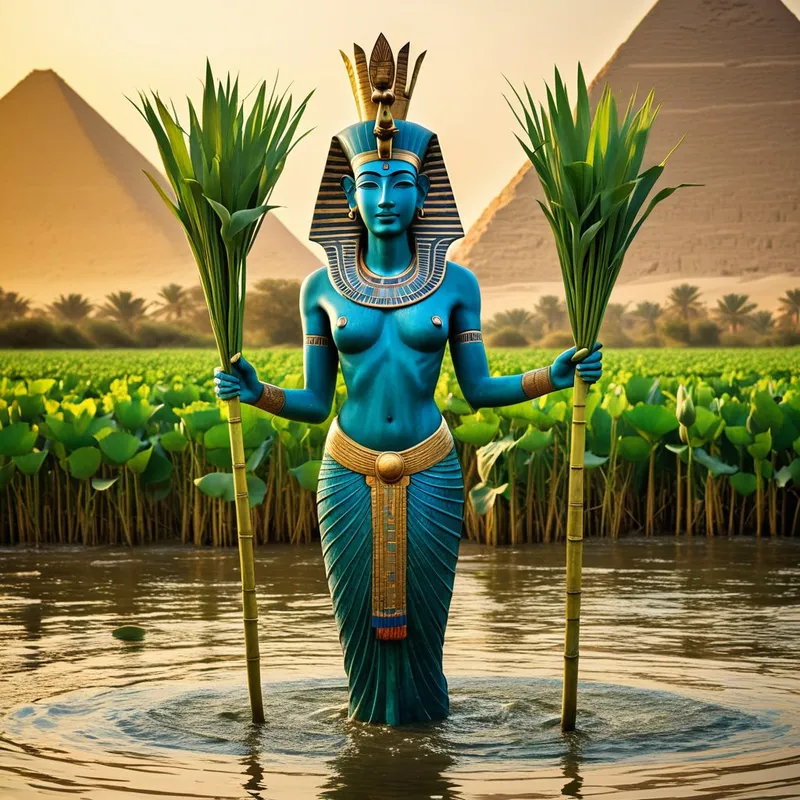
He came not as a man or a woman, but as a force of both. His body was the river itself—full, rounded, powerful, the blue-green of deep water and thriving reeds. Upon his head grew a thicket: the papyrus of the North and the lotus of the South, twined together. In his hands, he carried not weapons, but abundance: overflowing trays laden with figs, grapes, loaves of bread, and every good thing that the earth could yield.
He moved slowly, inevitably. His waters, thick with the rich silt from the heart of the continent, did not merely flood; they embraced. They seeped into the parched fields, a dark, life-giving kiss. The land, cracked and thirsty, drank deeply. For weeks, the world became a shallow, fertile sea, a mirror for the sky. Temples stood as islands. Boats sailed over fields. It was a time of suspended breath, of chaos that was not feared but awaited—the sacred chaos of potential.
Then, as the star Sopdet completed her journey, Hapi would begin to recede. Not in retreat, but in fulfillment. The waters sank back into their channel, leaving behind a gift: a blanket of black, gleaming mud. It was from this primordial ooze, this gift of Hapi’s body, that the green would erupt. Barley and emmer wheat pierced the soil in a vibrant shout. The marshes teemed with fish and fowl. The granaries, once echoing, filled to their ceilings.
The people did not say the river flooded. They said, “Hapi has come. Hapi has given. Hapi has made the Two Lands live.”
Cultural Origins & Context
The myth of Hapi is not a narrative of exploits, but a personification of an absolute, cyclical reality. Ancient Egyptian civilization was the “Gift of the Nile,” as Herodotus observed, and Hapi was the divine embodiment of that gift. Unlike the dramatic myths of Apep or the familial dramas of the Osirian cycle, Hapi’s story is the story of the land’s very heartbeat.
This myth was passed down not merely in tales, but in ritual, art, and the fabric of time itself. The Egyptian calendar was divided into three seasons: Akhet, Peret, and Shemu. Akhet was Hapi’s season. His image was carved into temple bases, literally supporting the structure, as his waters supported the kingdom. During the flood, hymns were sung and offerings made to honor him and ensure his continued bounty. The myth served a profound societal function: it sacralized the ecosystem. The unpredictable, powerful flood was not a natural disaster to be cursed, but a divine, life-giving event to be revered and harmonized with. It taught a theology of reciprocity between the people, the land, and the divine source of abundance.
Symbolic Architecture
Hapi represents the archetypal principle of fecundity itself, but with a profound complexity. He is not a simple god of water; he is the god of the right water, at the right time, carrying the right substance. His symbolism is a tapestry of essential unions.
The most profound abundance is born not from clarity, but from the sacred mingling of opposites.
First, he embodies the union of Upper and Lower Egypt. The papyrus (north) and lotus (south) on his head are not just plants; they are symbols of the reconciled duality that formed the kingdom. Hapi is the binding force of the nation.
Second, and more mysteriously, he embodies an androgynous union. Often depicted with pendulous breasts and a rounded belly, yet with the ceremonial beard of a deity, Hapi transcends gender. He is the self-fertilizing source, containing both the masculine and feminine principles of creation within one form. He is the progenitor who requires no consort.
Third, he symbolizes the necessary union of order and chaos. The inundation was a temporary dissolution of boundaries—a chaotic event. Yet from this chaos came the most precise order: the measured fields, the organized harvest, the societal surplus that built civilization. Hapi is the chaos that makes order possible.
Psychologically, Hapi represents the nourishing, unconditionally giving aspect of the Self—the inner source that, when allowed to flood our conscious, arid landscapes, brings forth unexpected growth and fertility from the silt of our experiences.
The Dreamer's Resonance
To dream of Hapi is to dream of impending, life-altering nourishment from the depths of the unconscious. It is rarely a calm dream.
You may dream of a river overflowing its banks in a beautiful, terrifying way, covering familiar ground with rich, dark mud. You may dream of a figure of ambiguous gender offering you a cup that overflows with both water and grain. Or you may dream of standing in a field that is suddenly, gently, becoming a lake.
Somatically, this can feel like a swelling, a fullness, or a pressure in the belly or chest—not of illness, but of potential. Psychologically, it signals that a long-dormant inner resource, a deep well of creative or emotional life, is rising to the surface. The “flood” in the dream is the psyche’s own inundation, bringing up the fertile silt of memory, intuition, and unlived life. The conflict is not with the water, but with our own resistance to the temporary chaos it brings. The dream asks: Can you tolerate the dissolution of your familiar banks to receive an abundance you did not cultivate?

Alchemical Translation
The alchemical journey modeled by Hapi is not one of slaying dragons, but of sacred reception and integration. It is the process of learning to host the inner inundation.
The modern individual, often striving for control and clear boundaries, is terrified of inner chaos. We dam our emotions, canalize our creativity, and desertify our instincts. The Hapi process begins with the cracking of those dams. This is the nigredo—the blackening, the flood. It feels like being overwhelmed by emotion, a surge of unprocessed past, or a chaotic upwelling of creative ideas that disrupt our neat schedules.
The first step in psychic transmutation is not to build a higher wall, but to learn to swim in the flood.
The key is to recognize this not as a pathological breakdown, but as the arrival of the inner Hapi. The fertile “silt” deposited is the raw material of the Self: forgotten talents, buried grief, instinctual wisdom. Our task is to “let the waters recede”—to allow the chaotic state to pass naturally, without forcing a premature resolution. Then, we must work the black mud. This is the albedo—the whitening. It is the conscious effort to plant seeds in this new inner terrain: to give form to the creative impulses, to articulate the emotions, to structure the insights.
The harvest that follows—the citrinitas and rubedo—is a transformed personality, nourished from within. We achieve a state of inner androgyny, where our nurturing (caregiver) and our generative (creator) capacities are unified. We become, like Hapi, a self-sustaining source of abundance, able to hold and harmonize the opposites within us—chaos and order, masculine and feminine, giving and receiving—and from that union, bring forth life.
Associated Symbols
Explore related symbols from the CaleaDream lexicon: