
Hansel and Gretel's Witch's House Myth Meaning & Symbolism
Two children, abandoned in a dark wood, find a house of sweet temptation that hides a devouring hunger, forcing them to confront their own cunning to survive.
The Tale of Hansel and Gretel's Witch's House
Listen, and let the old trees bear witness. In a time of gnawing hunger, when the land itself seemed to shrink from the sun, a woodcutter and his wife dwelt at the forest’s edge. Their hearts, once warm, grew cold and sharp as winter flint. The woman whispered a terrible thought: to lead the children, Hansel and Gretel, deep into the dark wood and leave them to its mercy.
But Hansel, with a mind quick as a fox, heard the plan. At dawn, as they were led into the thickening gloom, he dropped a trail of white pebbles, stolen from the moonlit yard, to gleam a path back home. That night, they followed the pebbles’ cold light and returned. The father’s heart wept with a joy he dared not show.
Famine’s grip tightened. Again, the plan was made. This time, the door was locked. Hansel could gather only crumbs of their meager bread. He scattered them behind as they walked the serpentine path deeper than ever before. But when the pale moon rose, they found no trail. The birds of the air—the silent, hungry witnesses of the wood—had eaten every last one.
For three days they wandered, their bellies hollowed by fear, sustained only by a few bitter berries. Then, through the skeletal branches, they saw it. A house unlike any other, a blasphemy against the forest’s somber palette. Its walls were cake, its windows clear sugar, its roof shingled with gingerbread and frosted with intricate, impossible whorls. The very air was thick with the scent of honey and burnt sugar, a cloying, seductive perfume.
They fell upon it, breaking pieces of the sweet wall to fill their desperate emptiness. As they ate, a voice, thin and cracked as old parchment, called from within. “Nibble, nibble, little mouse, who’s that nibbling at my house?” The door creaked open, and there stood an old woman, leaning on a crutch, her eyes deep-set and glinting. She beckoned them inside with promises of soft beds and finer foods.
But her kindness was a cage. The next morning, she seized Hansel and thrust him into a wrought-iron pen. “He will fatten nicely,” she cackled to Gretel, her guise of frailty melting away to reveal a raw, predatory hunger. Each day, the witch—for that is what she was—would make Hansel hold out a finger so she might feel his plumpness. But the clever boy, remembering the thin bones of a chicken, held out a dry stick instead, fooling her sightless, milky eyes.
Weeks passed. Impatience curdled the witch’s greed. She ordered Gretel to light the great oven, to bake the bread for her brother’s final meal. Gretel, her spirit forged in the cold fire of abandonment, understood the true recipe. “I do not know how,” she pleaded, her voice a mask of innocence. “Show me.”
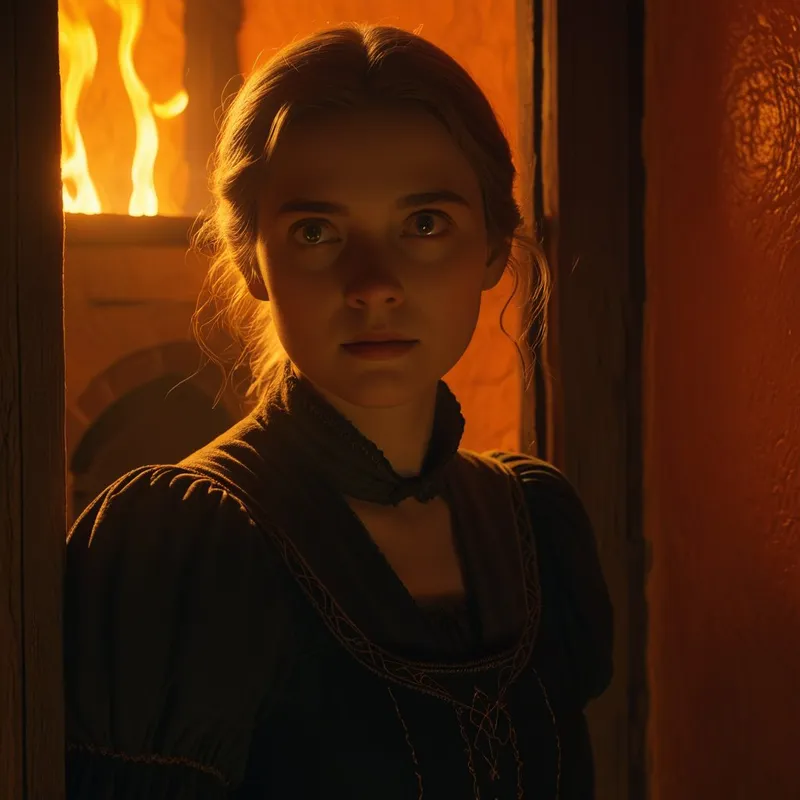
“Simple goose!” the witch snarled, stooping to peer into the fiery maw. “Like this!” In that moment, with a strength born of primal survival, Gretel shoved the bent form. A shriek was cut short by the heavy iron door slamming shut. The key turned in the lock. The devourer was devoured by her own consuming fire.
The children found the witch’s hoard: pearls, jewels, and coins spilling from chests like frozen tears. They filled their pockets and fled the candy tomb. At the forest’s edge, a great white swan carried them across a wide river they had never crossed before. On the other side, the wood was familiar. They ran, and there was their father’s cottage, the stepmother gone, and only a man broken by regret, waiting to be made whole by their impossible return.
Cultural Origins & Context
This tale, collected by the Brothers Grimm in the early 19th century, is a folk narrative with roots deep in the soil of Central European peasant life. It belongs not to the courts or salons, but to the hearths of the rural poor, told by mothers and grandmothers during the long, dark nights. Its primary societal function was twofold: a stark cautionary tale and a narrative of resilience.
The backdrop is one of very real, historical famine—the Mutterkorn (ergot) poisoning of rye crops, failed harvests, and the desperate poverty of the Hölzern (woodcutters) class. The tale openly speaks the unspeakable: the terror of parental abandonment due to scarcity, a brutal reality in pre-industrial Europe. By giving this terror a shape—a sugary house and a cannibalistic witch—the story externalizes the internal horror, making it something that can be seen, outwitted, and destroyed. It was a story told to children not merely to frighten, but to arm them psychologically with the cunning of Hansel and the decisive courage of Gretel, preparing them for a world that could indeed be merciless.
Symbolic Architecture
The myth’s power lies in its stark, almost brutal symbolism, mapping a profound psychological journey from passive victimhood to active self-liberation.
The woodcutter and stepmother represent the failure of the outer world, the personal and collective mother matrix, forcing the psyche into a state of existential orphanhood. The dark forest is the necessary, if terrifying, descent into the unconscious after this betrayal.
The house of candy is the ultimate siren's call of the unconscious: it presents the fulfillment of regressive, oral-stage desires—the wish to be fed, comforted, and enveloped without effort. It is the sweet prison of the complex that promises nourishment but delivers consumption.
The witch is the personification of this complex. She is not merely an external monster, but the embodied shadow of the stepmother’s neglect and the forest’s hunger—the psychic force that would keep the individual in a state of infantilized dependency, “fattening” them for assimilation. Hansel’s cleverness (the stick instead of the finger) represents the use of intellect and trickster energy to buy time within the complex. But it is Gretel’s act—the forced invitation (“show me”) that turns the witch’s own power against her—that is the pivotal moment of integration. She uses the witch’s method, the oven of transformation, to effect a true transformation: from prey to agent of destiny.

The Dreamer's Resonance
When this myth pattern erupts in modern dreams, it signals a profound somatic and psychological initiation. The dreamer is navigating a felt sense of profound abandonment—not necessarily literal, but a feeling of being cast adrift by a job, a relationship, a belief system, or one’s own inner parental figures.
Dreaming of wandering in a endless, confusing wood speaks to a loss of direction and meaning. The appearance of the gingerbread house in a dream is a major diagnostic symbol. It often manifests as an alluring but ultimately hollow solution: the too-perfect new relationship that demands you shrink yourself, the addictive substance or behavior that promises comfort but consumes vitality, the career path that sparkles with prestige but starves the soul. Somatic sensations here might include a cloying taste in the mouth, a feeling of being stuffed yet empty, or a literal nausea.
The confrontation with the witch-figure in the dream—who may wear the face of a boss, a partner, or a familiar stranger—is the psyche’s way of presenting the source of the devouring energy. The dream is inviting, indeed forcing, the dreamer to have their “Gretel moment”: to stop trying to simply outwit the situation (the Hansel strategy) and to find the courage to confront and dismantle the consuming mechanism itself.

Alchemical Translation
The journey of Hansel and Gretel is a perfect model of psychic alchemy, the individuation process where base, leaden experiences are transmuted into golden consciousness.
The initial state (nigredo) is the black despair of abandonment in the dark wood—the dissolution of the old, dependent identity. The gingerbread house represents a false albedo, a pseudo-solution of regression. The children’s imprisonment is the crucial separatio, where the psyche is literally caged by its own complex, forced to see it clearly.
The oven is the athanor, the sealed vessel of transformation. Gretel’s act is the coniunctio—not a union with the witch, but the integration of the witch’s power (the transformative fire) with her own will. She unites the opposing forces of victim and aggressor within the vessel of crisis.
The destruction of the witch is the rubedo, the fiery dawn of a new psychological authority. The treasure they take is not stolen, but rightfully earned—the retrieved psychic energy (libido) that was once locked in the complex of fear, hunger, and dependency. The return home is not a regression, but an arrival at a new level of being. The father, relieved of the negative feminine (the stepmother), is now ready to be in right relationship with the matured masculine (Hansel) and feminine (Gretel) principles within the individual. The alchemical gold is this wholeness: the orphaned parts of the self, having faced and consumed their own devouring darkness, return home, sovereign and complete.
Associated Symbols
Explore related symbols from the CaleaDream lexicon: