Hansel and Gretel Myth Meaning & Symbolism
Two abandoned children navigate a dark wood, are ensnared by a cannibalistic witch, and must use cunning and courage to incinerate their devourer and find their way home.
The Tale of Hansel and Gretel
Listen, and let the old tale settle in your bones. It begins not with a king or a quest, but with hunger. A deep, gnawing hunger that hollows out a woodcutter’s cottage and, worse, a father’s heart. His new wife, sharp-tongued and desperate, whispers a terrible solution into the dark: take the children, the boy Hansel and his sister Gretel, deep into the forest and leave them. The woodcutter’s soul cracks, but the fear of starvation is a louder voice.
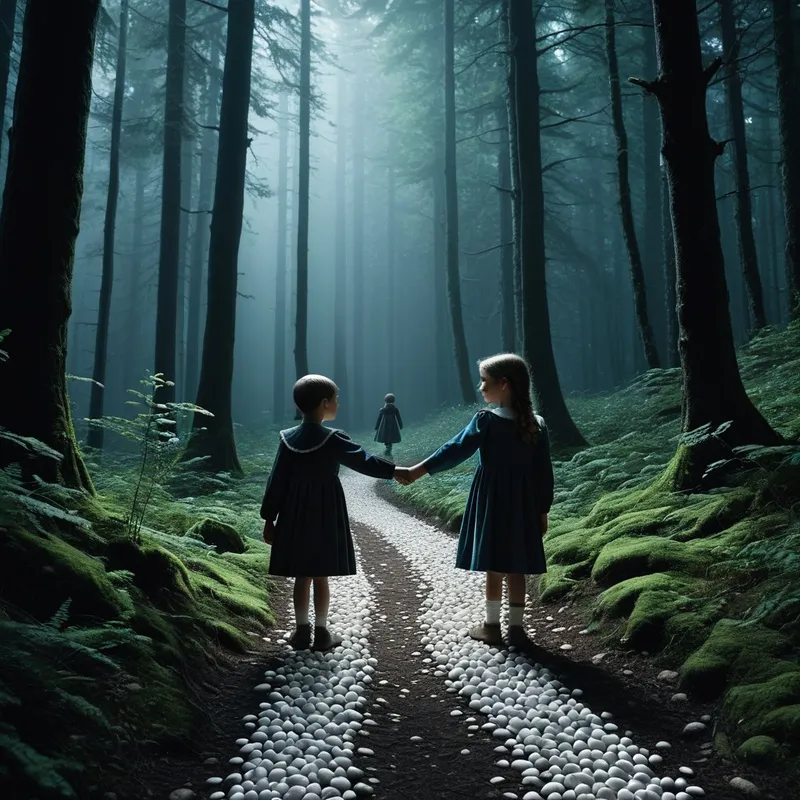
But Hansel, lying awake, heard the serpent’s whisper. At dawn, as they walked the lonely path, he dropped a trail of white pebbles, stolen from the moonlight, behind him. When the cold dark fell and the children were alone, those pebbles caught the moon’s eye and led them home, a river of silver through the black.
The famine did not relent. The stepmother’s will hardened. The next journey was deeper, and the door was locked. Hansel could gather only crumbs of bread. He scattered them, a fragile hope. But the birds of the air—the indifferent, hungry world—ate every one. The children were truly lost.
For three days they wandered, until their hunger was a beast inside them. Then, through the trees, they saw it: a house. But no ordinary house. Its walls were cake, its windows clear sugar, and its roof was laid with fine biscuits. It was a dream made solid, a promise to the starving. They broke pieces from it, and the sweet taste was a blessing. Then the door creaked open.
An old woman emerged, leaning on a crutch. Her eyes were kind, her voice a soft murmur. “Dear children, who has brought you here? Come in and stay, no harm shall come to you.” She fed them milk and pancakes with sugar, apples, and nuts, and led them to soft, white beds. It was salvation.
But with the sun came the truth. The old woman’s kindness was a mask. She was a witch, and her house was a larder. She seized Hansel, thrust him into a iron-barred cage, and commanded Gretel to feed him, to fatten him for the oven. Each morning, the witch, her eyesight dim, would make Hansel hold out a bone for her to feel. “Still too thin,” she’d grumble, deceived by the dry stick.
Weeks passed. Impatience won over gluttony. The witch decided to cook them both. She ordered Gretel to check if the oven was hot enough for the bread. Gretel, her spirit sharpened by terror, saw the maw of the furnace and understood. “I do not know how,” she said, playing the fool. “Show me.”
“Stupid goose!” cackled the witch, and bent her head to peer inside. In that moment, a force older than fear surged through Gretel. She shoved with all her might. The witch tumbled into her own hell. The door slammed shut. A terrible shriek, then silence.
The children were free. They found the witch’s house filled with pearls and jewels. They filled their pockets, and they fled. The forest, once a labyrinth of despair, now seemed to part. They came to a great water, but no bridge. A white duck appeared, a creature of mercy, and ferried them across, one by one.
And on the other shore, they saw their father’s cottage. The stepmother was gone, claimed by the same hunger she had wielded. The woodcutter, who had mourned them every day, wept with a joy that washed away all the old despair. The jewels they spilled at his feet ended the famine forever. The tale ends with them safe, the devourer consumed, and the house no longer hollow.

Cultural Origins & Context
The tale, as recorded by the Brothers Grimm in 1812, is rooted in the harsh socio-economic realities of medieval and early modern Central Europe. Periods of famine, the Mutter Korn (Mother Grain) failing, were not abstractions but visceral memories carried in the folk consciousness. The story belongs to the Kunstmärchen (art fairy tale) tradition, but its bones are pure Volksmärchen (folk tale), told by the hearth not to entertain, but to instruct and to inoculate.
It was a story told by women to children, a dark pedagogy. It acknowledged the unthinkable: parental fallibility and the terrifying reality of child abandonment, a practice tragically documented during times of extreme scarcity. The forest, the Wildnis, represented the literal and psychological unknown beyond the village border—a place of wolves, outlaws, and spirits. The witch is a crystallization of every forest-dwelling outcast, the Hexe of local legend, transformed by fear into a cannibalistic predator. The story functioned as a survival manual, teaching children cunning (the pebbles), suspicion of too-easy gifts (the candy house), and the necessity of decisive action (the oven).
Symbolic Architecture
At its core, this is a myth of the individuation process forced upon the psyche too soon, by trauma. The parents are not evil, but weak; the prima materia of the soul is abandonment.
The white pebbles are the first glimmer of conscious foresight—the ego’s attempt to mark a path back to the known world, to security. They are memory, logic, and hope made tangible.
The bread crumbs represent a more fragile, naïve consciousness, easily consumed by the instinctual, unconscious forces of nature (the birds). Their failure plunges the children into the deep unconscious—the forest. The candy house is the archetypal Devouring Mother. She offers regressive bliss: endless sweetness, no demands, infantile satiation. It is the lure of the complex that promises to take care of you, but only to consume your developing self.
Hansel in the cage symbolizes the captured, passive intellect, fed but not nourished, waiting for rescue. Gretel, forced into servitude, embodies the nascent, adaptable consciousness that must bear the burden of action. The bone substitutes for the finger is the trickster’s ruse, a necessary deception of the devouring force, buying time for the psyche to gather strength.
The final confrontation is the psychic climax. The oven is the athanor, the alchemical furnace. To be baked is to be annihilated; to bake the witch is to transmute her. Gretel’s “I don’t know how” is the ultimate cunning—it uses the witch’s own contempt and greed to guide her into the transformative fire. The devouring aspect is destroyed by its own element, leaving only the liberated energy (the jewels) and a cleared path home.

The Dreamer's Resonance
When this myth patterns a modern dream, the dreamer is navigating a profound initiation crisis. Dreaming of being lost in a deep, unfamiliar forest often signals a feeling of abandonment by one’s own internal guides or external support systems. The path is gone; the old maps no longer work.
The appearance of a deceptive, alluring place of comfort—a too-perfect job, a smothering relationship, an addictive behavior—manifests as the candy house. It feels like salvation but carries the scent of imprisonment. The witch may appear as a domineering figure, a suffocating parent, or even as a seductive voice offering easy answers that would cost the dreamer their autonomy.
The somatic experience is key: the gnawing hunger of unmet need, the claustrophobia of the cage (often felt as paralysis in the dream), and the intense, fiery anxiety surrounding the “oven” moment. This is the body registering the psychic danger and the impending necessity for a terrifying, self-preserving act of aggression or boundary-setting. To dream of pushing the witch into the oven is to feel, in the dream body, the immense release and empowerment of finally confronting and dismantling a devouring complex.

Alchemical Translation
The journey of Hansel and Gretel is a stark model of psychic transmutation. It begins with the nigredo: the dark night of abandonment, the loss of parental containment. The conscious mind (Hansel) and the relational, resourceful soul (Gretel) are thrown into the massa confusa of the forest.
The triumph is not in avoiding the witch, but in being captured by her, for it is within the captivity that the necessary heat for transformation is generated.
The candy house and the cage represent the albedo in its negative aspect—a false purity, a regression to infantile sweetness. The true albedo is the clarity that emerges in Gretel at the oven: the realization that one must use the devourer’s own method against it. The shove is the rubedo, the rubefaction—the act that is violent, terrifying, and utterly necessary for liberation.
The jewels retrieved are the lapis philosophorum, the treasure hard to attain. They are the integrated wisdom, the resilience, and the psychic value forged in the ordeal. The return home is not a regression to childhood, but a return to the ego with newfound resources. The father who welcomes them is the redeemed masculine principle, no longer passive but receptive and grateful. The stepmother’s disappearance signifies the shedding of the purely negative, life-denying complex. The children return as initiated adults, carrying the wealth of their harrowing journey, having performed the ultimate alchemy: turning the threat of being eaten into the power that sustains a life.
Associated Symbols
Explore related symbols from the CaleaDream lexicon: