Hanging Gardens of Babylon Myth Meaning & Symbolism
A king builds a mountain of greenery in the desert to soothe his queen's homesickness, creating a wonder that defies nature and memory.
The Tale of the Hanging Gardens of Babylon
Listen, and hear of a king’s heart, vast as his empire, and of a sorrow no conquest could soothe. In the great, sun-baked city of Babylon, where the Marduk watched from his ziggurat, King Nebuchadnezzar II ruled. His walls were impenetrable, his armies unmatched, his treasures gleaming under the relentless Mesopotamian sun. Yet, in the innermost chamber of his palace, a winter persisted.
His queen, Amytis, was a daughter of the green mountains. She came from a land where winds whispered through pine forests and cold streams danced over mossy stones. Babylon, for all its grandeur, was a kingdom of baked brick and flat, dust-hazed horizons. The sun here did not dapple; it hammered. The air did not carry the scent of damp earth and blossom, but of heat, dust, and distant river mud.
A profound homesickness settled in her spirit, a wasting melancholy that turned gold to dross and silks to shrouds. She grew pale, staring for hours from the high terraces, her eyes seeing not the magnificent city, but the ghostly slopes of a lost homeland. The king’s physicians were baffled; his priests made offerings to Ishtar, but the queen’s soul remained an exile.
Then, a resolve forged in the furnace of love took hold of the king. He would not find a cure; he would build one. He summoned his chief architects, his master engineers, his hydrologists, and gardeners from the farthest reaches of his domain. His decree was impossible: "Raise a mountain in my city. Not of stone, but of life. Clothe it in every tree, every vine, every flower that grows in the highlands of Media. Make its slopes weep with cool water. Create a memory made real."
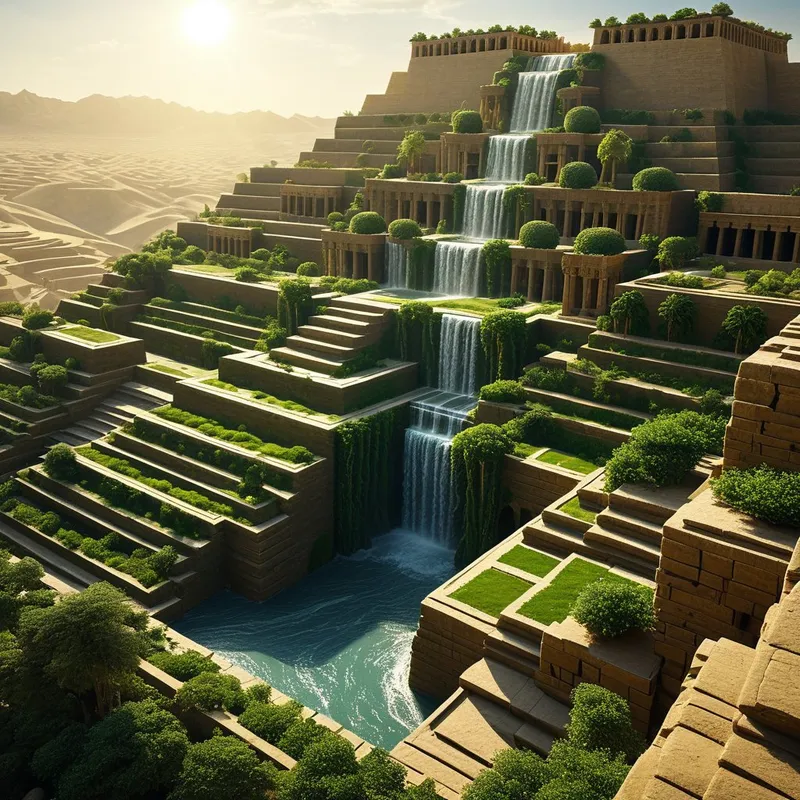
And so, the great work began. A colossal, stepped structure rose beside the palace, an artificial peak of vaults and terraces. A marvel of Archimedes' screws, hidden channels, and cisterns laboriously fed from the Euphrates brought life-giving water to the summit. From distant lands, soil was carried by caravan, and trees were transported with their root balls carefully bound. Cypress and cedar took root beside date palms; grapevines tangled with roses. Waterfalls, born of human ingenuity, cascaded from terrace to terrace, their mist cooling the air.
Day by day, a mountain of greenery ascended into the Babylonian sky. The scent of pine and blooming jasmine drifted through the royal quarters. The sound of falling water drowned out the city's clamor. The king led his queen, her eyes still clouded with sorrow, to the base of this newborn wonder. As she ascended the shaded, blooming terraces, feeling the cool spray and hearing the familiar rustle of mountain leaves, the winter in her soul began to thaw. Here, in the heart of the desert, her homeland lived again. The Gardens did not just hang; they soared, a testament not to dominion over men, but to a king’s dominion over despair itself, a love made manifest in stone, water, and leaf.

Cultural Origins & Context
The Hanging Gardens, as we know them, are a phantom of Greek imagination. They are absent from contemporary Babylonian records. Their story comes to us primarily through later Hellenistic authors like Berossus and, most famously, the Greek historians Herodotus and Xenophon, though their detailed descriptions come from even later compilers. For the Greeks, Babylon was the ultimate symbol of oriental luxury, immense scale, and ancient, almost alien wisdom. The Gardens fit perfectly into this schema: an impossible, luxurious marvel that demonstrated the boundless resources and romantic passion of an Eastern despot.
The myth functioned as a bridge between Greek rational admiration for engineering (the screws, the aqueducts) and their fascination with exotic, emotional excess. It was a story told to inspire awe at the limits of human capability and the extremes of human emotion. It served less as a historical account and more as a moral and aesthetic parable about the power of eros (passionate love) and techne (craft) to reshape the very world, to combat the existential melancholy of nostos (homecoming longing). It was a wonder of the world not just for its physicality, but for its poignant etiology—a cure for homesickness built on a monumental scale.
Symbolic Architecture
Psychologically, the myth is not about a garden, but about the construction of an internal landscape to house a displaced soul. The barren, flat Babylonian desert represents a conscious reality that is powerful, ordered, and materially successful, yet psychologically arid—a life that has lost its connection to the soul's native terrain. Queen Amytis embodies the anima, or the soul itself, withering in an environment that cannot nourish its specific, instinctual needs.
The Hanging Gardens are the psyche’s ultimate compensatory act: when the outer world cannot provide meaning, the inner world must build a mountain to reach it.
King Nebuchadnezzar represents the ruling conscious ego, whose power is initially useless against a soul-sickness. His decision to build is the moment the ego submits to the needs of the soul, employing all its resources of will, intellect, and organization (techne) in service of feeling (eros). The Gardens themselves are the symbol of the transcendent function—the living, breathing synthesis born from the tension between conscious reality (desert) and unconscious longing (mountain forest). They are a mediated space, neither fully one nor the other, but a new, third thing that allows life to continue. They symbolize the cultivated, irrigated, and consciously maintained inner sanctuary where our deepest nostalgias and identities can survive, even thrive, within an alien or hostile outer life.

The Dreamer's Resonance
To dream of the Hanging Gardens is to dream of a profound psychic construction project. The dreamer may be navigating a life that feels successful on paper—a "Babylon" of career, status, or routine—but which is experientially flat and soul-starving. The somatic sense is often one of dryness, fatigue, or a tightness in the chest—the "wasting melancholy" of Amytis.
The dream image could manifest as discovering a hidden, overgrown room in a modern house; building an intricate model of a forest; or tending to a single, impossibly vibrant plant in a concrete landscape. The process at work is one of irrigation and terracing. Psychologically, this is the hard, meticulous work of identifying what specific "water" (emotional nourishment, memory, beauty) one's soul lacks, and then designing internal systems—through therapy, art, ritual, or relationship—to lift that nourishment from the depths of the unconscious (the Euphrates river) to the arid heights of conscious life. It is a dream of active self-cure, signaling that the dreamer’s psyche is mobilizing its own resources to build a place where it can finally come home to itself.
Alchemical Translation
The alchemical process mirrored here is the solution and coagulation. First, the fixed, solid structures of the king's world (his certainty, his power) are dissolved by the queen's unsolvable sorrow—the aqua permanens (permanent water) of her tears that erodes his certainty. This is the necessary dissolution of an old, rigid ego stance.
The king does not conquer the queen’s sorrow; he is conquered by it, and in that surrender, finds the prima materia for a new world.
Then begins the laborious coagulation: the gathering of diverse materials (soils from far lands, various plants, water from the river), their elevation through disciplined, rotating effort (the screw), and their arrangement into a new, stable, and living form—the Philosopher's Stone as a thriving ecosystem. For the modern individual, this is the process of individuation. One must first acknowledge the incurable longing, the "homesickness" for a self not yet realized. Then, using all the faculties of the conscious mind (engineering, discipline, patience), one constructs an inner structure—a practiced philosophy, a creative outlet, a spiritual discipline—that can sustainably support the lush, wild, and vulnerable aspects of the soul that cannot survive in the raw desert of mere fact.
The triumph is not in returning to a literal past homeland, but in achieving the opus: creating a hanging, suspended reality within oneself—a garden that defies the gravity of despair and the aridity of mere existence. It teaches that love, in its deepest sense, is not merely a feeling but an architectural act: the building of a world where the beloved soul (one's own or another's) can finally, and miraculously, live.
Associated Symbols
Explore related symbols from the CaleaDream lexicon: